Brewing Guides
How much loose-leaf tea per cup
A tablespoon per 8 ounces, with one honest caveat: a tablespoon is a volume, and tea leaves are not all the same density.
We earn a commission if you buy through the links on this page, at no extra cost to you. It does not change which products we name or what we say about them — how this is funded.
Use about one tablespoon of loose leaf per 8 ounces of water. That is Art of Tea's published guidance and it is a good starting point for almost everything. The caveat worth understanding is that a tablespoon measures volume, and tea leaves vary enormously in density, so the same spoon does not deliver the same amount of tea across different types.
The ratio by mug size
| Vessel | Volume | Roughly |
|---|---|---|
| Small teacup | 6 oz | About three quarters of a tablespoon |
| Standard cup | 8 oz | 1 tablespoon |
| Typical coffee mug | 12 oz | About 1.5 tablespoons |
| Tall infuser mug | 15 oz | About 2 tablespoons |
| Small teapot | 300 ml (about 10 oz) | About 1.25 tablespoons |
| Large teapot | 700 ml (about 24 oz) | About 3 tablespoons |
The arithmetic is simple and it is where most people go wrong: they scale the mug and not the leaf. Under-dosing a large mug is the most common cause of tea that tastes weaker than the bag it replaced.
Why the spoon is unreliable
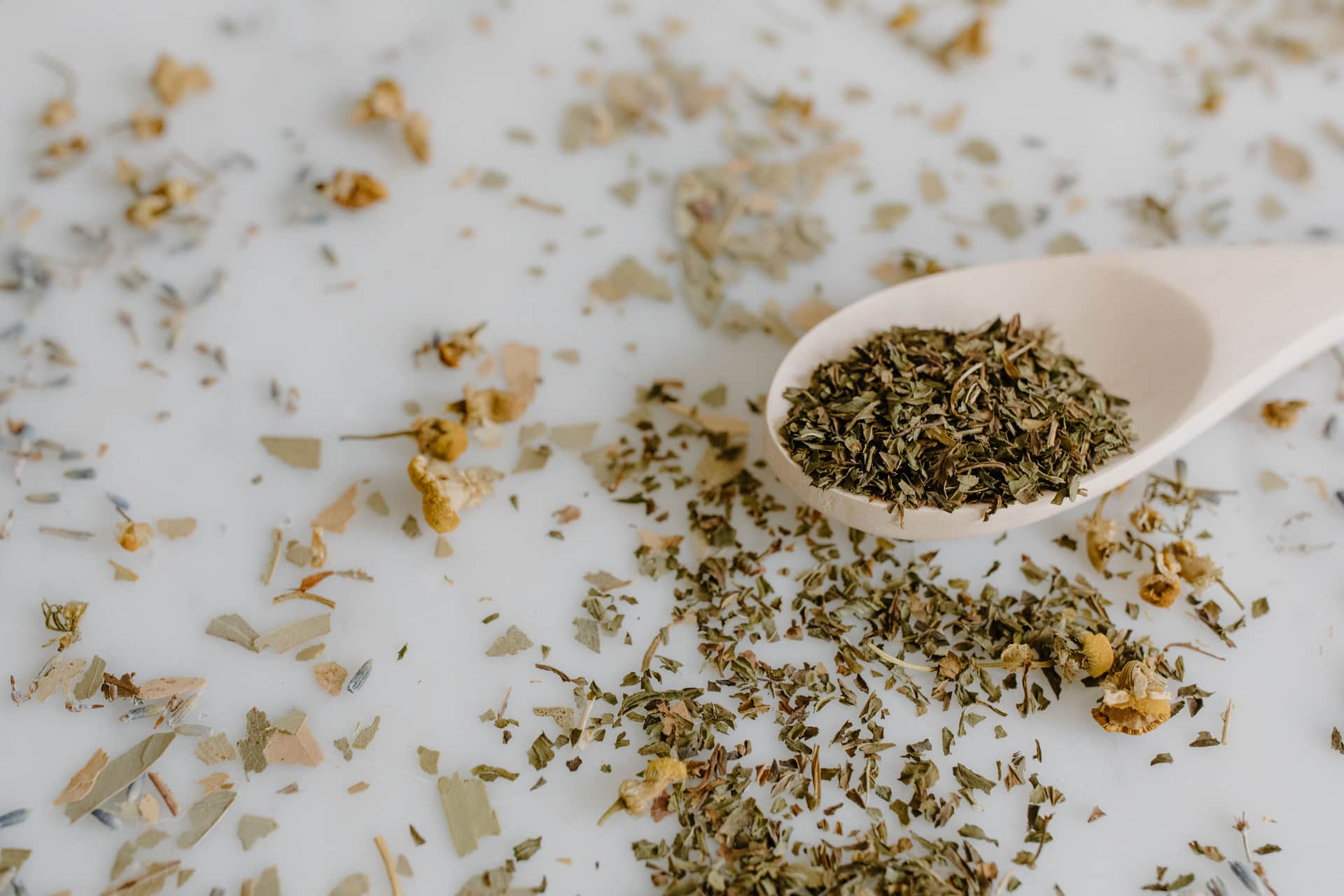
Tea leaves are processed into wildly different shapes. Rolled gunpowder green is compressed into dense pellets. Silver needle white is fluffy, whole and full of air. A tablespoon of each contains very different amounts of actual leaf.
The practical rule that follows: dense, rolled or compressed teas need less volume than the spoon suggests, and light, fluffy, whole-leaf teas need more.
When to start weighing
When a tea you liked starts tasting different day to day. That is the symptom the scale fixes, and before it appears, a scale is ceremony rather than a tool.
The commonly cited starting point in weight terms is around 2 to 3 grams per 8 ounces for most teas, which is roughly what a tablespoon of a mid-density tea comes to. We have not measured that and are quoting it as the conventional figure rather than as something we verified — treat it as a starting point to adjust from, exactly like the spoon.
The exceptions
- Gongfu brewing uses far more leaf — a fifth to a quarter of the vessel's depth — because contact time is only twenty to thirty seconds per infusion.
- Herbal tisanes are usually bulkier per gram than tea leaves, so they tend to want more volume for the same strength. Art of Tea publishes a longer steep for them too, at five to seven minutes.
- Re-steeps do not need more leaf, they need more time. The leaf is already there.
- Iced tea brewed hot and poured over ice needs a stronger brew to survive the dilution.
Adjust leaf before you adjust time
This is the rule that fixes most cups. More time does not make tea stronger in the way people expect — it extracts the late compounds, which are tannins, so you get bitterness rather than body.
More leaf at the same time gives you a fuller cup without the astringency. If your tea is thin, that is the lever.
Questions
How much loose-leaf tea per 8 oz cup?
About one tablespoon, which is Art of Tea's published guidance. Scale it with the vessel — a 15 oz mug wants close to two tablespoons.
Is a teaspoon or a tablespoon right for loose-leaf tea?
A tablespoon per 8 ounces is the published starting point. A teaspoon is the figure people remember from tea bags and it is usually too little for loose leaf in a large mug.
Why does the same spoon of tea give different strengths?
Because a spoon measures volume and leaf densities vary hugely. Dense rolled tea and fluffy whole-leaf tea occupy the same space at very different weights.
Do I need to weigh my tea?
Only once you want to reproduce a specific cup exactly, or when a tea you liked starts tasting inconsistent. Until then a spoon and a taste adjustment is fine.
Sources
Every figure on this page came from one of these, retrieved during the research pass for this article. Where a maker publishes nothing we could verify, the page says so instead of substituting a number.
Read next
- How to brew loose-leaf teaThe complete method in five steps, with published parameters and the four mistakes that account for most bad cups.
- How long to steep teaPublished steep times by type, the reason the ranges are wide, and what over-steeping actually does to the cup.
- The tea brewing accessories worth buyingFour accessories ordered by impact rather than price, including the one we tell you to buy last.
- How to use a tea infuserThe method in six steps, with the two mistakes that account for most disappointing cups.
- Tea gear you can skipNine purchases beginners are pushed toward, why each one can wait, and the cheaper thing that solves the same problem.