Tea Kettles
Kettle vs microwave for tea
A microwave heats water unevenly and cannot tell you when to stop. Both problems are real, and one of them is a safety issue.
We earn a commission if you buy through the links on this page, at no extra cost to you. It does not change which products we name or what we say about them — how this is funded.
Use a kettle. A microwave heats water unevenly, gives you no way to know what temperature you reached, and can superheat water past boiling without visible bubbles - which is a genuine burn risk rather than a purist objection. A twenty-dollar electric kettle removes all three problems.
| # | Product | Best for | Temperature control | Price |
|---|---|---|---|---|
| 1 | No image Hamilton Beach Glass Electric KettleTop pickA plain electric kettle with one setting: boil. For black and herbal tea that is the correct setting. | Boiling water for as little as possible | not verified | Check price#ad |
| 2 | 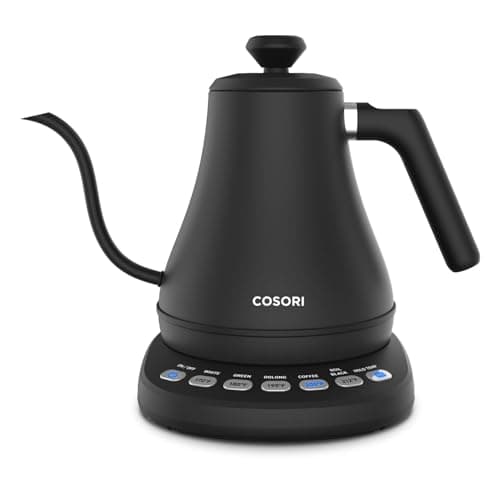 COSORI Original Electric Gooseneck Kettle (CO108-NK)Five presets that map to actual tea types, a 60-minute hold, and no plastic in the water path. This is the value pick and it is not close. | The sensible first variable-temperature kettle | 0.85 qt / 0.8 L | |
| 3 | No image Various Instant-Read Kitchen ThermometerFifteen dollars of thermometer does most of what a hundred dollars of kettle does. It is the highest-leverage thing on this page. | Turning any kettle into a variable-temperature kettle | not verified | Check price#ad |
image
Top pick · Boiling water for as little as possible
Hamilton Beach Glass Electric Kettle
A plain electric kettle with one setting: boil. For black and herbal tea that is the correct setting.
#ad · how this is funded · price checked October 20, 2026
Published specifications
- Temperature control
- Not verifiedThis is a boil-only kettle. There is no temperature setting to publish.
- Capacity
- Not verifiedSold in several capacities; we have not verified a figure for a specific model from Hamilton Beach's own documentation.
What the numbers mean
We list this because the honest answer for a lot of beginners is that they do not need temperature control yet. Black tea, rooibos, most herbal infusions and pu-erh all want water at or near boiling.
The upgrade path is real, though. The day you buy a green tea you like, a boil-only kettle becomes a kettle plus a five-minute wait plus a guess.
We have not verified a spec sheet for a specific model here, so treat this as a category recommendation rather than a model recommendation, and read the listing before you buy.
Good for
- The cheapest correct answer for black and herbal tea
- Cordless base, fast, nothing to learn
- Glass makes it obvious when it needs descaling
Against it
- No temperature control at all
- Green and white tea need a wait-and-guess workaround
- We could not verify published specs for a single model
Skip it ifSkip it if green tea is why you are here. Boiling water scorches it, and the fix costs about the same as this kettle.
Pick 2 · The sensible first variable-temperature kettle
COSORI Original Electric Gooseneck Kettle (CO108-NK)
Five presets that map to actual tea types, a 60-minute hold, and no plastic in the water path. This is the value pick and it is not close.
Published specifications
- Capacity
- 0.85 qt / 0.8 LSource: COSORI — Original Electric Gooseneck Kettle (CO108-NK)
- Presets
- 170F white, 180F green, 195F oolong, 205F coffee, 212F blackSource: COSORI — Original Electric Gooseneck Kettle (CO108-NK)
- Hold
- Keeps water warm for up to 60 minutesSource: COSORI — Original Electric Gooseneck Kettle (CO108-NK)
- Power
- 1200 W (AC 120 V, 60 Hz)Source: COSORI — Original Electric Gooseneck Kettle (CO108-NK)
- Water contact
- 304 food-grade stainless steel kettle, lid and spoutSource: COSORI — Original Electric Gooseneck Kettle (CO108-NK)
- Warranty
- 2-year limitedSource: COSORI — Original Electric Gooseneck Kettle (CO108-NK)
What the numbers mean
The presets are the reason to recommend this to someone new. You do not have to know that sencha wants roughly 180F; you press the button that says green. That is one fewer thing to learn on week one.
Presets are also its limit. If you later want 165F for a delicate gyokuro, the button for it does not exist. Most people never get there, and the ones who do have already stopped being beginners.
It publishes 304 stainless for everything the water touches. That is the single spec worth checking on any cheap kettle, and plenty of them will not tell you.
Good for
- Presets named after teas, not temperatures
- 60-minute hold, longer than several kettles that cost more
- Stainless kettle, lid and spout published, not implied
Against it
- Preset steps only — no arbitrary target temperature
- 0.8 L is the smallest capacity here
- The gooseneck is slower to fill under a tap than a wide-mouth kettle
Skip it ifSkip it if you want to dial an exact number. Buy the OXO or the Stagg for that; this one gives you five good answers instead of infinite ones.
image
Pick 3 · Turning any kettle into a variable-temperature kettle
Various Instant-Read Kitchen Thermometer
Fifteen dollars of thermometer does most of what a hundred dollars of kettle does. It is the highest-leverage thing on this page.
#ad · how this is funded · price checked October 20, 2026
Published specifications
- Accuracy
- Not verifiedAccuracy claims vary enormously across this category and we have not verified one for a specific model. Anything claiming plus or minus 1F is more precision than tea needs.
- Read time
- Not verifiedNot verified for a specific model.
What the numbers mean
Tea temperature bands are wide. Art of Tea publishes 160-180F for green and 200-212F for black, and a thermometer that is a couple of degrees out still lands you inside the band.
That is why this beats upgrading a kettle for most beginners: you do not need a kettle that holds 178F, you need to know when the water is roughly there.
The workflow is boil, wait, measure. Boiled water dropping to green-tea temperature in an open mug takes a couple of minutes; the thermometer removes the guessing from that wait.
Good for
- Converts a boil-only kettle into a usable green-tea kettle
- Useful outside tea, unlike everything else on this page
- Cheapest possible fix for the most common beginner mistake
Against it
- One more thing to find in a drawer
- Accuracy claims in this category are not comparable
- Adds a step every single brew
Skip it ifSkip it if you already own a variable-temperature kettle. It measures a number your kettle is already holding.
Why people microwave water in the first place
Because it works, they already own one, and no kettle takes up counter space. Those are all good reasons and it is worth saying so before explaining what goes wrong. Plenty of tea gets made this way and it is drinkable.
This page is not about whether it is acceptable. It is about the three specific things a kettle does better, ranked by how much they matter.
Problem one: uneven heating
A kettle heats water from a single element at the bottom, and that creates convection - hot water rises, cooler water falls, and the whole volume circulates until it is uniformly hot. It is a mixing system as much as a heating one.
A microwave heats by exciting water molecules throughout the volume, but not evenly: the field has hot and cold regions, and a still mug of water has nothing driving circulation. You end up with layers. The top can be scalding while the middle is merely warm.
For tea that matters because extraction is temperature-dependent. Pour layered water onto leaves and different parts of the dose extract at different rates, which produces the same thin-and-harsh cup that a packed infuser gives you, from a different cause.
Problem two: you cannot know the temperature
This is the one that actually decides the argument for tea. Art of Tea publishes 160-180F for green tea, 160-185F for white, 185-205F for oolong and 200-212F for black and herbal. Hitting those bands requires knowing where you are.
A kettle clicks off at boiling, which is a known reference point - 212F at sea level, every time. From there you can wait, or on a variable-temperature model you can simply set 180F. A microwave gives you a duration in seconds, and seconds map to temperature only if the volume, the starting temperature, the vessel and the oven's wattage all stay constant.
Ninety seconds is not a temperature. It is a guess that changes when you use a different mug.
Problem three: superheating, which is a real hazard
Water boils when bubbles can form, and bubbles need nucleation sites - scratches, mineral deposits, imperfections. A smooth ceramic mug of still water in a microwave can lack them, and the water can pass its boiling point without visibly boiling.
Disturb it - drop in a teabag, add sugar, pick it up - and it can flash-boil out of the mug. This is a documented phenomenon and the reason microwave manuals carry warnings about heating liquids.
The comparison, in one table
| Kettle | Microwave | |
|---|---|---|
| Heating evenness | Convection mixes the whole volume | Layers, with hot and cold regions |
| Known reference point | Clicks off at boiling | None - only elapsed seconds |
| Temperature control | Available from around twenty dollars upward | None |
| Superheating risk | None | Real, in smooth vessels with still water |
| Speed for one mug | Comparable | Comparable |
| Counter space | A kettle, permanently | None extra |
| Cost if you own neither | Low | Not a purchase anyone makes for tea |
Notice what is not on that list: energy efficiency. Both are electric resistance heating of a small volume of water and the difference is not the reason to choose one. Anyone telling you a microwave wastes dramatically more energy heating a single mug is overstating it.
The related question: kettle versus boiling water on the hob
A pan of water on a hob is a third option and it is better than the microwave on every count above except one. It heats by convection, so it mixes; it reaches a visible rolling boil, so you have a reference point; and it cannot superheat in the microwave sense.
What it lacks is a lid, a spout and an off switch. It is slower, it evaporates, and pouring from a saucepan into a mug is how people burn their hands. If you own no kettle at all, a pan is a much better stopgap than the microwave.
So what should you buy?
If you drink black tea, rooibos or peppermint, the cheapest plain electric kettle solves this completely, because those want water at or near boiling and boiling is the one temperature a kettle gives you for free.
If green or white tea is in the rotation, you have two honest routes: a variable-temperature kettle, or a fifteen-dollar instant-read thermometer plus whatever kettle you end up with. Both produce identical water. The thermometer adds a step; the kettle adds cost.
What we would not do is buy a hundred-dollar kettle as the first move out of the microwave. The gap between microwave and any kettle is enormous. The gap between a cheap kettle and an expensive one is a convenience feature.
Questions
Is it bad to microwave water for tea?
It makes worse tea for two physical reasons - the water heats unevenly into layers, and you have no way to know what temperature you reached. There is also a real superheating risk in smooth mugs, which is why microwave manuals warn about heating liquids.
Does microwaved water taste different in tea?
The water itself is the same water. What differs is that it arrives layered and at an unknown temperature, and both of those change how evenly the leaves extract, which is what you taste.
What is superheating and how do I avoid it?
Water passing its boiling point without forming bubbles, because a smooth vessel lacks nucleation sites. It can then flash-boil when disturbed. Put a non-metal stirrer in the mug before heating and stir before adding anything.
Is a kettle more energy efficient than a microwave?
Not dramatically, for a single mug. Both are electric resistance heating of a small volume. Efficiency is not the reason to choose a kettle - temperature control and even heating are.
Sources
Every figure on this page came from one of these, retrieved during the research pass for this article. Where a maker publishes nothing we could verify, the page says so instead of substituting a number.
Read next
- Types of tea kettles, explainedThe five kettle categories in plain English, with the specific job each one does better than the rest.
- The best tea kettles for loose-leaf teaFive kettles across every price band, chosen by what you actually drink rather than by feature count.
- How to brew loose-leaf teaThe complete method in five steps, with published parameters and the four mistakes that account for most bad cups.
- Green tea water temperatureThe forty-degree gap between green tea and boiling water, what it does to the cup, and three ways to close it.
- A complete first setup, without buying a kettleThree inexpensive objects that cover every tea type, including the green tea most people think requires a new kettle.
- Tea kettle vs Keurig for teaKeurig publishes 192F internal and 180-185F in cup. Set against the published tea bands, that decides most of this comparison.