Coming From Coffee
Tea kettle vs Keurig for tea
A Keurig runs cooler than the tea most people brew in it. The published numbers make this an unusually clean comparison.
We earn a commission if you buy through the links on this page, at no extra cost to you. It does not change which products we name or what we say about them — how this is funded.
Use a kettle. A Keurig runs too cool for black tea and herbal infusions, which is what most people put in it, and it gives you no way to change that. If you already own one it is a perfectly good hot-water dispenser for oolong, white and green tea - and the section below on getting the best out of it is written for exactly that reader.
| # | Product | Best for | Temperature control | Price |
|---|---|---|---|---|
| 1 | No image Hamilton Beach Glass Electric KettleTop pickA plain electric kettle with one setting: boil. For black and herbal tea that is the correct setting. | Boiling water for as little as possible | not verified | Check price#ad |
| 2 | 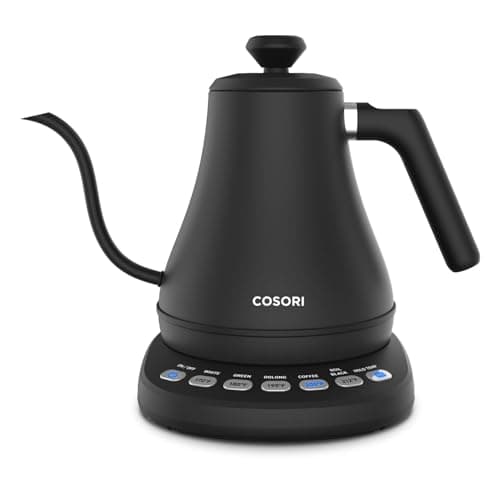 COSORI Original Electric Gooseneck Kettle (CO108-NK)Five presets that map to actual tea types, a 60-minute hold, and no plastic in the water path. This is the value pick and it is not close. | The sensible first variable-temperature kettle | 0.85 qt / 0.8 L | |
| 3 | 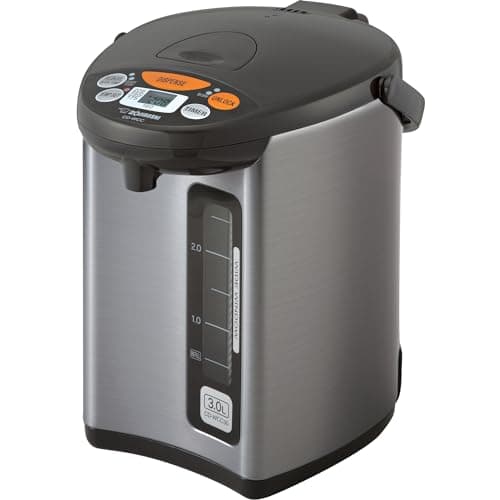 Zojirushi Micom Water Boiler & Warmer (CD-WCC30)Not a kettle. It boils three liters once and then parks the water at a tea temperature until you unplug it. | Drinking tea all day without boiling anything again | 101 oz / 3.0 liters |
image
Top pick · Boiling water for as little as possible
Hamilton Beach Glass Electric Kettle
A plain electric kettle with one setting: boil. For black and herbal tea that is the correct setting.
#ad · how this is funded · price checked October 24, 2026
Published specifications
- Temperature control
- Not verifiedThis is a boil-only kettle. There is no temperature setting to publish.
- Capacity
- Not verifiedSold in several capacities; we have not verified a figure for a specific model from Hamilton Beach's own documentation.
What the numbers mean
We list this because the honest answer for a lot of beginners is that they do not need temperature control yet. Black tea, rooibos, most herbal infusions and pu-erh all want water at or near boiling.
The upgrade path is real, though. The day you buy a green tea you like, a boil-only kettle becomes a kettle plus a five-minute wait plus a guess.
We have not verified a spec sheet for a specific model here, so treat this as a category recommendation rather than a model recommendation, and read the listing before you buy.
Good for
- The cheapest correct answer for black and herbal tea
- Cordless base, fast, nothing to learn
- Glass makes it obvious when it needs descaling
Against it
- No temperature control at all
- Green and white tea need a wait-and-guess workaround
- We could not verify published specs for a single model
Skip it ifSkip it if green tea is why you are here. Boiling water scorches it, and the fix costs about the same as this kettle.
Pick 2 · The sensible first variable-temperature kettle
COSORI Original Electric Gooseneck Kettle (CO108-NK)
Five presets that map to actual tea types, a 60-minute hold, and no plastic in the water path. This is the value pick and it is not close.
Published specifications
- Capacity
- 0.85 qt / 0.8 LSource: COSORI — Original Electric Gooseneck Kettle (CO108-NK)
- Presets
- 170F white, 180F green, 195F oolong, 205F coffee, 212F blackSource: COSORI — Original Electric Gooseneck Kettle (CO108-NK)
- Hold
- Keeps water warm for up to 60 minutesSource: COSORI — Original Electric Gooseneck Kettle (CO108-NK)
- Power
- 1200 W (AC 120 V, 60 Hz)Source: COSORI — Original Electric Gooseneck Kettle (CO108-NK)
- Water contact
- 304 food-grade stainless steel kettle, lid and spoutSource: COSORI — Original Electric Gooseneck Kettle (CO108-NK)
- Warranty
- 2-year limitedSource: COSORI — Original Electric Gooseneck Kettle (CO108-NK)
What the numbers mean
The presets are the reason to recommend this to someone new. You do not have to know that sencha wants roughly 180F; you press the button that says green. That is one fewer thing to learn on week one.
Presets are also its limit. If you later want 165F for a delicate gyokuro, the button for it does not exist. Most people never get there, and the ones who do have already stopped being beginners.
It publishes 304 stainless for everything the water touches. That is the single spec worth checking on any cheap kettle, and plenty of them will not tell you.
Good for
- Presets named after teas, not temperatures
- 60-minute hold, longer than several kettles that cost more
- Stainless kettle, lid and spout published, not implied
Against it
- Preset steps only — no arbitrary target temperature
- 0.8 L is the smallest capacity here
- The gooseneck is slower to fill under a tap than a wide-mouth kettle
Skip it ifSkip it if you want to dial an exact number. Buy the OXO or the Stagg for that; this one gives you five good answers instead of infinite ones.
Pick 3 · Drinking tea all day without boiling anything again
Zojirushi Micom Water Boiler & Warmer (CD-WCC30)
Not a kettle. It boils three liters once and then parks the water at a tea temperature until you unplug it.
#ad · how this is funded · price checked October 24, 2026
Published specifications
- Capacity
- 101 oz / 3.0 litersSource: Zojirushi — Micom Water Boiler & Warmer CD-WCC30/40
- Keep-warm settings
- 160F, 175F, 195F and 208FSource: Zojirushi — Micom Water Boiler & Warmer CD-WCC30/40
- Quick Temp mode
- Reaches 160F, 175F or 195F without boiling firstSource: Zojirushi — Micom Water Boiler & Warmer CD-WCC30/40
- Power
- 120 V / 700 WSource: Zojirushi — Micom Water Boiler & Warmer CD-WCC30/40
- Dimensions
- 8.25 x 11.25 x 11.5 inSource: Zojirushi — Micom Water Boiler & Warmer CD-WCC30/40
What the numbers mean
The four keep-warm settings are the tea argument for this machine. 175F is green tea, 195F is oolong, 208F is black tea and everything herbal. You choose once in the morning.
Quick Temp is quietly the best feature: reaching 175F without going to a boil first saves both the wait and the energy of heating water 37 degrees past where you needed it.
Three liters is a lot of standing water and a permanent counter tenant. This is a household appliance, not a gear purchase, and it should be judged that way.
Good for
- Water at a tea temperature on demand, all day, no waiting
- Keep-warm settings that map to real tea types
- 700 W holding is far cheaper than re-boiling a kettle six times
Against it
- Large, heavy and always plugged in
- Refilling and descaling three liters is a chore
- No use at all if you drink one cup a day
Skip it ifSkip it unless you genuinely drink four or more cups a day. Below that it is a large appliance keeping water warm for nobody.
Who this is for
Someone with a pod machine on the counter, wondering whether it can cover tea too, or whether a kettle is worth the extra space. It is a fair question - a Keurig delivers hot water on demand with no waiting, which is genuinely the thing a kettle is worst at.
The numbers, which settle most of it
This comparison is unusually clean because both sides publish figures, so it can be decided on arithmetic rather than opinion.
Keurig states that the optimal temperature for brewing beverages in its K-Cup brewers is 192F, which is the internal temperature of the water in the machine. Its Platinum manuals describe a 192F preset adjustable down by five degrees, and the K-Elite guide gives an adjustable range of 187F to 192F.
Keurig also publishes what happens after that. Once the beverage is brewed the dispensed temperature varies with the cup, and brewing into an insulated container such as a foam or paper cup typically attains 180-185F in the cup. A cold ceramic mug cools it further.
So the machine tops out around 192F inside and delivers somewhere in the low 180s to a real mug. Now set that against Art of Tea's published brewing bands.
| Tea | Published band | Keurig internal (192F) | Keurig in cup (180-185F) |
|---|---|---|---|
| Black | 200-212F | Below the band | Well below the band |
| Herbal tisanes | 200-212F | Below the band | Well below the band |
| Pu-erh, ripe | 205-212F | Below the band | Well below the band |
| Oolong | 185-205F | Inside the band | At or just below the bottom |
| White | 160-185F | Above the band | Inside the band |
| Green | 160-180F | Above the band | At or just above the top |
That table is the whole page in one image, and the result is the opposite of what most people assume. A Keurig is not too hot for delicate tea. It is too cool for robust tea.
Which is exactly backwards from how people use it
The teas people most often make in a pod machine are black tea, breakfast blends, chai and herbal infusions - and those are the four that want 200-212F. A Keurig cannot reach that band at any setting.
Under-brewed black tea does not taste bitter or scorched. It tastes thin and slightly flat, and the usual reaction is to blame the tea or to leave the bag in longer. Leaving it longer does help a little, because time partly compensates for temperature, but it is compensating rather than fixing.
Meanwhile green and white tea, the two that a kettle most commonly ruins by being too hot, land inside or near their published bands straight out of a Keurig. That is a genuine and slightly funny advantage, and it is worth knowing if green tea is what you drink.
The second issue: it is one water path
A pod machine pushes water through the same tubing and needle assembly that coffee passes through. That is simply how the machine is built, and it is worth knowing before you brew a delicate tea in one.
We are not going to tell you how much flavor carries over, because we have not measured it and any number here would be invented. What we can say is that the shared path exists, that running a pod-free hot water cycle first is the obvious precaution, and that the more delicate the tea the more likely you are to notice.
A kettle has no equivalent problem. It holds water and nothing else has ever been in it.
A note on tea K-Cups
Tea pods exist and they work as designed. What they are, mechanically, is bagged tea in a plastic cup: a small fixed dose of usually broken leaf, in a chamber that gives it no room to expand.
That is the same structural limitation we describe on the tea bag comparison, with a higher cost per cup and more packaging. If pods are what gets you drinking tea, they are fine. But this is a loose-leaf site, and the whole argument for loose leaf is that whole leaf with room to open extracts more evenly.
Using a Keurig as a plain hot-water dispenser and steeping loose leaf in the mug is strictly better than a tea pod, costs less per cup, and is what we would do with a machine already on the counter.
What a Keurig is genuinely better at
Two things, and it is worth being straight about them because they are the reason the question gets asked.
Speed. There is no wait. A kettle takes minutes to boil; a pod machine delivers hot water in well under one. If the friction of waiting is what stops you making tea, that is a real advantage and not a trivial one.
Portion control. It dispenses a fixed volume into a single mug, so nothing is heated that you do not use.
If those two are what you actually want, the honest like-for-like upgrade is not a kettle at all - it is a water boiler. Zojirushi publishes keep-warm settings at 160F, 175F, 195F and 208F on its 3-liter Micom, which is hot water on demand with no wait, at temperatures chosen for tea rather than for coffee. That is the machine a Keurig is imitating when you use it for tea, done properly.
The comparison, in one table
| Kettle | Keurig | |
|---|---|---|
| Reaches 200-212F for black and herbal | Yes | No - 192F internal is the ceiling |
| Suits green and white tea | Only with control or a thermometer | Yes, more or less by accident |
| Temperature adjustable | On variable-temperature models, 104-212F | 187-192F on the models that allow it |
| Water path | Water only, nothing else | Shared with coffee |
| Wait | Minutes | Under a minute |
| Counter space | A kettle | Already there |
| Cost per cup with pods | Leaf only | Higher, plus packaging |
If you are keeping the Keurig
Most people reading this are, and that is a reasonable decision. Four things get the best out of it.
- Run one pod-free hot water cycle and discard it before brewing tea, so the first water through the line is not the water in your cup.
- Set it to its maximum temperature. On models with the adjustment that is 192F, and for tea you want every degree of it.
- Match the tea to the machine. Oolong, white and green land inside or near their published bands. Black tea and herbal infusions do not.
- Steep loose leaf in the mug rather than using a tea pod. Use the machine to dispense water and a basket infuser to hold the leaves, and you get whole leaf with room to expand at a lower cost per cup.
So which should you buy?
If you drink black or herbal tea and own only a Keurig, buy the cheapest plain electric kettle you can find. There is no subtlety here - the machine cannot reach the temperature and the kettle costs very little.
If green or white tea is your drink and you already own a Keurig, you may genuinely not need anything. Set it to 192F, use a basket infuser in the mug, and you are close enough to the published band that a purchase is hard to justify.
If what you love about the Keurig is that there is no waiting, and you drink several cups a day, a water boiler replaces it properly rather than approximately.
What we would not do is buy an expensive variable-temperature kettle as the first move away from a pod machine. The gap between a Keurig and any kettle that boils is large. The gap between a cheap kettle and an expensive one is a convenience feature, and it is covered on our page about whether variable temperature is worth it.
What we did not do
We have not measured the temperature of water out of a Keurig, timed one, or tasted anything brewed in one. There is no test kitchen behind this site. The 192F figure, the 187-192F adjustable range and the 180-185F in-cup figure are all Keurig's own published statements from its owner's manuals, cited below.
The brewing bands are Art of Tea's published guidance, also cited. Everything else on this page is arithmetic between those two sets of numbers, which you are welcome to check.
Questions
Can you use a Keurig to make tea?
Yes, as a hot-water dispenser. It works well for oolong, white and green tea, which sit near its output temperature. It runs too cool for black tea and herbal infusions, which Art of Tea puts at 200-212F.
What temperature does a Keurig brew at?
Keurig publishes 192F as the optimal internal water temperature, with a 187-192F adjustable range on models such as the K-Elite. In-cup temperature is lower - Keurig says 180-185F is typical in an insulated container, and a cold ceramic mug cools it further.
Is a Keurig hot enough for black tea?
No. Art of Tea publishes 200-212F for black tea, and 192F internal is below that band before the cup cools it further. The result is thin rather than bitter, which is why people blame the tea instead of the temperature.
Does Keurig water taste like coffee when making tea?
The water passes through the same tubing and needle the coffee does, so a shared path exists. We have not measured any flavor transfer and will not quote a figure. Running one pod-free hot water cycle first is the sensible precaution.
Are tea K-Cups better than loose leaf?
No. A tea pod is bagged tea in a plastic cup - a small fixed dose of usually broken leaf with no room to expand - at a higher cost per cup. Dispensing hot water and steeping loose leaf in the mug is better and cheaper.
Sources
Every figure on this page came from one of these, retrieved during the research pass for this article. Where a maker publishes nothing we could verify, the page says so instead of substituting a number.
Read next
- Use your coffee gear for teaItem by item through a coffee setup: what transfers to tea, what does not, and the ten dollars that completes it.
- Kettle vs microwave for teaWhy microwaved water makes worse tea, the superheating risk nobody mentions, and the cheapest way to stop doing it.
- Tea brewing temperature chartPublished brewing temperatures in F and C for every tea type, with the source named for each figure.
- Loose leaf vs tea bagsWhat genuinely changes when you switch, what does not, and the situations where a tea bag still wins.
- Is a variable-temperature kettle worth it?Worth it if you drink green tea daily and value the removed step. Not worth it as a first purchase, and here is why.
- Tea kettle vs water boilerA water boiler removes the wait and takes a permanent piece of counter. Which one is right depends on how many times a day you actually boil.