Start Here
Loose-leaf tea for beginners
All tea comes from one plant. Everything after that is how long the leaves were left to oxidize.
We earn a commission if you buy through the links on this page, at no extra cost to you. It does not change which products we name or what we say about them — how this is funded.
White, green, oolong, black and pu-erh all come from the same plant, Camellia sinensis. The difference is how long the picked leaf is allowed to oxidize before it is heated to stop the process. White is barely oxidized, black is fully oxidized, and everything else sits in between. Herbal tea is not tea at all — it is other plants, which is why it behaves differently.
The types, and what that means for brewing
| Type | Oxidation | Water | Steep |
|---|---|---|---|
| White | Barely | 160-185F | 1-3 minutes |
| Green | None to minimal | 160-180F | 1-3 minutes |
| Oolong (rolled) | Partial | 185-205F | 3-5 minutes |
| Oolong (long leaf) | Partial | 185-205F | 4-7 minutes |
| Black | Full | 200-212F | 3-5 minutes |
| Pu-erh (raw) | Fermented | 195-205F | 2-4 minutes |
| Pu-erh (ripe) | Fermented | 205-212F | 3-5 minutes |
| Herbal tisanes | Not tea | 200-212F | 5-7 minutes |
The pattern is worth internalizing because it means you never have to memorize the table: the less oxidized the tea, the cooler the water and the shorter the steep.
Which to start with
Start with a loose version of something you already drink. If your usual bag is breakfast tea, buy a loose black tea. You will have a reference point, and the comparison will tell you immediately whether the switch is worth it to you.
If you have no reference point, a rolled oolong is the most rewarding first purchase. It is forgiving on temperature, it re-steeps several times with genuinely different results each round, and it is the tea most likely to make someone understand what the fuss is about.
The one to avoid first is a delicate green like gyokuro. It is superb and it is unforgiving — get the water thirty degrees too hot and it tastes like disappointment, and you will blame the tea.
The four mistakes
1. Not enough leaf
This is the most common by a distance. Art of Tea publishes about a tablespoon per 8 ounces of water, and a 15 oz mug therefore wants close to two. People dose a large mug like a teacup and conclude that loose leaf is weaker than bags.
2. Water too hot for the type
Boiling water on green tea produces astringency and a flat cooked flavor. An enormous number of people believe they dislike green tea when what they dislike is green tea brewed at 212F.
3. Leaving the leaves in
Extraction does not stop when the timer goes; it stops when the leaves leave the water. A mug with the infuser still in it gets more astringent as you drink it.
4. Storing it badly
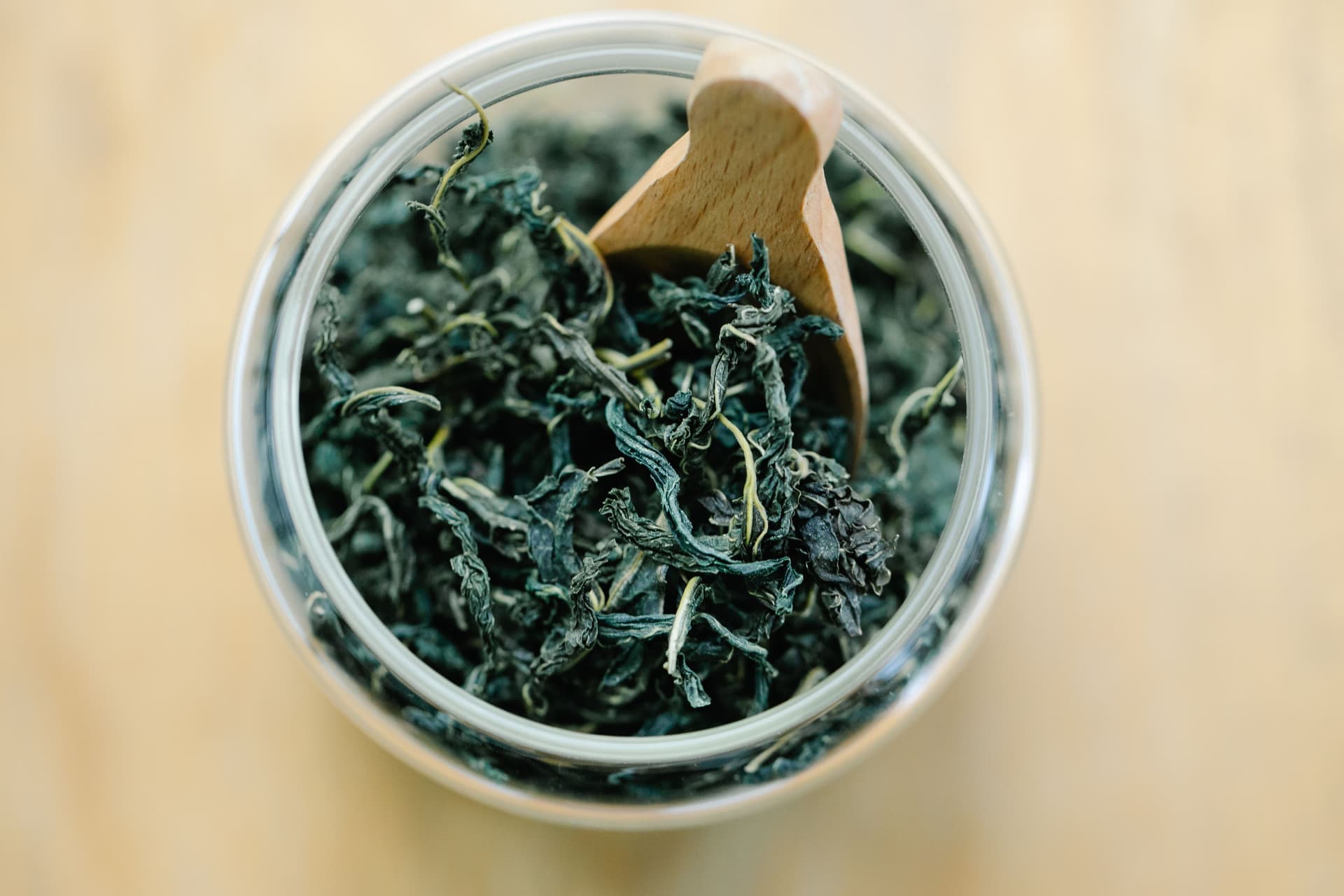
Air, light, heat and moisture all degrade tea. The beautiful glass jar on a sunny shelf is the worst possible storage, and the cupboard above the hob is the second worst. Opaque, airtight, cool.
The vocabulary, briefly
- Kyusu — a teapot. Usually a Japanese one with a side handle.
- Tetsubin — a cast iron pot. Traditionally used for boiling; modern ones are usually for brewing only.
- Gaiwan — a lidded bowl you brew in and pour from, using the lid as a gate.
- Gongfu — brewing with a lot of leaf and very short infusions, repeated many times.
- Tisane — a herbal infusion. Not made from the tea plant.
- Oxidation — what turns green leaf into black tea. Often incorrectly called fermentation.
None of these words is a gate. They are shorter than the descriptions, which is the only reason they exist.
What to do tonight
- Put a tablespoon of leaf per 8 ounces into a basket, filled no more than a third.
- Use water at the temperature the table says for that type.
- Cover the mug and set a timer.
- Take the basket out when it goes off.
- If it is too strong, use less leaf next time rather than less time. If it is too weak, use more leaf.
Questions
What is the difference between white, green, oolong and black tea?
All four come from the same plant. The difference is how long the leaf oxidizes before being heated to stop the process — white barely at all, black fully, green and oolong in between.
What loose-leaf tea should a beginner start with?
A loose version of something you already drink, so you have a reference point. If you have none, a rolled oolong is forgiving on temperature and re-steeps several times with different results.
Why does my loose-leaf tea taste weak?
Almost always under-dosing. Art of Tea publishes about a tablespoon per 8 ounces, so a 15 oz mug wants close to two tablespoons. People dose a big mug like a teacup.
How should I store loose-leaf tea?
Airtight, opaque, and away from heat. Air, light, heat and moisture all degrade it, which is why a glass jar on a sunny shelf is the worst common storage choice.
Sources
Every figure on this page came from one of these, retrieved during the research pass for this article. Where a maker publishes nothing we could verify, the page says so instead of substituting a number.
Read next
- What you actually need for loose-leaf teaThe complete requirement, stated once and plainly, and the reason everything else can wait.
- How to brew loose-leaf teaThe complete method in five steps, with published parameters and the four mistakes that account for most bad cups.
- Tea brewing temperature chartPublished brewing temperatures in F and C for every tea type, with the source named for each figure.
- Loose leaf vs tea bagsWhat genuinely changes when you switch, what does not, and the situations where a tea bag still wins.
- How much loose-leaf tea per cupThe published ratio, why a spoon is unreliable across tea types, and the point at which weighing starts to matter.
- How to store loose leaf teaOpaque and airtight are the whole specification. Why the tea-branded tins publish nothing, and what to buy instead.