Teapots & Brewing Vessels
Gaiwan vs teapot
They are not competing for the same job. One is a tasting instrument and the other is a serving vessel.
We earn a commission if you buy through the links on this page, at no extra cost to you. It does not change which products we name or what we say about them — how this is funded.
If you are curious about what a specific tea actually tastes like, buy a gaiwan — it is usually the cheapest vessel in the shop and it will teach you more in a week than a teapot will in a year. If you want to make a pot and drink it over an afternoon with other people, buy a teapot. They are not really alternatives.
What a gaiwan is
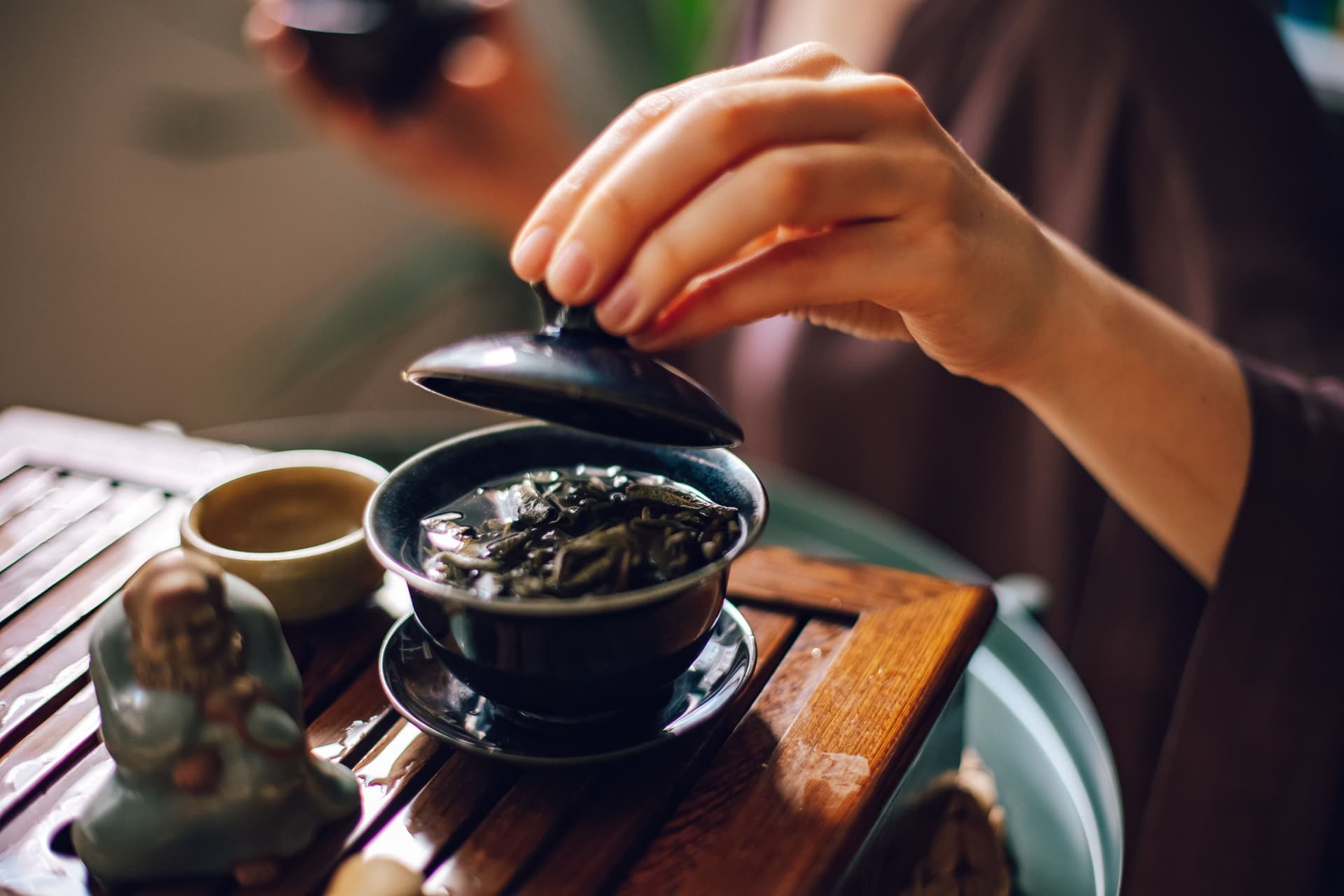
Three pieces: a bowl, a lid and a saucer. You put leaves in the bowl, add water, and use the lid tilted as a gate to hold the leaves back while you pour the liquor out. That is the entire mechanism, and there is nothing in it to break, clog or replace.
They are typically small — around 100 to 150 ml for the ones sold for tasting — because they are built around short, repeated infusions rather than one long one.
The actual difference: how many infusions
A teapot is built for one steep. Art of Tea publishes three to five minutes for black tea, and you get one pot out of that dose in any meaningful sense.
A gaiwan is built for many short ones. A high dose of leaf, thirty seconds of contact, pour it all off, repeat with a little more time each round. Five infusions from one dose is ordinary, and each tastes different.
That is why it teaches you faster. A three-minute mug steep averages a tea's whole character into a single flavor. Five short infusions show you that character arriving and departing in sequence.
| Gaiwan | Teapot | |
|---|---|---|
| Typical capacity | About 100-150 ml | 300-1000 ml |
| Infusions per dose | Four to six, short | One, long |
| Attention required | Constant — you pour every 30-60 seconds | None during the steep |
| Serves | One, or small cups for two | Two to four |
| Mechanism | None — a lid used as a gate | Basket, tube or press |
| Cost | Usually the cheapest vessel in the shop | Varies widely |
| Learning curve | The grip takes a few tries | None |
The honest drawbacks of a gaiwan
The rim gets hot. Porcelain conducts heat and the correct grip — fingers on the rim and the lid, thumb and middle finger steadying it — takes a few sessions to learn without wincing. Under-filling slightly while you learn helps a great deal.
It also demands your presence. There is no walking away and coming back; the whole point is pouring off every thirty to sixty seconds. On a busy morning that is the wrong tool.
The honest drawbacks of a teapot
The leaves keep extracting after the first cup, which is the flaw that press pots exist to fix. And a pot commits you to a volume — a half-full pot cools quickly and brews worse than a filled small one.
Teapots also hide the tea, unless they are glass. That is fine once you know what you like and a genuine disadvantage while you are learning.
So which first?
If you drink alone and want to understand tea: gaiwan. It costs very little, it has no failure modes, and short infusions are the fastest education available.
If you make tea for a household or want to brew and walk away: teapot, and pick the size for the number of drinkers rather than for ambition.
If you want one object that does both, buy the small teapot. A 300 ml pot with a wide basket will do short infusions passably and serve one person properly, which no gaiwan can.
Questions
What is a gaiwan?
A lidded bowl with a saucer. You brew in the bowl and pour from it, using the tilted lid as a gate to hold the leaves back. There is no mechanism, no filter and nothing to replace.
Is a gaiwan better than a teapot?
Better for tasting a tea properly through short repeated infusions, and worse for serving a table. They do different jobs rather than competing for the same one.
Should a beginner buy a gaiwan?
If you drink alone and want to learn what a tea actually tastes like, yes — it is usually the cheapest vessel available and short infusions teach you far more than one long steep.
Is a gaiwan hard to use?
The grip takes a few sessions because the rim gets hot. Under-filling slightly while you learn helps. There is nothing else to it.
Sources
Every figure on this page came from one of these, retrieved during the research pass for this article. Where a maker publishes nothing we could verify, the page says so instead of substituting a number.
Read next
- How to use a gaiwanThe grip, the ratio and the rhythm of short infusions, written for someone holding a gaiwan for the first time.
- The best teapots for loose-leaf teaFour teapots covering glass, press and cast iron, chosen on published capacity, materials and safety limits.
- Infuser or teapot first?Buy the infuser first unless you are regularly brewing for two or more. Here is why, and what changes when you are.
- Teapot materials comparedFive teapot materials on heat retention, flavor neutrality and how much upkeep each one demands.
- How to brew loose-leaf teaThe complete method in five steps, with published parameters and the four mistakes that account for most bad cups.