Teapots & Brewing Vessels
How to use a gaiwan
A bowl, a lid and a saucer. The only hard part is the grip, and that takes about three sessions.
We earn a commission if you buy through the links on this page, at no extra cost to you. It does not change which products we name or what we say about them — how this is funded.
Fill the gaiwan about a fifth full of dry leaf. Add water at the right temperature for the tea. Wait twenty to thirty seconds. Tilt the lid so it leaves a narrow gap at the rim, hold the bowl by the rim and the lid knob, and pour everything out into a cup. Repeat, adding a few seconds each round. That is the whole practice.
The grip, which is the only difficult part
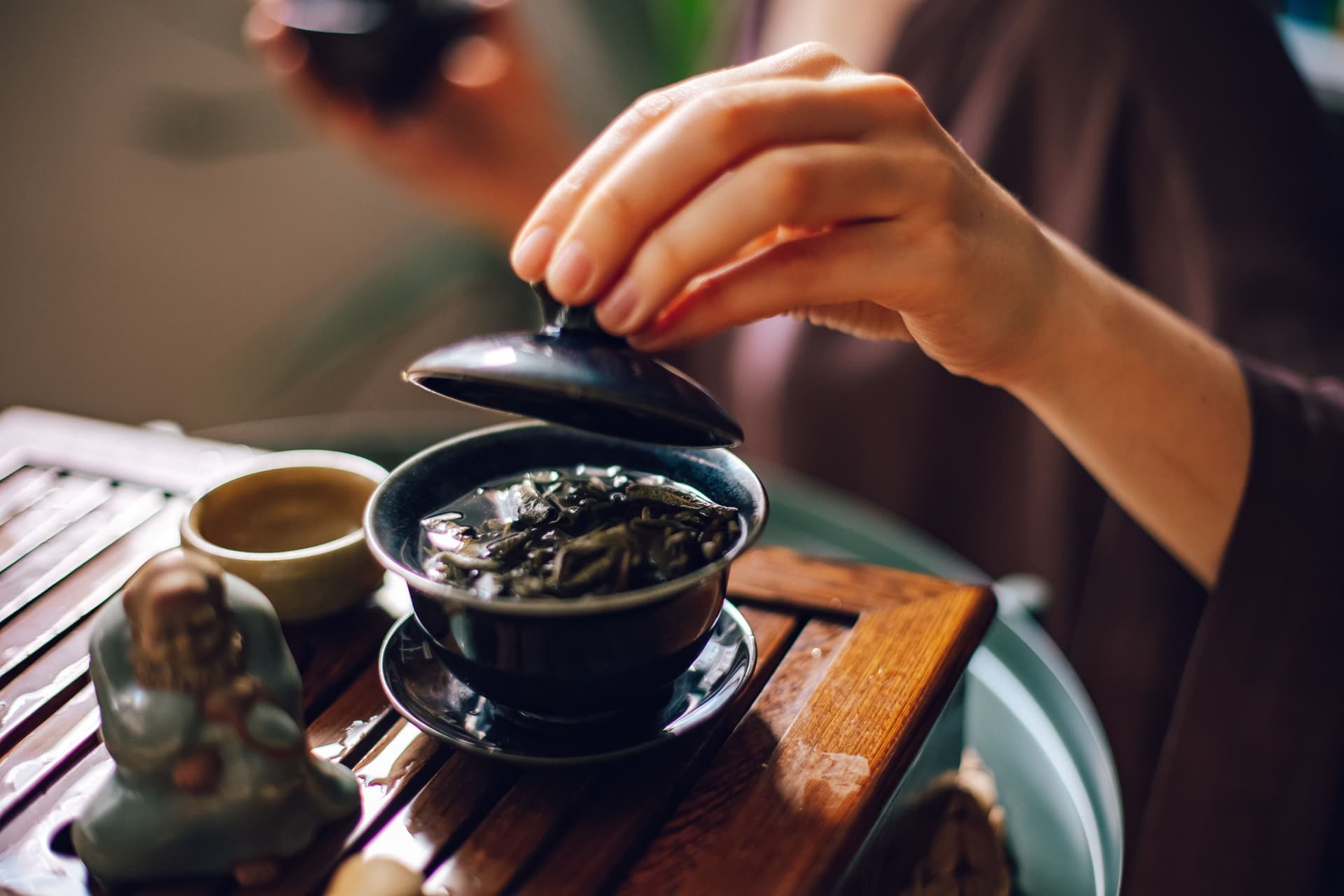
Set the lid on the bowl slightly off-center so there is a gap of a few millimeters at one edge — that gap is the filter. Place your index finger on the lid knob, and your thumb and middle finger on opposite sides of the bowl's rim. Lift and pour in one motion.
The rim is the coolest part of a gaiwan, which is the entire reason gaiwan have flared rims. Gripping lower down, on the body, is what burns people.
- Under-fill while you are learning. Water two-thirds up rather than to the brim keeps the rim cooler and forgives a wobble.
- Pour decisively. A slow tentative pour keeps your fingers over hot porcelain for longer, which is the opposite of what you want.
- Pour it all out, every time. Liquid left in the bowl keeps extracting and the next infusion starts unbalanced.
Leaf ratio: much more than you think
Gaiwan brewing uses far more leaf per volume of water than mug brewing, because contact time is a fraction as long. A rough starting point is filling the bowl a fifth to a quarter deep with dry leaf.
That will look like too much if you are used to Art of Tea's published guidance of about a tablespoon per 8 ounces for ordinary brewing. It is not the same technique. High leaf, short contact, many rounds.
Temperature is unchanged
The published bands still apply. Art of Tea gives 160-180F for green, 160-185F for white, 185-205F for oolong, and 200-212F for black and pu-erh. A gaiwan does not change what the leaf wants; it changes how long the leaf is in contact with it.
A gooseneck kettle genuinely helps here, and this is the one place on the site where we will say that plainly. Filling a 100 ml bowl from a wide-mouth kettle is splashy in a way that a narrow spout simply solves.
The rhythm of infusions
| Infusion | Rough time | What is usually happening |
|---|---|---|
| Rinse (optional) | 5 seconds, discarded | Wakes rolled leaf; skip it for delicate greens |
| First | 20-30 seconds | Light; the leaf has not fully opened |
| Second | 20-30 seconds | Usually the strongest and most complete |
| Third | 30-40 seconds | Character shifts; often the most interesting |
| Fourth onward | Add 10-15 seconds each | Gently fading, sweeter |
These are starting points rather than rules, and they are ours rather than a published standard — the honest position is that gongfu timings vary by tea, by leaf grade and by personal taste, and anyone publishing them as fixed numbers is over-claiming.
Which teas suit it
- Rolled oolong is the classic answer. It opens over several infusions and changes noticeably each round, which is the whole point.
- Pu-erh, both raw and ripe, rewards the technique for the same reason.
- Whole-leaf green works, at the lower end of the temperature band and with short infusions.
- Fine-cut black tea and most herbal blends do not. They give everything up at once and there is no sequence to observe.
Cleaning
Tip the leaves out and rinse. Porcelain is non-porous, so there is nothing to season and nothing to preserve. That is a genuine advantage over clay, which has to be kept to one tea type and washed without soap.
Questions
How do you hold a gaiwan without burning your fingers?
Grip the flared rim, not the body — the rim is the coolest part and that is why it flares. Index finger on the lid knob, thumb and middle finger on opposite sides of the rim. Under-fill while you are learning.
How much tea goes in a gaiwan?
Far more than in a mug: roughly a fifth to a quarter of the bowl's depth in dry leaf. Contact time is only twenty to thirty seconds, so the ratio has to be much higher.
How many times can you infuse tea in a gaiwan?
Four to six is ordinary with rolled oolong or pu-erh, and each infusion tastes different. Add ten to fifteen seconds to each successive round.
Which teas are best in a gaiwan?
Rolled oolong and pu-erh, because they open gradually and change between infusions. Fine-cut black tea and herbal blends give everything up at once and gain nothing from the technique.
Sources
Every figure on this page came from one of these, retrieved during the research pass for this article. Where a maker publishes nothing we could verify, the page says so instead of substituting a number.
Read next
- Gaiwan vs teapotA gaiwan is for tasting a tea properly; a teapot is for serving one. Buying the wrong one is a mismatch of purpose, not quality.
- The best teapots for loose-leaf teaFour teapots covering glass, press and cast iron, chosen on published capacity, materials and safety limits.
- Gooseneck vs regular kettleA gooseneck buys you an aimable, slow stream. Whether that is worth anything depends entirely on the size of what you are pouring into.
- How to brew oolong teaOolong's published parameters, why leaf style changes the steep, and the two brewing approaches that suit it.
- How to brew loose-leaf teaThe complete method in five steps, with published parameters and the four mistakes that account for most bad cups.