Brewing Guides
How to brew oolong tea
The most forgiving tea to brew and the most rewarding to re-steep. If you buy one tea to learn on, buy this.
We earn a commission if you buy through the links on this page, at no extra cost to you. It does not change which products we name or what we say about them — how this is funded.
Art of Tea publishes 185-205F for oolong, with three to five minutes for rolled leaf and four to seven for long leaf. It is the most forgiving tea on the chart — the temperature band is wide, the time band is wide, and the leaf keeps giving after the first infusion in a way most teas do not.
Why leaf style changes the time
Oolong comes in two broad shapes and the published steep times differ between them.
Rolled oolong is compressed into tight balls. It takes time to open, so the first infusion often tastes light and the second is where it arrives properly. Art of Tea publishes three to five minutes for these.
Long-leaf oolong is twisted rather than balled. It is already partly open, which sounds like it should be faster and is not — Art of Tea publishes four to seven minutes, because there is less surface compression forcing early extraction.
| Leaf style | Water | Steep | Notes |
|---|---|---|---|
| Rolled | 185-205F | 3-5 minutes | First infusion runs light; the second is fuller |
| Long leaf | 185-205F | 4-7 minutes | Slower to give up flavor despite looking open |
Where in the temperature band
The 185-205F band spans a lot of ground and the convention is that lighter, greener oolongs sit at the lower end while darker, more roasted ones handle the upper end.
That is a convention rather than a published rule and we are labeling it as such. If your tea came with instructions, they beat this page.
Two ways to brew it
Western style: one long infusion
- About a tablespoon of leaf per 8 ounces, in a basket filled no more than a third.
- Water at 185-205F.
- Cover, and steep three to five minutes for rolled leaf, four to seven for long leaf.
- Remove the leaves.
- Re-steep at least once, adding about a minute.
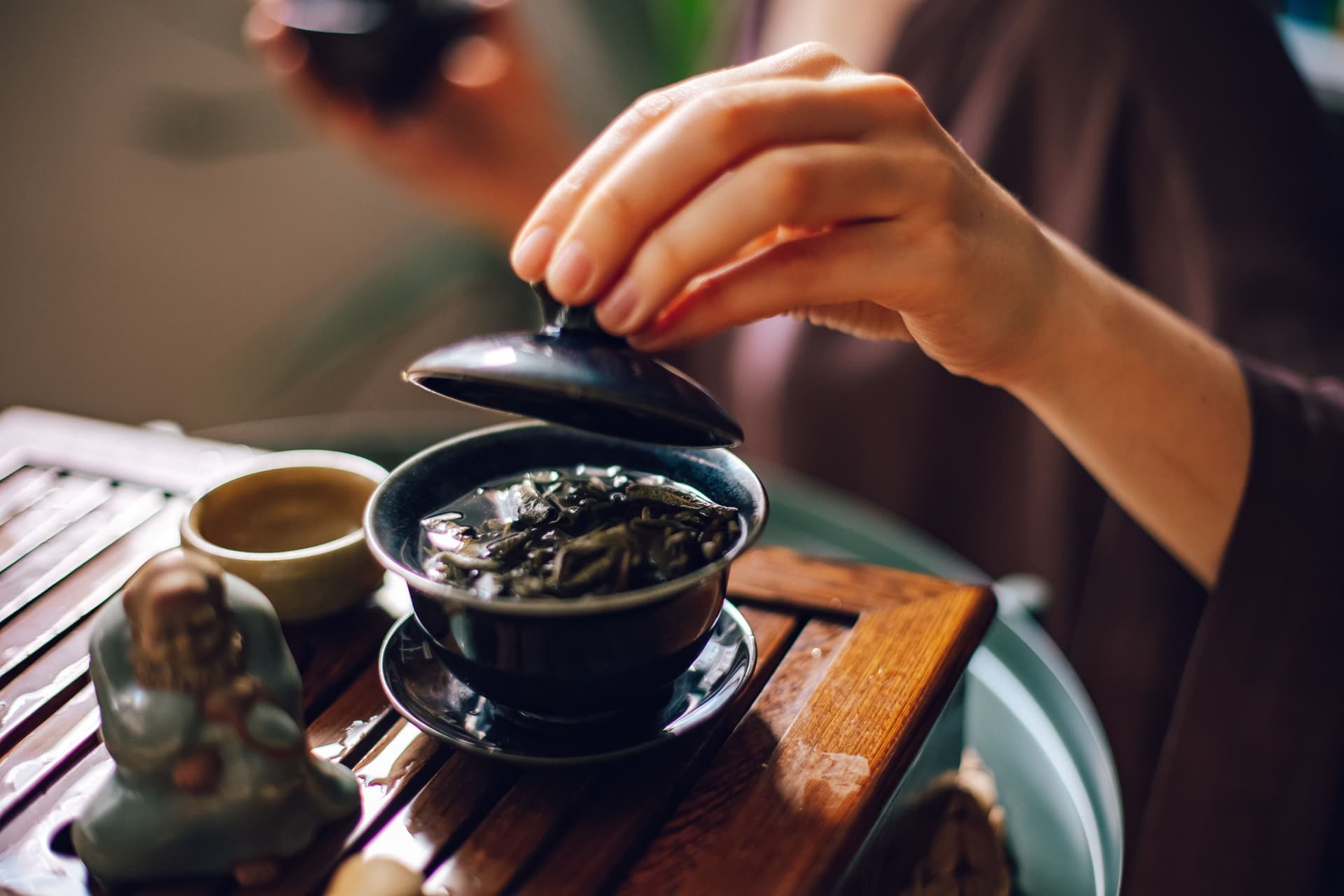
Short infusions: the reason to own a gaiwan
Fill a gaiwan a fifth deep with dry leaf, add water in the same band, and pour everything off after twenty to thirty seconds. Repeat, adding ten to fifteen seconds each round.
Five infusions from one dose is ordinary with rolled oolong, and — this is the part that makes it worth trying — they taste genuinely different from each other rather than simply weakening. That progression is the clearest demonstration available of why loose leaf is worth the trouble.
Those short-infusion timings are a starting point of ours rather than published guidance, and we are saying so. Gongfu timings vary by tea, by leaf grade and by taste, and anyone presenting them as fixed numbers is over-claiming.
The optional rinse
Many people pour a few seconds of hot water over rolled oolong and discard it before the first real infusion. The stated purpose is to help tightly rolled leaf begin opening.
It is optional. If you skip it, your first infusion is simply a little lighter, which is fine — and you can treat that first light infusion as the rinse's replacement.
Why oolong is the best tea to learn on
- The temperature band is twenty degrees wide, so small errors do not ruin it.
- It re-steeps several times, so one purchase gives you many attempts.
- The infusions differ from each other, which teaches you what changing a variable actually does.
- It spans an enormous flavor range, from floral and green to dark and roasted, so one category covers a lot of preference discovery.
If someone asks us what single tea to buy first with no other information, this is the answer.
Questions
What temperature should oolong tea be brewed at?
Art of Tea publishes 185-205F. Lighter, greener oolongs are conventionally brewed at the lower end and darker roasted ones at the upper end.
How long should you steep oolong tea?
Art of Tea publishes three to five minutes for rolled oolong and four to seven for long-leaf oolong. Long leaf takes longer despite looking more open.
How many times can you re-steep oolong?
Several. Western style gives at least two good infusions; short gaiwan infusions commonly give five or more, and they taste different from each other rather than simply fading.
Should I rinse oolong tea before brewing?
Optional. A few seconds of hot water discarded before the first infusion helps tightly rolled leaf begin opening. Skipping it just means a lighter first cup.
Sources
Every figure on this page came from one of these, retrieved during the research pass for this article. Where a maker publishes nothing we could verify, the page says so instead of substituting a number.
Read next
- Tea brewing temperature chartPublished brewing temperatures in F and C for every tea type, with the source named for each figure.
- How to use a gaiwanThe grip, the ratio and the rhythm of short infusions, written for someone holding a gaiwan for the first time.
- How long to steep teaPublished steep times by type, the reason the ranges are wide, and what over-steeping actually does to the cup.
- Gaiwan vs teapotA gaiwan is for tasting a tea properly; a teapot is for serving one. Buying the wrong one is a mismatch of purpose, not quality.
- How to brew loose-leaf teaThe complete method in five steps, with published parameters and the four mistakes that account for most bad cups.
- How to cold brew loose-leaf teaCold brewing in the refrigerator, the ratio to start from, and why this is the one method that is hard to get wrong.