Coming From Coffee
Use your coffee gear for tea
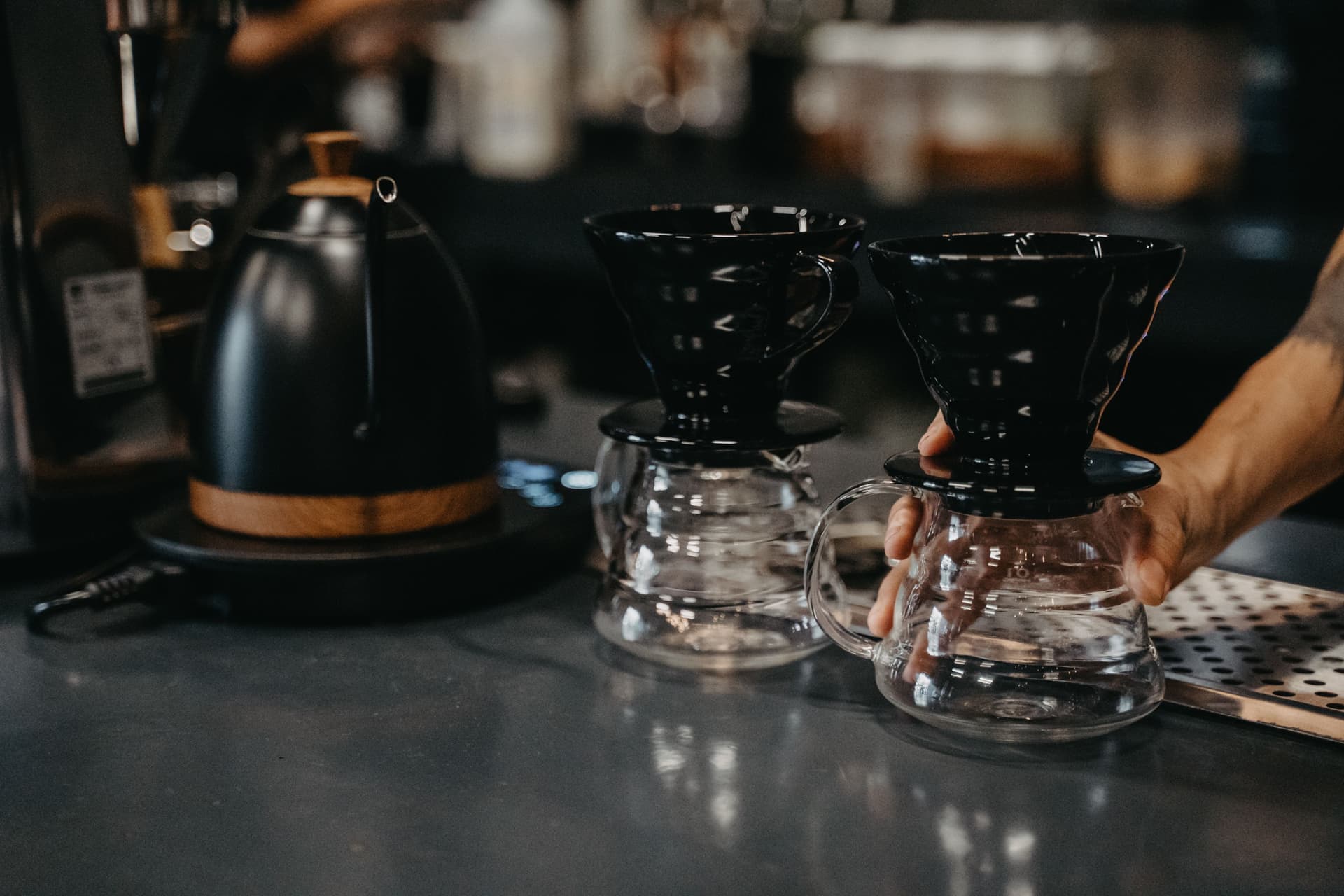
If you pour over, you own the expensive half of a tea setup already. Here is exactly which half.
We earn a commission if you buy through the links on this page, at no extra cost to you. It does not change which products we name or what we say about them — how this is funded.
Your kettle, your scale, your timer and your French press all work for tea, unchanged. Your grinder and your paper filters do not. The single object you are missing costs about ten dollars, and this page goes through the whole setup item by item.
The kettle: your best piece of tea equipment
A variable-temperature pour-over kettle is a better tea kettle than most kettles sold as tea kettles, and this is not a stretch — it is the same specification.
Pour-over coffee sits around 195-205F. Art of Tea publishes 160-180F for green, 185-205F for oolong and 200-212F for black. Any kettle covering the coffee range already covers oolong and black outright, and the good ones reach down to green.
COSORI publishes a coffee preset at 205F alongside white at 170F, green at 180F, oolong at 195F and black at 212F — the same machine, labeled for both drinks. OXO publishes one-degree control from 104F to 212F. Fellow publishes 104F to 212F with a hold you set to 15, 30, 45 or 60 minutes.
The gooseneck: more useful for tea than people think
For a mug, a gooseneck buys you nothing. For a gaiwan or a 300 ml teapot it is the difference between pouring and splashing, because those vessels have small openings and fill in seconds.
Hario's V60 Buono — a fixture of pour-over setups — publishes a practical capacity of 800 ml and a stainless body, and it is a perfectly good stovetop tea kettle.
The scale: same problem, same solution
You already weigh coffee because scoops are unreliable across different bean densities and roast levels. Tea has exactly the same problem, more severely: a tablespoon of dense rolled gunpowder green and a tablespoon of fluffy white tea are wildly different masses.
Most tea beginners do not own a scale and are told they do not need one, which is true for them. You already have one, so you get repeatability for free.
The timer: more important, not less
Tea is more time-sensitive than coffee. Art of Tea publishes one to three minutes for green, and the difference between two and four minutes on a delicate green is very audible in the cup.
The French press: a tea press with a coarse filter
Leaves loose in the water, plunge at the end of the steep to stop extraction. That is exactly what a purpose-built tea press does — the Bodum Assam is the same mechanism with a finer filter and a 34 oz body serving three to four.
Two cautions. Rinse it very thoroughly or your tea will taste of coffee, and plunge gently, because forcing it drives fine particles through the mesh.
The grinder: leave the tea alone
Grinding tea destroys the leaf structure that even extraction depends on, and turns it into dust that over-extracts almost instantly. The result is bitter and there is no brewing adjustment that saves it.
Matcha is the exception and it is not one you can replicate: it is stone-ground to a fineness no burr grinder approaches, from leaf grown specifically for it.
Paper filters and the pour-over cone
Paper strips more than metal mesh does, and tea does not have coffee's oil content to spare, so the cup comes out flat. Metal is the right filter material for tea, which is exactly why a French press works and a paper V60 does not.
If you want to use your cone, fit a metal filter and put loose leaf in it. It works, though a basket in a mug is easier.
So what do you actually buy?
A basket infuser, about ten dollars. That is the complete shopping list for a coffee drinker with a pour-over setup, and it is the entire reason this hub exists.
Spend everything you would have spent on a tea kettle on tea instead. It makes far more difference to what is in the cup.
Questions
Can I use my pour-over kettle for tea?
Yes, and it is probably better than most tea kettles. Pour-over runs 195-205F and tea spans about 160F to 212F, so a variable-temperature coffee kettle covers the whole range.
Can I brew tea in a pour-over cone?
Only with a metal filter. Paper strips more than tea can spare and the cup comes out flat. A basket infuser in a mug is easier and gives the leaves more room.
Can I use my coffee grinder for tea?
No. Grinding destroys the leaf structure even extraction depends on and produces dust that over-extracts immediately. Matcha is stone-ground far finer than any burr grinder reaches.
What do I actually need to buy to start drinking tea?
If you already have a variable-temperature kettle, a scale and a timer, you need a basket infuser. That is about ten dollars and it completes the setup.
Sources
Every figure on this page came from one of these, retrieved during the research pass for this article. Where a maker publishes nothing we could verify, the page says so instead of substituting a number.
Read next
- How to make tea in a French pressThe method, the two things that go wrong, and why the plunge is a genuine advantage over an ordinary teapot.
- Tea for coffee drinkersWhich teas suit a coffee palate, which of your coffee gear already works, and the two cheap things you still need.
- Gooseneck vs regular kettleA gooseneck buys you an aimable, slow stream. Whether that is worth anything depends entirely on the size of what you are pouring into.
- The best tea infusersFour infusers, one of which we tell you not to buy. The format matters more than the brand.
- Tea brewing temperature chartPublished brewing temperatures in F and C for every tea type, with the source named for each figure.
- The best gooseneck kettles for teaFour goosenecks ranked on hold time and water contact, and a straight answer on whether tea needs the spout at all.