Tea Kettles · Best gooseneck
The best gooseneck kettles for tea
Goosenecks are sold to coffee drinkers and bought by tea drinkers. Here is which one to get, and when the spout genuinely earns its place.
We earn a commission if you buy through the links on this page, at no extra cost to you. It does not change which products we name or what we say about them — how this is funded.
Buy the COSORI Original Gooseneck. Five presets named after tea types, sixty published minutes of keep-warm, and 304 food-grade stainless for the kettle, lid and spout. Nothing else here gives you that combination, and the two kettles that beat it on control both hold temperature for less time.
| # | Product | Best for | Capacity | Price |
|---|---|---|---|---|
| 1 | 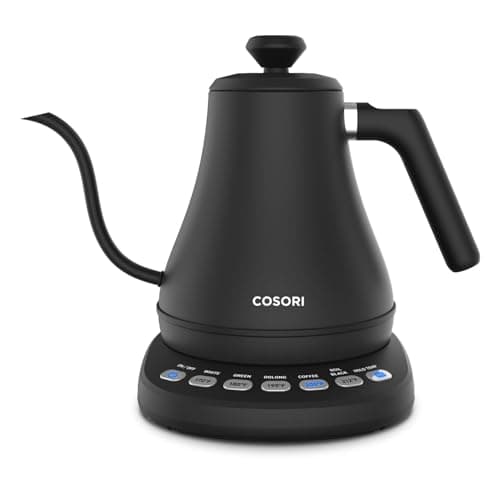 COSORI Original Electric Gooseneck Kettle (CO108-NK)Top pickFive presets that map to actual tea types, a 60-minute hold, and no plastic in the water path. This is the value pick and it is not close. | The sensible first variable-temperature kettle | 0.85 qt / 0.8 L | |
| 2 | No image Fellow Stagg EKG Electric KettleSets any temperature between 104F and 212F and holds it, which is the whole job. Everything else about it is preference. | The one to buy if the budget stretches | 30 oz (0.9 L) | Check price#ad |
| 3 | No image OXO Brew Adjustable Temperature Gooseneck KettleOne-degree control and a 1 L body. The hold window is half the Cosori's, which is the trade you are making. | Setting an exact temperature without the premium price | 1 liter | Check price#ad |
| 4 | 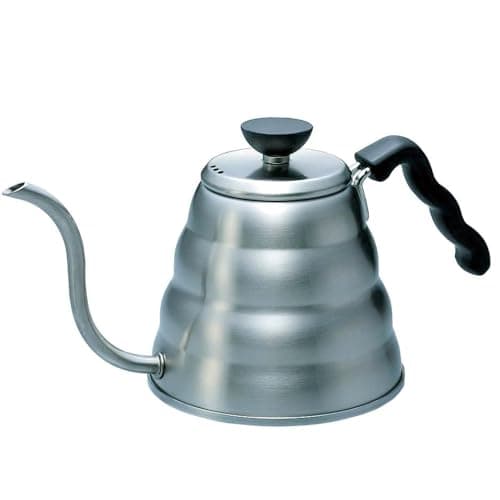 HARIO V60 Buono Drip KettleThe stovetop gooseneck. Made in Japan, 800 ml of working capacity, and the spout that most pour-over technique was written around. | A gooseneck you can use on the hob | 800 ml |
Top pick · The sensible first variable-temperature kettle
COSORI Original Electric Gooseneck Kettle (CO108-NK)
Five presets that map to actual tea types, a 60-minute hold, and no plastic in the water path. This is the value pick and it is not close.
Published specifications
- Capacity
- 0.85 qt / 0.8 LSource: COSORI — Original Electric Gooseneck Kettle (CO108-NK)
- Presets
- 170F white, 180F green, 195F oolong, 205F coffee, 212F blackSource: COSORI — Original Electric Gooseneck Kettle (CO108-NK)
- Hold
- Keeps water warm for up to 60 minutesSource: COSORI — Original Electric Gooseneck Kettle (CO108-NK)
- Power
- 1200 W (AC 120 V, 60 Hz)Source: COSORI — Original Electric Gooseneck Kettle (CO108-NK)
- Water contact
- 304 food-grade stainless steel kettle, lid and spoutSource: COSORI — Original Electric Gooseneck Kettle (CO108-NK)
- Warranty
- 2-year limitedSource: COSORI — Original Electric Gooseneck Kettle (CO108-NK)
What the numbers mean
The presets are the reason to recommend this to someone new. You do not have to know that sencha wants roughly 180F; you press the button that says green. That is one fewer thing to learn on week one.
Presets are also its limit. If you later want 165F for a delicate gyokuro, the button for it does not exist. Most people never get there, and the ones who do have already stopped being beginners.
It publishes 304 stainless for everything the water touches. That is the single spec worth checking on any cheap kettle, and plenty of them will not tell you.
Good for
- Presets named after teas, not temperatures
- 60-minute hold, longer than several kettles that cost more
- Stainless kettle, lid and spout published, not implied
Against it
- Preset steps only — no arbitrary target temperature
- 0.8 L is the smallest capacity here
- The gooseneck is slower to fill under a tap than a wide-mouth kettle
Skip it ifSkip it if you want to dial an exact number. Buy the OXO or the Stagg for that; this one gives you five good answers instead of infinite ones.
image
Pick 2 · The one to buy if the budget stretches
Fellow Stagg EKG Electric Kettle
Sets any temperature between 104F and 212F and holds it, which is the whole job. Everything else about it is preference.
#ad · how this is funded · price checked October 20, 2026
Published specifications
- Capacity
- 30 oz (0.9 L)Source: Fellow — Stagg EKG product page
- Temperature range
- 104F-212F / 40C-100CSource: Fellow — Stagg EKG product page
- Hold mode
- 15, 30, 45 or 60 minutesHolds the set temperature rather than reheating from cold.Source: Fellow — Stagg EKG product page
- Power
- 1000-1200 WSource: Fellow — Stagg EKG product page
- Water contact
- 304 18/8 stainless steelThe handle and lid pull are BPA-free plastic; neither touches water.Source: Fellow — Stagg EKG product page
- Warranty
- 2 yearsSource: Fellow — Stagg EKG product page
- Weight
- 1,400 g including the baseSource: Fellow — Stagg EKG product page
What the numbers mean
The 104F floor is far below anything tea needs. What matters is that the dial resolves the gap between green tea and black tea, which is roughly 175F to 212F, and this covers it with room on both sides.
Hold mode is the feature a beginner underestimates. Without it you boil, wait, guess, and pour at whatever temperature the kettle happens to be. With it you set 180F, walk away, and the water is still 180F when you come back.
The 0.9 L capacity is two large mugs, not a pot for the table. That is deliberate on a pour-over kettle and it is the main reason people who host end up owning two kettles.
Good for
- Temperature is set to the degree and then actually held
- Only stainless steel touches the water
- The narrow spout pours where you point it, which matters for gaiwan and small teapots
Against it
- The most expensive way to solve a problem a $60 kettle also solves
- 0.9 L runs out fast if more than one person is drinking
- The counter footprint is a base plus a kettle, permanently
Skip it ifSkip it if you drink one mug of black tea a day. Black tea wants boiling water, and a plain kettle boils water for a fifth of the price.
image
Pick 3 · Setting an exact temperature without the premium price
OXO Brew Adjustable Temperature Gooseneck Kettle
One-degree control and a 1 L body. The hold window is half the Cosori's, which is the trade you are making.
#ad · how this is funded · price checked October 20, 2026
Published specifications
- Capacity
- 1 literSource: OXO — Adjustable Temperature Kettle
- Temperature range
- 104F-212F in one-degree incrementsSource: OXO — Adjustable Temperature Kettle
- Hold
- Held at the set temperature for up to 30 minutesSource: OXO — Adjustable Temperature Kettle
- Timer
- Built-in count-up timerSource: OXO — Adjustable Temperature Kettle
- Body
- BPA-free borosilicate glassSource: OXO — Adjustable Temperature Kettle
- Warranty
- 2 yearsSource: OXO — Adjustable Temperature Kettle
What the numbers mean
One-degree increments sound like overkill and mostly are. The honest case for them is that you can find your own number for a tea you drink constantly and then reproduce it exactly, which presets cannot do.
Thirty minutes of hold against the Cosori's sixty is the real difference between these two. If you brew, drink, and come back for a second cup twenty minutes later, both work. If your second cup is an hour later, only one does.
The built-in timer is aimed at pour-over coffee, but it is the same timer a three-minute steep needs, so it earns its place either way.
Good for
- Exact target temperature rather than fixed presets
- 1 L, a useful step up from the 0.8 L class
- The count-up timer removes one phone reach from every brew
Against it
- 30-minute hold, half what the Cosori offers
- Glass shows limescale sooner than steel hides it
- Glass body means more care when it is full and hot
Skip it ifSkip it if you have hard water and no patience for descaling. A glass body makes scale visible; a steel one lets you ignore it for longer.
Pick 4 · A gooseneck you can use on the hob
HARIO V60 Buono Drip Kettle
The stovetop gooseneck. Made in Japan, 800 ml of working capacity, and the spout that most pour-over technique was written around.
Published specifications
- Practical capacity
- 800 mlHario publishes practical capacity, not brim capacity — the 1.2 L on the box is the latter.Source: HARIO USA — V60 Buono Drip Kettle
- Materials
- Stainless steel body and lid; phenol resin handle and knobSource: HARIO USA — V60 Buono Drip Kettle
- Dimensions
- W274 x D144 x H147 mmSource: HARIO USA — V60 Buono Drip Kettle
- Made in
- JapanSource: HARIO USA — V60 Buono Drip Kettle
- Induction compatibility
- Not verifiedHario's US page does not state a hob type. Check the base against your own hob before buying if you cook on induction.
What the numbers mean
The practical-versus-brim capacity distinction is worth internalizing. A kettle sold as 1.2 L that holds 800 ml in use is not overstating anything, but it will surprise you if you plan around the bigger number.
This is the crossover object for anyone arriving from coffee. If you already pour over, this kettle is already in your kitchen, and the only tea gear you still need costs about ten dollars.
No temperature control, and the published spec is silent on induction. Both are the price of a stovetop kettle at this price.
Good for
- A genuine gooseneck without an electric base on the counter
- Published practical capacity, which is the honest number
- Pours slowly and precisely into a gaiwan or a small pot
Against it
- No temperature control
- Induction compatibility is not published
- The resin handle gets warm on a gas hob with a wide flame
Skip it ifSkip it if you cook on induction and want certainty. The maker does not publish a hob compatibility line, and a gooseneck you cannot heat is an expensive jug.
Who this is for
Someone who has already decided they want a gooseneck, either because they brew into small vessels or because they also make pour-over coffee. If you are still deciding whether the spout is worth it, read the gooseneck versus regular comparison first, because the honest answer for a mug drinker is that it is not.
The criteria, in the order they matter
Everything on this page pours a narrow, aimable stream. That is the category's entry requirement, not a differentiator, so ranking on it would tell you nothing. What separates these four is what happens to the water before it leaves the spout.
- Hold time. Reaching a temperature is trivial; still being at it ninety seconds later is the feature you are paying for. This is the specification that varies most across the category and the one most reviews skip.
- Control type. Presets labeled by tea type, or a dial you set to the degree. Presets are better for a first kettle and a dial is better once you have a number you want to reproduce.
- What touches the water. Stainless, glass and enamel are all inert. Plastic in the water path can carry a faint taste into a drink whose whole point is faint flavors.
- Capacity, which in this category is always small. A narrow spout and a big body do not pair well, so a gooseneck is a one-or-two-mug object by design.
Hold time, side by side
| Kettle | Published hold | Control | Capacity |
|---|---|---|---|
| COSORI Original Gooseneck | Up to 60 minutes | 5 presets, 170F to 212F | 0.85 qt / 0.8 L |
| Fellow Stagg EKG | 15, 30, 45 or 60 minutes | 104F-212F | 30 oz / 0.9 L |
| OXO Brew Adjustable Temperature | Up to 30 minutes at the set temperature | 104F-212F, one-degree steps | 1 liter |
| HARIO V60 Buono | None - stovetop | None | 800 ml practical |
The COSORI and the Fellow both top out at sixty published minutes, and the Fellow lets you choose the window rather than accepting one. The OXO gives you half that. In practice thirty minutes covers a brew and a refill twenty minutes later; it does not cover coming back to the kitchen an hour after the first cup.
Presets or a dial
COSORI publishes five presets: 170F for white, 180F for green, 195F for oolong, 205F for coffee and 212F for black. Those map onto the published brewing bands from Art of Tea, which give 160-185F for white, 160-180F for green, 185-205F for oolong and 200-212F for black. Five buttons cover the whole chart.
The Fellow and the OXO both run 104F to 212F, and the OXO moves in one-degree steps. That matters for exactly one thing, and it is worth naming precisely: reproducing a temperature you have settled on. If you have found that a particular sencha is best at 168F, presets cannot give you 168F twice and a dial can.
Most people never get there. The ones who do have stopped being the reader this page is written for, and they already know which of these they want.
The stovetop entry
The HARIO V60 Buono is on this list because it is one of very few real goosenecks that lives on a hob instead of an electric base. Hario publishes 800 ml as the practical capacity, a stainless body with a phenol resin handle, and Japanese manufacture.
It also has no temperature control at all, and Hario's US page does not state a cooktop type, so induction owners are inferring. Those two gaps are why it ranks fourth rather than second despite being the nicest object here to pour with.
What the spout is actually for
Two things, and only two. Saturating a coffee bed evenly, which is a coffee problem. And hitting a small target without splashing, which is the tea case.
| What you brew in | Gooseneck useful? | Why |
|---|---|---|
| A mug with a basket infuser | No | Wide opening, nothing to aim at |
| A 700 ml teapot | Barely | Big target and you are filling it fully |
| A 300 ml teapot | Somewhat | Small opening, easy to overshoot |
| A gaiwan | Yes | Fills in seconds through a teacup-sized mouth |
| Pour-over coffee | Yes | Even saturation depends on stream control |
If your row says no, the honest recommendation is a larger non-gooseneck kettle with the same temperature control, and there is a roundup of those on this site.
Capacity is the trade you are making
Published capacities here run 0.8 to 1 liter, against 1.6 to 1.8 liters for a stovetop kettle. That is roughly half the water, and it is a design consequence rather than a cost saving: a narrow spout on a large body pours badly and fills slowly.
For one or two people this never comes up. For three, a 0.8 liter kettle means boiling twice, and the annoyance compounds daily.
Water contact
- COSORI publishes 304 food-grade stainless for the kettle, the lid and the spout - all three named separately, which is unusually specific.
- Fellow publishes 304 18/8 stainless, with BPA-free plastic confined to the handle and lid pull, neither of which meets water.
- OXO publishes a BPA-free borosilicate glass body, inert and easy to inspect for scale.
- Hario publishes a stainless body and lid with a phenol resin handle and knob.
All four are fine. We list it because in the tier below these, makers frequently publish nothing about the water path at all, and that silence is the most useful signal you get on a cheap kettle.
How we picked
Published hold time first, then control type against what a beginner actually needs, then water contact, then capacity against realistic use. Every figure above came from the maker's own specification page and is cited at the foot of this article and on each product card. Our full method is on the how we pick page.
What we did not do
We have not poured from any of these kettles. No flow-rate measurements, no boil times, no comparison of how steady the stream is, because those would require having them in a kitchen and we have not. Everything above is published specification plus reasoning about what a narrow spout and a held temperature do for tea.
Questions
What is the best gooseneck kettle for tea?
The COSORI Original Gooseneck for most people: five presets named after tea types, up to 60 published minutes of keep-warm, and 304 food-grade stainless published for the kettle, lid and spout.
Do I need a gooseneck kettle for tea?
Only if you brew into small vessels such as a gaiwan or a 300 ml teapot, or you also make pour-over coffee. For a mug with a basket infuser the spout buys you precision you will never use.
Are all gooseneck kettles temperature controlled?
No, and conflating the two is the most common mistake in this category. Hario's V60 Buono is a gooseneck with no temperature control, and plenty of temperature-controlled kettles have ordinary spouts.
Why are gooseneck kettles so small?
A narrow spout and a large body pour badly together, so the category settles at 0.8 to 1 liter against 1.6 to 1.8 for a stovetop kettle. If you brew for three people that difference will annoy you daily.
Sources
Every figure on this page came from one of these, retrieved during the research pass for this article. Where a maker publishes nothing we could verify, the page says so instead of substituting a number.
Read next
- Gooseneck vs regular kettleA gooseneck buys you an aimable, slow stream. Whether that is worth anything depends entirely on the size of what you are pouring into.
- The best electric tea kettlesElectric kettles ranked on the specification that actually matters: how long they hold the temperature they reached.
- Use your coffee gear for teaItem by item through a coffee setup: what transfers to tea, what does not, and the ten dollars that completes it.
- How to use a gaiwanThe grip, the ratio and the rhythm of short infusions, written for someone holding a gaiwan for the first time.
- Is a variable-temperature kettle worth it?Worth it if you drink green tea daily and value the removed step. Not worth it as a first purchase, and here is why.
- COSORI Original Gooseneck Kettle reviewFive presets, a sixty-minute hold and a published all-stainless water path. A review of what COSORI documents and where the spec sheet stops.