Tea Kettles
Chantal vs Le Creuset tea kettle
Same construction, same job, similar price. The difference that matters is how much each maker is willing to tell you.
We earn a commission if you buy through the links on this page, at no extra cost to you. It does not change which products we name or what we say about them — how this is funded.
Buy the Chantal. It costs about twenty dollars less, it publishes two specifications Le Creuset does not — base diameter and weight — and both makers name induction in their hob lists, so you are not giving up compatibility to save the money. Buy the Le Creuset if the name and the colorway range matter to you, which is a real reason, just not a specification.
| # | Product | Best for | Capacity | Price |
|---|---|---|---|---|
| 1 | 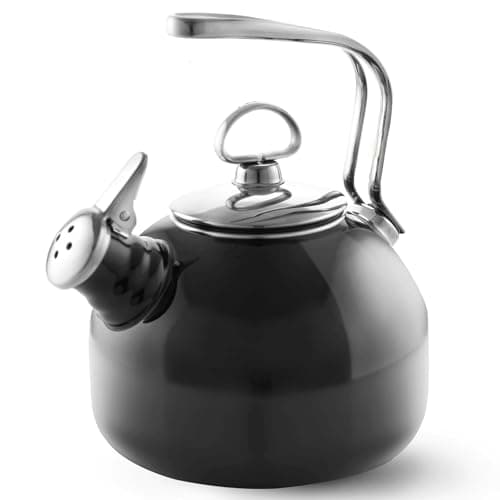 Chantal Enamel-on-Steel Classic Teakettle, 1.8 Qt.Top pickPorcelain enamel over carbon steel, a two-note harmonica whistle, and a published line saying it works on every cooktop including induction. The specification sheet is the reason to buy it. | A stovetop kettle that names every hob type | 1.8 Qt. | |
| 2 | 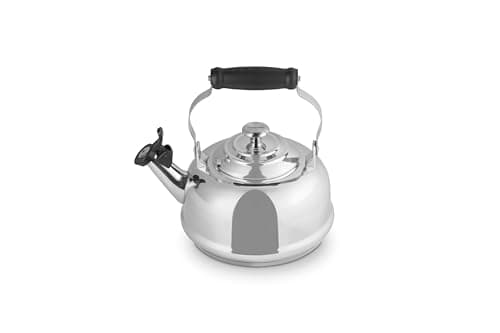 Le Creuset Classic Whistling KettleEnameled carbon steel, works on every heat source including induction, and whistles. It is a kettle, and it is a very good one. | A stovetop kettle you will still own in a decade | 1.7 qt |
Top pick · A stovetop kettle that names every hob type
Chantal Enamel-on-Steel Classic Teakettle, 1.8 Qt.
Porcelain enamel over carbon steel, a two-note harmonica whistle, and a published line saying it works on every cooktop including induction. The specification sheet is the reason to buy it.
#ad · how this is funded · price checked September 27, 2026
Published specifications
- Functional capacity
- 1.8 Qt.Source: Chantal — Enamel-on-Steel Classic Teakettle (1.8 Qt.) product page
- Construction
- Heavy-duty carbon steel with a US-formulated commercial-grade porcelain glass enamel interiorSource: Chantal — Enamel-on-Steel Classic Teakettle (1.8 Qt.) product page
- Cooktop compatibility
- Suitable for all stove types, including induction, gas and electricCarbon steel is magnetic, which is what makes the induction claim work.Source: Chantal — Enamel-on-Steel Classic Teakettle (1.8 Qt.) product page
- Whistle
- Two-note harmonica whistleSource: Chantal — Enamel-on-Steel Classic Teakettle (1.8 Qt.) product page
- In the box
- Includes a quilted mittSource: Chantal — Enamel-on-Steel Classic Teakettle (1.8 Qt.) product page
- Base diameter
- 6.5 in exteriorSource: Chantal B2B — Enamel-on-Steel Classic Teakettle (1.8 Qt.) spec sheet
- Warranty length
- Not verifiedChantal states a limited warranty but does not publish a duration on the product page.
What the numbers mean
The compatibility line is the whole point. Chantal writes out every cooktop type by name, including induction, rather than using a summary adjective. On a stovetop kettle that is the single specification most worth having in writing, because induction is binary.
Porcelain enamel over carbon steel is the same construction as the Le Creuset, and the properties follow: non-reactive, non-porous, holds no flavors, chips if you knock it hard against a tap.
At 1.8 quarts it is a touch larger than the 1.7-quart norm in this category, which is around seven to eight cups. That is a kettle for a household, and heating it for one mug is slow.
Good for
- Every cooktop type published by name, induction included
- Enamel interior specified as commercial-grade porcelain glass
- The harmonica whistle is genuinely distinctive rather than a marketing line
- A quilted mitt is included rather than sold separately
Against it
- Boiling only, like every stovetop kettle
- No published warranty duration
- Enamel chips, and it is hand-wash territory
- 1.8 quarts is a slow boil if you only want one mug
Skip it ifSkip it if you brew a single mug at a time. Heating nearly two quarts for 300 ml of tea is a habit that wastes both time and energy.
Pick 2 · A stovetop kettle you will still own in a decade
Le Creuset Classic Whistling Kettle
Enameled carbon steel, works on every heat source including induction, and whistles. It is a kettle, and it is a very good one.
#ad · how this is funded · price checked September 27, 2026
Published specifications
- Capacity
- 1.7 qtSource: Le Creuset — Classic Whistling Kettle
- Construction
- Carbon steel with porcelain enamelSource: Le Creuset — Classic Whistling Kettle
- Heat sources
- Gas, electric, ceramic, halogen and inductionSource: Le Creuset — Classic Whistling Kettle
- Dimensions
- 8.25 in diameter x 9.75 in highSource: Le Creuset — Classic Whistling Kettle
- Care
- Hand washSource: Le Creuset — Classic Whistling Kettle
What the numbers mean
Porcelain enamel is the reason this is on the list rather than a cheaper steel kettle. It is non-reactive and non-porous, so it does not hold onto flavor or stain the way bare aluminum does.
Induction compatibility is published, which is more than most enameled kettles will tell you. If your hob is induction, that single line is the difference between a kettle and an ornament.
It has no temperature control, because no stovetop kettle does. Pair it with a thermometer or with teas that want boiling water.
Good for
- Published as compatible with every common hob, induction included
- Enamel does not react with water or hold flavors
- No electronics, so nothing in it can fail
Against it
- Boiling only — temperature is on you
- Hand wash, and enamel chips if you are careless
- Costs more than several electric kettles that do more
Skip it ifSkip it if you mostly drink green tea and do not own a thermometer. A stovetop kettle cannot tell you when the water is at 180F.
Why these two get compared
They are the same idea executed by two premium brands. Both are porcelain enamel over steel, both are stovetop whistling kettles in the 1.7 to 1.8 quart class, both name induction among their hob types, and both sit within about twenty dollars of each other. If you have shortlisted one you have almost certainly shortlisted the other.
What separates them is not performance. Neither kettle does anything the other cannot, because the job is boiling water and both boil water. The separation is in disclosure, weight and price, in that order.
What each maker publishes
| Chantal Classic | Le Creuset Classic | |
|---|---|---|
| Capacity | 1.8 qt functional | 1.7 qt |
| Construction | Heavy-duty carbon steel, US-formulated commercial-grade porcelain glass enamel interior | Carbon steel with porcelain enamel |
| Hob types | All stove types, including induction, gas and electric | Gas, electric, ceramic, halogen and induction |
| Base diameter | 6.5 in exterior | Not published |
| Weight | 5 lb | Not published |
| Dimensions | Not published | 8.25 in diameter x 9.75 in high |
| Whistle | Two-note harmonica whistle | Not described beyond whistling |
| In the box | A quilted mitt | Not published |
| Care | Not published | Hand wash |
| Warranty | Limited, duration not published | Not published |
Read the two middle rows first, because they are the ones that decide a purchase rather than describe it.
The two numbers that actually matter
Base diameter and weight are the specifications that determine whether a stovetop kettle works in your kitchen, and Chantal is the only one of the two that publishes either.
Base diameter decides heat transfer on a smooth-top electric hob, where the kettle heats through the contact patch where metal meets glass. A base roughly matching the printed element ring transfers the most heat. Chantal publishes 6.5 inches. Le Creuset publishes an 8.25 inch diameter, but read that carefully — it is the body diameter of a kettle that curves inward toward the bottom, not a stated flat base contact patch, and we are not going to convert one into the other.
Weight decides what it is like to lift full, one-handed, hot. Chantal publishes 5 lb empty; add 1.8 quarts of water and you are placing close to nine pounds. Le Creuset publishes no weight at all, so you cannot plan for it, and on a glass-ceramic hob — where the failure mode is impact rather than load — that is a real gap.
What Chantal gives you
Chantal publishes 1.8 quarts of functional capacity, heavy-duty carbon steel with a US-formulated commercial-grade porcelain glass enamel interior, suitability for all stove types including induction, gas and electric, a two-note harmonica whistle, a 6.5 inch exterior base diameter, a 5 lb weight and a quilted mitt in the box. That is eight specifications to Le Creuset's five.
Naming the enamel formulation is unusual. Most makers say porcelain enamel and stop; stating that it is a US-formulated commercial-grade glass enamel is a claim a company has to stand behind. The two-note whistle is a small thing that you hear every single time and that nobody else on this site describes at all.
Against it: 5 lb empty is genuinely heavy and it is the specification most likely to annoy someone with wrist trouble. It publishes a limited warranty without a duration, which is a gap on a kettle at this price. It publishes no overall dimensions, so cupboard fit is unknown. And enamel chips if it is knocked against a tap, exposing carbon steel that can rust.
What Le Creuset gives you
Le Creuset publishes 1.7 quarts, carbon steel with porcelain enamel, a hob list naming gas, electric, ceramic, halogen and induction, dimensions of 8.25 inches diameter by 9.75 inches high, and hand wash care.
The hob list is the strongest thing on that list. Naming ceramic and halogen explicitly — not just induction — makes it one of very few kettles you can buy with confidence for an unusual hob. If you have a halogen hob, this is the kettle that says so in writing.
The colorway range is the other real draw and we cannot document it. Le Creuset's own site is behind bot protection as far as this VM can reach, so the figures above are those recorded from its product page during this site's research pass, and we cannot verify its current color lineup. The listing our buy link points at is the Stainless Steel colorway.
Against it: it costs more and publishes less than the kettle below it. No weight, no base diameter, no warranty term, no whistle description, nothing about what is in the box. Hand wash only is published, which is a weekly job rather than a footnote. And like all enamel, it chips.
Capacity: 1.7 against 1.8 quarts
This difference is close to meaningless and worth saying so plainly, because comparison pages love to make something of it. One tenth of a quart is about three ounces, or a third of a mug. Neither kettle serves a materially different number of people than the other.
What the capacities have in common is more useful: both are household-sized, roughly seven cups, which means both are the wrong shape for heating one mug of water and the right shape for a table. If you brew a single cup at a time, the honest recommendation is neither of these — a 1.5 quart kettle heats less water you will not use.
Which one for which hob
| Your hob | Pick | Why |
|---|---|---|
| Induction | Either | Both name induction. Carbon steel is magnetic, which is what makes the claim work. |
| Halogen or ceramic | Le Creuset | It is the only one of the two that names those types outright. |
| Smooth-top electric | Chantal | It publishes a base diameter you can match to the element ring. |
| Gas | Either | Both name gas, and flame heats the sides as well as the base. |
| You want to know the weight first | Chantal | It is the only one that publishes one. |
The verdict, and the honest caveat
On specifications, Chantal wins and it is not especially close: more published, less money, and the two figures it adds are the two that govern fit. If you are choosing on what you can verify before paying, that is the answer.
The caveat is that nobody buys a Le Creuset kettle purely on specifications, and pretending otherwise would be dishonest about how this purchase actually gets made. It is a design object with a colorway range and thirty years of kitchen presence behind it, and if that is what you are buying, a spec sheet is not the document that decides it. Just know what the premium is buying, which is not better boiling water.
What we did not do
We did not test either kettle. There are no boil times, no measured whistle volumes and no durability trials, because we have run none. Every figure above is read from the maker's own published page and links back to it from the product card. Le Creuset's site is currently inaccessible to us, so its figures are as recorded during this site's research pass rather than re-verified today, and that is stated rather than glossed.
Questions
Is Chantal or Le Creuset the better tea kettle?
Chantal, on what you can verify. It costs about twenty dollars less and publishes eight specifications against Le Creuset's five — including base diameter and weight, the two figures that decide whether a stovetop kettle suits your hob and your wrist.
Are Chantal and Le Creuset kettles made the same way?
Both are porcelain enamel over carbon steel, which is why they get compared. Chantal goes further and names its interior as a US-formulated commercial-grade porcelain glass enamel; Le Creuset publishes porcelain enamel without elaborating.
Do both work on induction?
Yes, and both publish it. Chantal states all stove types including induction, gas and electric. Le Creuset names gas, electric, ceramic, halogen and induction — the only one of the two that covers halogen and ceramic explicitly.
How heavy is the Chantal kettle compared to Le Creuset?
Chantal publishes 5 lb empty. Le Creuset publishes no weight at all, so a direct comparison is not possible — which is itself the finding. If weight matters to you, only one of these two tells you.
Is the capacity difference between them significant?
No. 1.8 quarts against 1.7 is about three ounces, roughly a third of a mug. Both are household-sized at around seven cups, and both are the wrong shape for heating a single mug of water.
Is Le Creuset worth the extra money for a kettle?
Not on performance — both boil water identically. The premium buys the name, the colorway range and the design, which are fair reasons to want something. It does not buy a better spec sheet; on this pair it buys a shorter one.
Sources
Every figure on this page came from one of these, retrieved during the research pass for this article. Where a maker publishes nothing we could verify, the page says so instead of substituting a number.
Read next
- The best stovetop tea kettlesThree stovetop kettles with published hob compatibility, and the one spec that decides whether any of them will work in your kitchen.
- Chantal Classic Teakettle reviewChantal publishes every cooktop type, the enamel formulation and a base diameter. A review of what full disclosure is actually worth.
- The best-looking tea kettlesAppearance is a fair reason to pick a kettle when performance ties. Five judged on finish durability and whether the maker documents what you are buying.
- Tea kettles for induction and gas stovesWhich stovetop kettles publish induction compatibility by name, which only imply it, and how to check before you buy.
- The best tea kettles for glass top stovesGlass tops are decided by base flatness and weight. Almost nobody publishes either number, and we name the one maker who publishes both.
- The safest tea kettle materialsStainless, glass and enamel are all inert. What separates kettles is whether the maker publishes what the water touches.