Tea Kettles
How to choose a tea kettle
Five questions, asked in the order that actually eliminates options. Most people can stop after two.
We earn a commission if you buy through the links on this page, at no extra cost to you. It does not change which products we name or what we say about them — how this is funded.
If you drink green or white tea, buy the COSORI Original Gooseneck: it has presets named after tea types rather than temperatures, and COSORI publishes 304 food-grade stainless for the kettle, lid and spout. If you only drink black, herbal or rooibos, buy the cheapest documented stovetop kettle you can find — the Primula Stewart at around fifteen dollars boils water exactly as well as anything above it. Everything else on this page is about the cases where those two answers are wrong.
| # | Product | Best for | Capacity | Price |
|---|---|---|---|---|
| 1 | 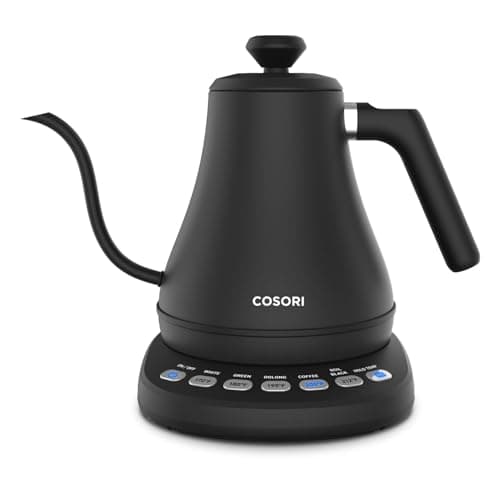 COSORI Original Electric Gooseneck Kettle (CO108-NK)Top pickFive presets that map to actual tea types, a 60-minute hold, and no plastic in the water path. This is the value pick and it is not close. | The sensible first variable-temperature kettle | 0.85 qt / 0.8 L | |
| 2 | 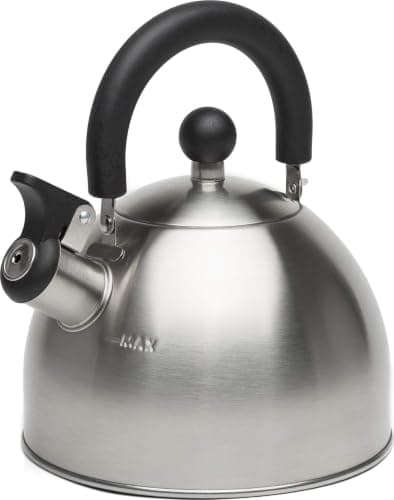 Primula Stewart Whistling Kettle with Folding Handle, 1.5 Qt.A 1.5-quart food-grade stainless whistler with a flip-up spout and a handle that folds flat. It boils water and stores in a drawer, which is the entire brief. | The cheapest kettle on this site that we would actually own | 1.5 qt | |
| 3 | 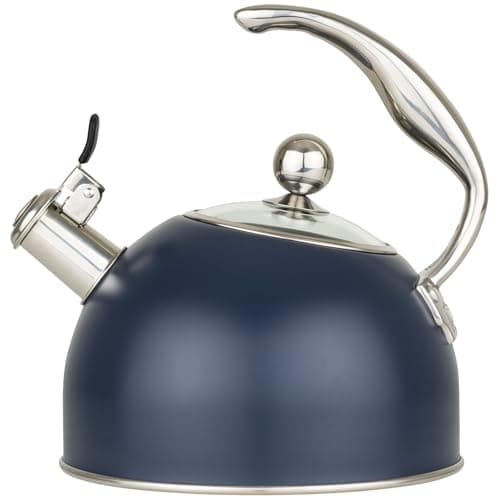 Viking 2.6-Quart Stainless Steel Whistling Kettle with 3-Ply BaseA clad-base stainless kettle that publishes more about itself than anything else in the category, including a Limited Lifetime Warranty nobody else on this site will commit to. | The only kettle here with a lifetime warranty | 2.6 quarts (2.5 liters) | |
| 4 | No image Various Instant-Read Kitchen ThermometerFifteen dollars of thermometer does most of what a hundred dollars of kettle does. It is the highest-leverage thing on this page. | Turning any kettle into a variable-temperature kettle | not verified | Check price#ad |
Top pick · The sensible first variable-temperature kettle
COSORI Original Electric Gooseneck Kettle (CO108-NK)
Five presets that map to actual tea types, a 60-minute hold, and no plastic in the water path. This is the value pick and it is not close.
Published specifications
- Capacity
- 0.85 qt / 0.8 LSource: COSORI — Original Electric Gooseneck Kettle (CO108-NK)
- Presets
- 170F white, 180F green, 195F oolong, 205F coffee, 212F blackSource: COSORI — Original Electric Gooseneck Kettle (CO108-NK)
- Hold
- Keeps water warm for up to 60 minutesSource: COSORI — Original Electric Gooseneck Kettle (CO108-NK)
- Power
- 1200 W (AC 120 V, 60 Hz)Source: COSORI — Original Electric Gooseneck Kettle (CO108-NK)
- Water contact
- 304 food-grade stainless steel kettle, lid and spoutSource: COSORI — Original Electric Gooseneck Kettle (CO108-NK)
- Warranty
- 2-year limitedSource: COSORI — Original Electric Gooseneck Kettle (CO108-NK)
What the numbers mean
The presets are the reason to recommend this to someone new. You do not have to know that sencha wants roughly 180F; you press the button that says green. That is one fewer thing to learn on week one.
Presets are also its limit. If you later want 165F for a delicate gyokuro, the button for it does not exist. Most people never get there, and the ones who do have already stopped being beginners.
It publishes 304 stainless for everything the water touches. That is the single spec worth checking on any cheap kettle, and plenty of them will not tell you.
Good for
- Presets named after teas, not temperatures
- 60-minute hold, longer than several kettles that cost more
- Stainless kettle, lid and spout published, not implied
Against it
- Preset steps only — no arbitrary target temperature
- 0.8 L is the smallest capacity here
- The gooseneck is slower to fill under a tap than a wide-mouth kettle
Skip it ifSkip it if you want to dial an exact number. Buy the OXO or the Stagg for that; this one gives you five good answers instead of infinite ones.
Pick 2 · The cheapest kettle on this site that we would actually own
Primula Stewart Whistling Kettle with Folding Handle, 1.5 Qt.
A 1.5-quart food-grade stainless whistler with a flip-up spout and a handle that folds flat. It boils water and stores in a drawer, which is the entire brief.
Published specifications
- Material
- Food-grade stainless steelSource: Primula — Stewart Whistling Kettle with Folding Handle, 1.5 Qt.
- Spout
- Flip-up whistling spoutThe flip is one-handed, which matters when the other hand is holding a mug.Source: Primula — Stewart Whistling Kettle with Folding Handle, 1.5 Qt.
- Handle
- Stay-cool coating; folds down for storageThe folding handle is the reason this fits in a drawer rather than living on the hob.Source: Primula — Stewart Whistling Kettle with Folding Handle, 1.5 Qt.
- Lid
- Wide-mouth lid for cleaning and dryingSource: Primula — Stewart Whistling Kettle with Folding Handle, 1.5 Qt.
- Finishes
- Brushed stainless (PTK-6215-B) and chromeSource: Primula — Stewart Whistling Kettle with Folding Handle, 1.5 Qt.
- Cooktop compatibility
- Not verifiedPrimula does not name hob types on this page. Stainless is induction-compatible only when the base is magnetic, so hold a magnet to it or check the listing before buying for an induction hob.
- Warranty
- Not verifiedNo warranty length is published on the product page.
What the numbers mean
The honest case for a kettle at this price is that boiling water is a solved problem. A stovetop whistler has no electronics to fail, no temperature board to drift and nothing that stops working in year three. What you give up is the ability to set a temperature, and for black and herbal tea there is nothing to set.
1.5 quarts is about six mugs. That is a genuinely useful size: enough for a pot on the table, not so much that you are heating a liter of water you will pour down the sink.
The folding handle sounds like packaging copy and is the most practical thing here. A kettle that folds flat goes in a cupboard between uses, which is the difference between owning one and living with one permanently occupying a burner.
Good for
- Costs less than most infusers
- Nothing electronic to fail
- Folds flat, so it does not have to live on the hob
- Food-grade stainless is published, which is more than most kettles at this price say
Against it
- Boiling only — no temperature setting of any kind
- Thin stainless heats fast and cools fast
- No published hob compatibility, so induction buyers have to check
- No published warranty
Skip it ifSkip it if green tea is the reason you are here. Boiling water scorches it, and no whistling kettle will tell you when the water has dropped to 175F.
Pick 3 · The only kettle here with a lifetime warranty
Viking 2.6-Quart Stainless Steel Whistling Kettle with 3-Ply Base
A clad-base stainless kettle that publishes more about itself than anything else in the category, including a Limited Lifetime Warranty nobody else on this site will commit to.
#ad · how this is funded · price checked October 23, 2026
Published specifications
- Capacity
- 2.6 quarts (2.5 liters)Source: Viking Culinary — 2.6-Quart Stainless Steel Whistling Kettle with 3-Ply Base
- Body and spout
- 304 stainless steel, with a surgical grade stainless interiorSource: Viking Culinary — 2.6-Quart Stainless Steel Whistling Kettle with 3-Ply Base
- Base
- 3-ply, with an aluminum core between two layers of stainlessAluminum conducts heat far better than steel, so a clad base spreads heat across the whole base instead of concentrating it over the burner.Source: Viking Culinary — 2.6-Quart Stainless Steel Whistling Kettle with 3-Ply Base
- Handle
- High-polished stainless steel, riveted to the pot, with a heat breakA heat break is a deliberate interruption in the metal path so less heat travels from body to handle.Source: Viking Culinary — 2.6-Quart Stainless Steel Whistling Kettle with 3-Ply Base
- Also included
- Removable quilted fabric heat sleeveSource: Viking Culinary — 2.6-Quart Stainless Steel Whistling Kettle with 3-Ply Base
- Lid
- Tempered glassSource: Viking Culinary — 2.6-Quart Stainless Steel Whistling Kettle with 3-Ply Base
- Whistle
- Melodic whistleSource: Viking Culinary — 2.6-Quart Stainless Steel Whistling Kettle with 3-Ply Base
- Cooktop compatibility
- Works on all stovetops, including inductionViking also lists gas, electric, halogen and ceramic.Source: Viking Culinary — 2.6-Quart Stainless Steel Whistling Kettle with 3-Ply Base
- Care
- Hand wash onlySource: Viking Culinary — 2.6-Quart Stainless Steel Whistling Kettle with 3-Ply Base
- Warranty
- Limited Lifetime WarrantySource: Viking Culinary — 2.6-Quart Stainless Steel Whistling Kettle with 3-Ply Base
- Dimensions and weight
- Not verifiedNot published on Viking's product page. At 2.6 quarts this is the largest kettle on the site, so check it against your hob and your cupboard.
What the numbers mean
The warranty is the specification that separates this from everything else we have written up. Caraway publishes no warranty at all and Chantal states a limited warranty without a duration. Viking publishes Limited Lifetime, which is a commitment rather than an adjective.
The 3-ply base is the real construction difference. Every other stovetop kettle on this site is a single layer of steel or enameled carbon steel, where heat enters wherever the burner touches. An aluminum core spreads it across the base first, which is the same reason clad pans exist.
At 2.6 quarts it is the largest kettle here by a clear margin, against 1.7 to 1.8 for the enameled ones. That is around ten cups from one boil and a genuinely slow way to make a single mug.
Good for
- Limited Lifetime Warranty, published - the only one on this site
- 3-ply clad base with an aluminum core, which no other kettle here has
- Handle heat break and a removable heat sleeve, both published
- Every cooktop named, induction included
- Tempered glass lid, so you can see the water
Against it
- Boiling only, like every stovetop kettle
- 2.6 quarts is a lot of water to heat for one mug
- Hand wash only, published
- A glass lid is a breakable part the all-metal kettles do not have
- No published dimensions or weight
Skip it ifSkip it if you brew a single mug at a time. Ten cups of capacity is the wrong shape for one person, and the enameled 1.7-quart kettles heat faster because there is less water in them.
image
Pick 4 · Turning any kettle into a variable-temperature kettle
Various Instant-Read Kitchen Thermometer
Fifteen dollars of thermometer does most of what a hundred dollars of kettle does. It is the highest-leverage thing on this page.
#ad · how this is funded · price checked October 23, 2026
Published specifications
- Accuracy
- Not verifiedAccuracy claims vary enormously across this category and we have not verified one for a specific model. Anything claiming plus or minus 1F is more precision than tea needs.
- Read time
- Not verifiedNot verified for a specific model.
What the numbers mean
Tea temperature bands are wide. Art of Tea publishes 160-180F for green and 200-212F for black, and a thermometer that is a couple of degrees out still lands you inside the band.
That is why this beats upgrading a kettle for most beginners: you do not need a kettle that holds 178F, you need to know when the water is roughly there.
The workflow is boil, wait, measure. Boiled water dropping to green-tea temperature in an open mug takes a couple of minutes; the thermometer removes the guessing from that wait.
Good for
- Converts a boil-only kettle into a usable green-tea kettle
- Useful outside tea, unlike everything else on this page
- Cheapest possible fix for the most common beginner mistake
Against it
- One more thing to find in a drawer
- Accuracy claims in this category are not comparable
- Adds a step every single brew
Skip it ifSkip it if you already own a variable-temperature kettle. It measures a number your kettle is already holding.
Why the order of the questions matters
Most kettle guides hand you a list of features and leave you to weigh them. That is the wrong shape for this decision, because the features are not independent. Hob compatibility eliminates entire categories at a stroke; temperature control is irrelevant to about half of tea drinkers; capacity quietly contradicts the gooseneck spout you were about to buy. Asked in the wrong order, the questions produce a kettle that satisfies five criteria and fits nobody.
So the five below are ordered by how much each one removes from the field. Answer them in sequence and stop as soon as you have an answer you believe.
Question 1: do you drink green or white tea?
This is the question that decides most kettle purchases, and it is not about the kettle at all. Art of Tea publishes 160-180F for green tea and 160-185F for white, against 200-212F for black and herbal. A kettle only ever does one thing: it gets water to a temperature. If the temperature you need is boiling, every kettle ever made is equally good at it and you are shopping on price, looks and durability.
If the answer is no, skip to question three. You have just eliminated every temperature-controlled kettle on the market and saved somewhere between forty and two hundred dollars.
If the answer is yes, you have two honest routes and only one of them involves buying a kettle. A fifteen-dollar instant-read thermometer plus the kettle already in your kitchen hits the same numbers with one extra step per brew. We recommend that route often enough that it is the fourth pick on this page. The kettle route removes the step, which is why people who try both tend to keep the kettle.
Question 2: presets or a dial?
Only relevant if you answered yes above. Presets are fixed buttons; a dial is every degree in a range. COSORI publishes five presets — white 170F, green 180F, oolong 195F, coffee 205F, black 212F. OXO and Fellow publish adjustable control from 104F to 212F.
Presets win in week one, because you do not have to know that gyokuro wants 140F before you can make it correctly. A dial wins in year two, once you have a specific tea you want at a specific number and the preset nearest it is eight degrees out. Almost nobody is in year two when they buy their first kettle, which is why the preset kettle is the pick here.
The specification that actually separates these kettles is neither of those. It is hold time — whether the kettle parks the water at the number or reaches it and starts cooling. COSORI publishes up to 60 minutes of keep-warm, OXO publishes up to 30 at the set temperature, and Fellow publishes a hold you set to 15, 30, 45 or 60. That is the difference between water still being right when you come back and water being a guess again.
Question 3: what will it sit on?
For an electric kettle this question is trivial — a counter and an outlet. For a stovetop kettle it is the one specification that can make a purchase simply not work, and it is the one makers are least consistent about publishing.
| Hob | The requirement | What to check before buying |
|---|---|---|
| Induction | A ferrous base the hob can couple to | An explicit induction line from the maker. Stainless is not automatically magnetic, and silence is not a yes |
| Glass or ceramic smooth top | A flat base and restrained weight | Base diameter against your element ring; a warped base costs minutes every boil |
| Gas | A handle the flame cannot lick | Handle material and how far it sits from the body |
| Electric coil | Almost nothing — coils are forgiving | Nothing. Any stovetop kettle works here |
Chantal publishes an explicit compatibility line covering gas, electric, halogen and induction, which makes it the easiest kettle on this site to buy with confidence. Viking publishes induction ready. HARIO publishes no hob type at all for the Buono, which is why our entry for it marks induction compatibility unverified rather than guessing. If you cook on induction, treat a missing compatibility line as a no.
Question 4: how many people are you making tea for?
Capacity is the specification people get wrong, and the mistake runs in both directions. The gooseneck kettles are small by design, because a narrow spout and a large body do not go together — the COSORI holds 0.85 quarts, roughly two mugs. If you regularly brew for three people, that kettle will annoy you every single day.
In the other direction, a 2.6-quart stovetop kettle is a poor way to make one mug of tea. You are boiling four times the water you need and waiting for it. The Viking is a genuinely good kettle and the capacity is the honest argument against it for a solo drinker.
- Brewing for one: 0.8 to 1 liter. Anything larger is heating water you will pour away.
- Brewing for two: 1 to 1.5 liters, which is where most stovetop kettles sit.
- Brewing for a table: 1.5 liters and up, and accept that you are not getting a gooseneck.
- Brewing all day, repeatedly: this is the one case for a water boiler rather than a kettle.
Question 5: what touches the water?
This is last because it rarely changes the answer, and first in importance if two kettles have otherwise tied. Stainless steel, borosilicate glass and porcelain enamel are all inert and all fine. Plastic in the water path is the thing to avoid, and the honest reason is taste rather than danger: heated plastic can carry a faint flavor into water, and tea is a drink where faint flavors are the entire point.
The genuinely useful signal is not which material a kettle uses. It is whether the maker names it. COSORI publishes 304 food-grade stainless for the kettle, lid and spout. Fellow publishes 304 18/8 stainless with BPA-free plastic confined to the handle and lid pull. OXO publishes a BPA-free borosilicate glass body. A maker who publishes a named alloy for every water-contact part and a maker who publishes the word stainless are telling you different things, and a maker who publishes nothing is telling you a third thing.
How we judged these picks
We started from the five questions above rather than from a product list, then read each maker's published specification page and recorded every figure with the URL it came from. Where a maker publishes nothing verifiable, the pick's card says so rather than borrowing a number from a retail listing. The ranking is by how many buyers each branch serves, not by price and not by how good the kettle is in the abstract.
Each pick is the answer to one branch and the wrong answer to the others, which is why every card carries a line naming the buyer it is wrong for. Our full method is on the how we pick page.
The decision in one table
| If this is you | Buy | Why |
|---|---|---|
| You drink green or white tea | COSORI Original Gooseneck | Presets named after teas, 60-minute hold, 304 stainless published for every water-contact part |
| You drink only black, herbal or rooibos | Primula Stewart, 1.5 qt | Boiling is boiling. Folding handle, whistle, and about fifteen dollars |
| You brew for a table, or want one kettle for twenty years | Viking 2.6-quart | 3-ply base, induction ready, and the only lifetime warranty on this site |
| You already own a kettle you like | Instant-read thermometer | Hits the same numbers for about fifteen dollars and one extra step |
Three things that should not decide this
A whistle is a preference, not a feature. It tells you the water reached boiling, which is the one temperature you did not need telling about. On a variable-temperature kettle it would be meaningless, which is why none of them have one.
Boil speed differences between kettles are real and small, and they are swamped by how much water you put in. A kettle that boils 0.5 liters in ninety seconds is faster than one that boils 1.7 liters in four minutes in exactly the way that is not useful to compare.
A gooseneck spout is for pouring slowly into something small. If your tea lives in a mug, it is precision you will not use, and it costs you capacity to have. It becomes genuinely useful the day you buy a gaiwan.
What we did not do
We have not boiled water in any of these kettles. We do not own them, we have not timed them, and we publish no test results because we have run no tests. Everything above is published specification plus reasoning about what those specifications mean for making tea. Where a figure appears, the source it came from is listed below.
Questions
How do I choose a tea kettle?
Ask five questions in order: do you drink green or white tea, presets or a dial, what hob will it sit on, how many people are you brewing for, and what touches the water. The first question eliminates the most options — if you only drink black and herbal tea, any kettle that boils water is correct and you are shopping on price.
What should I look for in a tea kettle?
A published statement of what the water touches, a hob compatibility line if it is a stovetop kettle, a capacity that matches how many people you brew for, and temperature control only if you drink green or white tea. Everything else is preference.
How can I tell if a tea kettle is good quality?
Read what the maker publishes rather than what the listing claims. A maker who names the alloy for every water-contact part, states hob compatibility and gives a warranty length is telling you something. A listing full of adjectives and no figures is telling you something too.
Is an expensive tea kettle worth it?
It is better built and usually holds temperature more precisely. It does not make better tea than a cheaper kettle set to the same temperature. If you only drink black tea, the extra money buys nothing that reaches the cup.
Do I need a temperature-controlled kettle?
Only if you drink green or white tea. Art of Tea publishes 200-212F for black and herbal, which is what any kettle produces. Green wants 160-180F, and that gap is the entire reason the feature exists.
Sources
Every figure on this page came from one of these, retrieved during the research pass for this article. Where a maker publishes nothing we could verify, the page says so instead of substituting a number.
- Art of Tea — recommended steep times and temperatures
- COSORI — Original Electric Gooseneck Kettle (CO108-NK)
- Fellow — Stagg EKG product page
- OXO — Adjustable Temperature Kettle
- Chantal — Enamel-on-Steel Classic Teakettle (1.8 Qt.) product page
- Viking Culinary — 2.6-Quart Stainless Steel Whistling Kettle with 3-Ply Base
- Primula — Stewart Whistling Kettle with Folding Handle, 1.5 Qt.
Read next
- The best tea kettles for loose-leaf teaFive kettles across every price band, chosen by what you actually drink rather than by feature count.
- Types of tea kettles, explainedThe five kettle categories in plain English, with the specific job each one does better than the rest.
- The safest tea kettle materialsStainless, glass and enamel are all inert. What separates kettles is whether the maker publishes what the water touches.
- Is a variable-temperature kettle worth it?Worth it if you drink green tea daily and value the removed step. Not worth it as a first purchase, and here is why.
- Tea kettles for induction and gas stovesWhich stovetop kettles publish induction compatibility by name, which only imply it, and how to check before you buy.
- Glass vs stainless steel kettleBoth materials are inert. What separates them is that the steel kettles publish what the water touches and the cheap glass ones do not.