Tea Kettles
Glass vs stainless steel kettle
Both materials are inert, which means safety does not decide this. Two things that nobody mentions do.
We earn a commission if you buy through the links on this page, at no extra cost to you. It does not change which products we name or what we say about them — how this is funded.
Buy stainless steel unless you specifically want to watch the water, and if you do, buy borosilicate glass and accept that you will see every bit of limescale. The pick for most people is the COSORI Original Gooseneck in steel, because COSORI publishes 304 food-grade stainless for the kettle, lid and spout — and that published line, not the metal itself, is what you are actually choosing.
| # | Product | Best for | Capacity | Price |
|---|---|---|---|---|
| 1 | 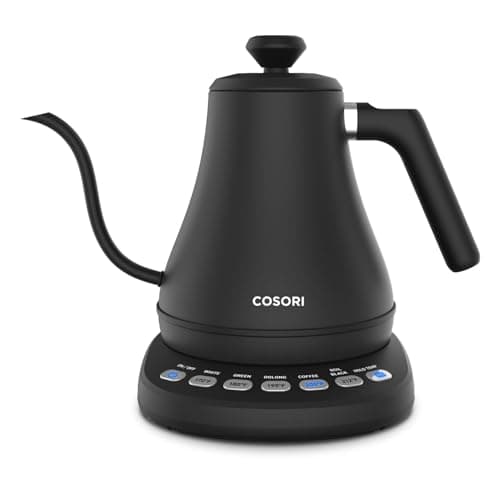 COSORI Original Electric Gooseneck Kettle (CO108-NK)Top pickFive presets that map to actual tea types, a 60-minute hold, and no plastic in the water path. This is the value pick and it is not close. | The sensible first variable-temperature kettle | 0.85 qt / 0.8 L | |
| 2 | 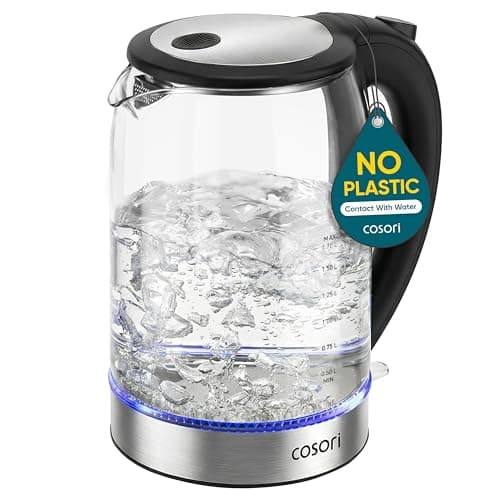 COSORI Electric Glass Tea Kettle, 1.7 LA borosilicate glass body from a maker that publishes two numbers about it and leaves the rest to the listing. | Seeing the water, at the cheapest price a documented maker charges | 1.7 L | |
| 3 | No image OXO Brew Adjustable Temperature Gooseneck KettleOne-degree control and a 1 L body. The hold window is half the Cosori's, which is the trade you are making. | Setting an exact temperature without the premium price | 1 liter | Check price#ad |
| 4 | 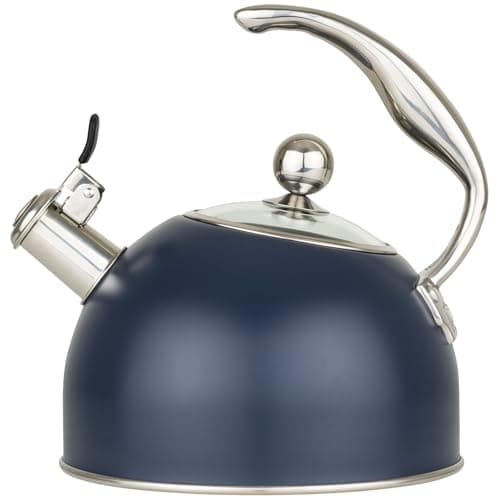 Viking 2.6-Quart Stainless Steel Whistling Kettle with 3-Ply BaseA clad-base stainless kettle that publishes more about itself than anything else in the category, including a Limited Lifetime Warranty nobody else on this site will commit to. | The only kettle here with a lifetime warranty | 2.6 quarts (2.5 liters) |
Top pick · The sensible first variable-temperature kettle
COSORI Original Electric Gooseneck Kettle (CO108-NK)
Five presets that map to actual tea types, a 60-minute hold, and no plastic in the water path. This is the value pick and it is not close.
Published specifications
- Capacity
- 0.85 qt / 0.8 LSource: COSORI — Original Electric Gooseneck Kettle (CO108-NK)
- Presets
- 170F white, 180F green, 195F oolong, 205F coffee, 212F blackSource: COSORI — Original Electric Gooseneck Kettle (CO108-NK)
- Hold
- Keeps water warm for up to 60 minutesSource: COSORI — Original Electric Gooseneck Kettle (CO108-NK)
- Power
- 1200 W (AC 120 V, 60 Hz)Source: COSORI — Original Electric Gooseneck Kettle (CO108-NK)
- Water contact
- 304 food-grade stainless steel kettle, lid and spoutSource: COSORI — Original Electric Gooseneck Kettle (CO108-NK)
- Warranty
- 2-year limitedSource: COSORI — Original Electric Gooseneck Kettle (CO108-NK)
What the numbers mean
The presets are the reason to recommend this to someone new. You do not have to know that sencha wants roughly 180F; you press the button that says green. That is one fewer thing to learn on week one.
Presets are also its limit. If you later want 165F for a delicate gyokuro, the button for it does not exist. Most people never get there, and the ones who do have already stopped being beginners.
It publishes 304 stainless for everything the water touches. That is the single spec worth checking on any cheap kettle, and plenty of them will not tell you.
Good for
- Presets named after teas, not temperatures
- 60-minute hold, longer than several kettles that cost more
- Stainless kettle, lid and spout published, not implied
Against it
- Preset steps only — no arbitrary target temperature
- 0.8 L is the smallest capacity here
- The gooseneck is slower to fill under a tap than a wide-mouth kettle
Skip it ifSkip it if you want to dial an exact number. Buy the OXO or the Stagg for that; this one gives you five good answers instead of infinite ones.
Pick 2 · Seeing the water, at the cheapest price a documented maker charges
COSORI Electric Glass Tea Kettle, 1.7 L
A borosilicate glass body from a maker that publishes two numbers about it and leaves the rest to the listing.
Published specifications
- Capacity
- 1.7 LSource: COSORI — Electric Glass Tea Kettle 1.7L
- Warranty
- 2-year limited warrantySource: COSORI — Electric Glass Tea Kettle 1.7L
- Water contact
- Not verifiedCOSORI's own page for this kettle makes no water-contact statement in its text. The phrases 'no plastic contact with water' and 'premium stainless steel and glass materials' appear only in the page's image alt text, which is marketing copy rather than a published specification. The Amazon listing title carries the same claim. We are not treating either as a spec.
- Body material
- Not verifiedBorosilicate glass per the retail listing title; COSORI's product page does not state the glass type in its text.
- Temperature control
- Not verifiedNone published. This is a boil-only kettle on every listing we read.
- Wattage
- Not verifiedNot published on COSORI's page for this model.
What the numbers mean
This is the glass kettle to point at when someone asks for one, and the reason is price rather than documentation. It is the cheapest glass body sold by a maker that publishes anything at all about its kettles, and COSORI does publish properly for its gooseneck — so the silence here is about this model, not about the company.
What you can verify is thin: a capacity and a warranty. The claim people actually buy this kettle for, that no plastic touches the water, appears on COSORI's own page only as alt text on a photograph. That is not nothing, and it is not a specification either.
COSORI's page also carries a California Proposition 65 notice stating the product can expose you to chemicals including lead. Prop 65 notices are posted broadly and on a very low threshold, so this is context rather than an alarm — but it is published, and a page about what touches your water should not quietly leave it out.
Good for
- The cheapest glass kettle here from a maker that documents its range
- You can see the fill level and the scale, which is the whole case for glass
- 2-year limited warranty, published
- Wide opening, which is what makes a glass body practical to descale
Against it
- COSORI publishes almost nothing about this model in text
- The no-plastic-contact claim lives in alt text and a listing title, not a spec
- No temperature control, so green and white tea need a thermometer
- A Prop 65 lead notice is published on the maker's own page
Skip it ifSkip it if green tea is the reason you are buying a kettle. This one boils and nothing else, and the gooseneck from the same maker publishes its water-contact materials properly for about twice the price.
image
Pick 3 · Setting an exact temperature without the premium price
OXO Brew Adjustable Temperature Gooseneck Kettle
One-degree control and a 1 L body. The hold window is half the Cosori's, which is the trade you are making.
#ad · how this is funded · price checked October 23, 2026
Published specifications
- Capacity
- 1 literSource: OXO — Adjustable Temperature Kettle
- Temperature range
- 104F-212F in one-degree incrementsSource: OXO — Adjustable Temperature Kettle
- Hold
- Held at the set temperature for up to 30 minutesSource: OXO — Adjustable Temperature Kettle
- Timer
- Built-in count-up timerSource: OXO — Adjustable Temperature Kettle
- Body
- BPA-free borosilicate glassSource: OXO — Adjustable Temperature Kettle
- Warranty
- 2 yearsSource: OXO — Adjustable Temperature Kettle
What the numbers mean
One-degree increments sound like overkill and mostly are. The honest case for them is that you can find your own number for a tea you drink constantly and then reproduce it exactly, which presets cannot do.
Thirty minutes of hold against the Cosori's sixty is the real difference between these two. If you brew, drink, and come back for a second cup twenty minutes later, both work. If your second cup is an hour later, only one does.
The built-in timer is aimed at pour-over coffee, but it is the same timer a three-minute steep needs, so it earns its place either way.
Good for
- Exact target temperature rather than fixed presets
- 1 L, a useful step up from the 0.8 L class
- The count-up timer removes one phone reach from every brew
Against it
- 30-minute hold, half what the Cosori offers
- Glass shows limescale sooner than steel hides it
- Glass body means more care when it is full and hot
Skip it ifSkip it if you have hard water and no patience for descaling. A glass body makes scale visible; a steel one lets you ignore it for longer.
Pick 4 · The only kettle here with a lifetime warranty
Viking 2.6-Quart Stainless Steel Whistling Kettle with 3-Ply Base
A clad-base stainless kettle that publishes more about itself than anything else in the category, including a Limited Lifetime Warranty nobody else on this site will commit to.
#ad · how this is funded · price checked October 23, 2026
Published specifications
- Capacity
- 2.6 quarts (2.5 liters)Source: Viking Culinary — 2.6-Quart Stainless Steel Whistling Kettle with 3-Ply Base
- Body and spout
- 304 stainless steel, with a surgical grade stainless interiorSource: Viking Culinary — 2.6-Quart Stainless Steel Whistling Kettle with 3-Ply Base
- Base
- 3-ply, with an aluminum core between two layers of stainlessAluminum conducts heat far better than steel, so a clad base spreads heat across the whole base instead of concentrating it over the burner.Source: Viking Culinary — 2.6-Quart Stainless Steel Whistling Kettle with 3-Ply Base
- Handle
- High-polished stainless steel, riveted to the pot, with a heat breakA heat break is a deliberate interruption in the metal path so less heat travels from body to handle.Source: Viking Culinary — 2.6-Quart Stainless Steel Whistling Kettle with 3-Ply Base
- Also included
- Removable quilted fabric heat sleeveSource: Viking Culinary — 2.6-Quart Stainless Steel Whistling Kettle with 3-Ply Base
- Lid
- Tempered glassSource: Viking Culinary — 2.6-Quart Stainless Steel Whistling Kettle with 3-Ply Base
- Whistle
- Melodic whistleSource: Viking Culinary — 2.6-Quart Stainless Steel Whistling Kettle with 3-Ply Base
- Cooktop compatibility
- Works on all stovetops, including inductionViking also lists gas, electric, halogen and ceramic.Source: Viking Culinary — 2.6-Quart Stainless Steel Whistling Kettle with 3-Ply Base
- Care
- Hand wash onlySource: Viking Culinary — 2.6-Quart Stainless Steel Whistling Kettle with 3-Ply Base
- Warranty
- Limited Lifetime WarrantySource: Viking Culinary — 2.6-Quart Stainless Steel Whistling Kettle with 3-Ply Base
- Dimensions and weight
- Not verifiedNot published on Viking's product page. At 2.6 quarts this is the largest kettle on the site, so check it against your hob and your cupboard.
What the numbers mean
The warranty is the specification that separates this from everything else we have written up. Caraway publishes no warranty at all and Chantal states a limited warranty without a duration. Viking publishes Limited Lifetime, which is a commitment rather than an adjective.
The 3-ply base is the real construction difference. Every other stovetop kettle on this site is a single layer of steel or enameled carbon steel, where heat enters wherever the burner touches. An aluminum core spreads it across the base first, which is the same reason clad pans exist.
At 2.6 quarts it is the largest kettle here by a clear margin, against 1.7 to 1.8 for the enameled ones. That is around ten cups from one boil and a genuinely slow way to make a single mug.
Good for
- Limited Lifetime Warranty, published - the only one on this site
- 3-ply clad base with an aluminum core, which no other kettle here has
- Handle heat break and a removable heat sleeve, both published
- Every cooktop named, induction included
- Tempered glass lid, so you can see the water
Against it
- Boiling only, like every stovetop kettle
- 2.6 quarts is a lot of water to heat for one mug
- Hand wash only, published
- A glass lid is a breakable part the all-metal kettles do not have
- No published dimensions or weight
Skip it ifSkip it if you brew a single mug at a time. Ten cups of capacity is the wrong shape for one person, and the enameled 1.7-quart kettles heat faster because there is less water in them.
The question people are really asking
Searches for this comparison almost always carry a second half: which is safer, which is healthier, which one is not leaching something into the water. So it is worth settling that first and then moving on to the things that genuinely differ.
304 stainless steel and borosilicate glass are both inert. Neither reacts with water at boiling temperature, neither holds flavors, and neither is the thing to worry about in a kettle. The part worth avoiding is plastic in the water path, and that is orthogonal to this comparison — plenty of glass kettles have a plastic lid, a plastic filter and a plastic spout collar, and plenty of steel ones do too. Choosing glass does not get you out of reading the specification.
So safety does not decide this. Two other things do, and they pull in opposite directions.
What actually separates them
| Borosilicate glass | 304 stainless steel | |
|---|---|---|
| Reactivity with water | None | None |
| Limescale | Fully visible, which is both the complaint and the reminder | Hidden until it flakes into the cup |
| Fill level | Visible without opening the lid | Window, gauge or guesswork |
| Thermal shock | Borosilicate tolerates it well; ordinary glass does not. Check which you are buying | Not a consideration |
| Impact | Breaks | Dents |
| Heat on the outside | Hot to touch across the body | Hot to touch across the body |
| Stovetop use | Almost never. Electric only unless the maker says otherwise in writing | Common, and the hob line is published more often |
| What makers publish | Frequently nothing beyond the word glass | Often a named alloy, which is a specification rather than a description |
The case for glass: you can see it
This sounds trivial and is not. A glass body tells you the fill level without opening the lid, which matters more than it should when you are boiling 500 ml rather than a full kettle to save two minutes. It also shows you the scale, and a kettle you can see inside is a kettle you descale roughly four times as often as one you cannot.
That visibility is usually filed as the drawback of glass — people complain that glass kettles look dirty. They look dirty because they are dirty. A steel kettle with the same hard water has the same deposit and simply hides it until a flake comes out in your tea.
The specification to check is borosilicate rather than ordinary glass. Borosilicate has boron oxide in it, which makes it far more tolerant of the thermal shock of cold water meeting a hot body. OXO publishes BPA-free borosilicate glass for its adjustable-temperature kettle. Most cheap glass kettles do not publish the glass type anywhere in their own text, which is the recurring problem on this side of the comparison.
The case for steel: the makers tell you more
This is the finding of the page, and it was not the one we expected. Across the kettles on this site, the steel ones publish substantially more about what the water touches than the glass ones do.
COSORI publishes 304 food-grade stainless for the kettle, lid and spout on its gooseneck — all three parts named separately, which is unusually explicit. Fellow publishes 304 18/8 stainless and states that the BPA-free plastic is confined to the handle and lid pull. Viking publishes 304 stainless with a surgical-grade stainless interior.
Now the glass side. COSORI's own page for its 1.7-liter glass kettle states a capacity and a two-year warranty and almost nothing else. The phrases buyers are looking for — no plastic contact with water, premium stainless steel and glass materials — appear on that page only as alt text attached to photographs. That is marketing copy, not a published specification, and we have marked the water-contact line on our entry for it unverified rather than quoting a slogan as a fact.
Limescale is the practical difference
Limescale is dissolved calcium and magnesium deposited as water boils. Every kettle in hard water gets it, at the same rate, regardless of material. It is a taste and efficiency problem rather than a safety one.
What the material changes is whether you notice. In glass you watch the film build and you descale it. In steel you forget for eight months and then find a sheet of it. If you live somewhere hard and you know you will not keep a descaling schedule, glass is quietly the better choice for exactly the reason people cite against it.
The counter-argument is real too: a glass kettle that looks scaled looks scaled on your counter, in front of guests, permanently, unless you stay on top of it. That is a preference, not a specification, and it is a legitimate reason to buy steel.
Can you put a glass kettle on the stove?
Almost never, and this is worth saying plainly because it is one of the more expensive mistakes available in this category. A glass electric kettle is designed for its own powered base and nothing else. Putting one on a gas burner or a radiant element does not heat it gently from below; it applies a sharp local heat to one spot of a vessel engineered for even heating through a concealed element.
Borosilicate helps and does not rescue you. What borosilicate resists is thermal shock — a rapid change in temperature across the whole body. A flame concentrated on one patch of glass is a different stress, and the handle, lid seal and base collar on an electric kettle are not built for a hob regardless of what the glass can take.
Stainless is the material if you want a kettle that can sit on a hob, and even then the specification to read is the hob compatibility line rather than the metal. A stovetop stainless kettle still needs a ferrous base to work on induction, and the 300-series alloys used for most kettle bodies are generally not magnetic.
How each one ages
Five years in, the two materials fail differently, and neither failure is dramatic.
Glass clouds. Repeated scale cycles and repeated descaling leave a faint etch that polishing does not remove, and it is most visible exactly where you look — the body you bought the kettle to see through. Nothing about the water changes. The object simply stops being the clear thing it was, which matters because clarity was the reason you chose it.
Stainless scratches and dulls on the outside, and on the inside it does the thing glass cannot: it hides what is happening. A steel kettle descaled twice a year and a steel kettle never descaled look identical from above. The difference shows up as flakes in a cup, usually months after the point at which you should have dealt with it.
Both outlive the electronics in an electric kettle, which is the honest timeline for this decision. The element, the thermostat and the switch are what fail first, in either body.
Which one for which buyer
| If this is you | Buy | Best for |
|---|---|---|
| You drink green or white tea and want it documented | COSORI Original Gooseneck (steel) | The only kettle here that publishes an alloy for all three water-contact parts |
| You want glass and you want it cheap | COSORI Electric Glass Tea Kettle, 1.7 L | The cheapest glass body from a maker that documents the rest of its range |
| You want glass and you want the spec sheet | OXO Brew Adjustable Temperature | Published BPA-free borosilicate, 104-212F, 30-minute hold |
| You want steel with no electronics at all | Viking 2.6-quart | Published 304 body with a surgical-grade interior, and a lifetime warranty |
Three things that are not reasons to pick either
Taste. Neither material imparts one. If your water tastes of something, the cause is the plastic parts, the scale or the water itself, in roughly that order of likelihood.
Boil speed. The element does the work, not the body. A 1500 W glass kettle and a 1500 W steel kettle holding the same volume are the same kettle for this purpose.
Heat retention. Neither keeps water hot for meaningfully long and neither is trying to. If you want water held at a temperature, that is a hold mode on an electric kettle or a water boiler, and it is a different purchase.
How we judged this
By reading what each maker publishes about its own kettle and recording the URL every figure came from. Where a maker publishes a claim only in image alt text or only in a retail listing title, we have said so rather than promoting it to a specification. That distinction is the whole reason the glass side of this comparison came out the way it did.
What we did not do
We have not boiled water in any of these kettles, measured scale accumulation, or tested a glass body to destruction. There is no test kitchen here. Everything above is published specification plus reasoning about what those materials do, and every source is listed below.
Questions
Is a glass or stainless steel kettle better?
Stainless steel for most buyers, because the makers publish more about what the water touches. Glass if you want to see the fill level and the limescale — which is a real advantage, since a kettle you can see inside is one you actually descale.
Are glass kettles safer than stainless steel?
No, and neither is unsafe. Borosilicate glass and 304 stainless are both inert and neither reacts with water. The part worth checking is whether plastic touches the water, and that varies by model rather than by material.
Are glass electric kettles safe to use?
Yes, provided the glass is borosilicate, which tolerates the thermal shock of cold water meeting a hot body. Ordinary glass does not, so check the glass type before buying. Glass breaks where steel dents, which is the practical risk rather than a chemical one.
Why does my glass kettle look dirty inside?
That is limescale, and your steel kettle has the same amount. Glass simply shows it. Descale with dilute vinegar or citric acid when you can see or taste it.
Can you put a glass kettle on the stove?
Almost never. Glass electric kettles are for their own base and nothing else. A handful of borosilicate pots are rated for a hob and they say so explicitly in writing — assume no unless the maker states otherwise.
Sources
Every figure on this page came from one of these, retrieved during the research pass for this article. Where a maker publishes nothing we could verify, the page says so instead of substituting a number.
Read next
- The safest tea kettle materialsStainless, glass and enamel are all inert. What separates kettles is whether the maker publishes what the water touches.
- The best electric tea kettlesElectric kettles ranked on the specification that actually matters: how long they hold the temperature they reached.
- Why does my kettle taste like plastic?A diagnostic: whether the plastic taste will fade, how to clear it, and which kettles publish a water path that cannot produce it.
- The best tea kettles for hard waterLimescale is decided by your water, not your kettle. What a kettle can change is visibility and access - and a gooseneck makes both worse.
- How to choose a tea kettleThe five questions that eliminate kettles fastest, in order, each ending in a named pick rather than a category.
- The best glass teapotsThree glass teapots, and the single specification that separates a long-lived one from a cracked one.