Infusers, Steepers & Strainers · Best strainer
The best tea strainers
A strainer gives leaves the whole vessel to move in, which is the best extraction available. The catch is finding one whose mesh is fine enough.

We earn a commission if you buy through the links on this page, at no extra cost to you. It does not change which products we name or what we say about them — how this is funded.
Buy the FORLIFE Extra-fine Tea Infuser and Dish Set. It is the only pick on this page whose maker publishes a mesh gauge - 0.3 mm - and it ships with a ceramic rest dish, which solves the problem every strainer creates the moment the steep ends. That combination of a published number and somewhere to put the wet thing is rarer than it should be.
| # | Product | Best for | Mesh | Price |
|---|---|---|---|---|
| 1 | 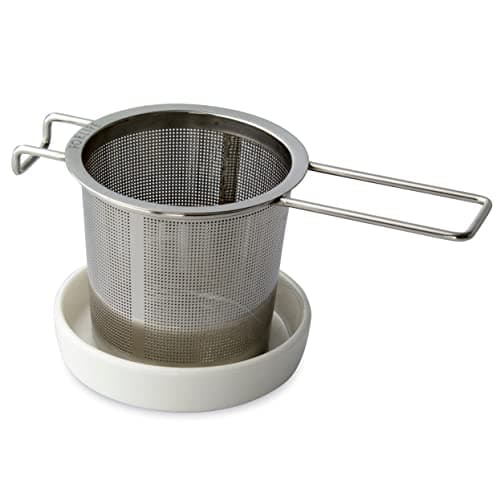 FORLIFE Extra-fine Tea Infuser & Dish SetTop pickA 0.3 mm extra-fine stainless basket with a ceramic rest dish in the same box. The published mesh gauge is rare in this category and the dish solves the problem every strainer creates. | The strainer that comes with somewhere to put it | Extra-fine 0.3 mm holes | |
| 2 | No image OXO Good Grips Double Handle Tea StrainerThe tool for the oldest method there is: leaves loose in the water, strainer over the cup. No infuser can beat it on flavor. | Brewing loose in the pot and straining on the way out | not verified | Check price#ad |
| 3 | No image finum TEA CONTROL 0.8A 0.8 liter brewer with a patented insert that halts extraction on a twist. It answers the same problem a strainer does, from the other direction. | Stopping the steep without lifting anything out | 0.8 liters (28 oz) | Check price#ad |
| 4 | 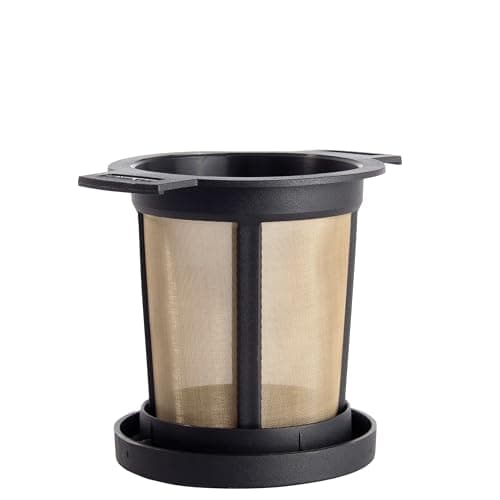 finum Brewing BasketA tall stainless mesh basket with a lid that flips over into a drip tray. Ten dollars, and it makes better tea than most infusers costing five times more. | The first thing to buy, full stop | Stainless-steel micro-mesh |
Top pick · The strainer that comes with somewhere to put it
FORLIFE Extra-fine Tea Infuser & Dish Set
A 0.3 mm extra-fine stainless basket with a ceramic rest dish in the same box. The published mesh gauge is rare in this category and the dish solves the problem every strainer creates.
#ad · how this is funded · price checked October 21, 2026
Published specifications
- Mesh
- Extra-fine 0.3 mm holesSource: FORLIFE Design — Extra-fine Tea Infuser & Dish Set
- Infuser material
- Stainless steel, dishwasher safeSource: FORLIFE Design — Extra-fine Tea Infuser & Dish Set
- Dish material
- Lead-free high-fired ceramic, dishwasher safe and microwavableSource: FORLIFE Design — Extra-fine Tea Infuser & Dish Set
- Fit
- Designed to fit a variety of teacups and teapotsFORLIFE does not publish a diameter range, so measure your mug before buying.Source: FORLIFE Design — Extra-fine Tea Infuser & Dish Set
- Care
- Baking soda dissolved in warm water for tea stainsSource: FORLIFE Design — Extra-fine Tea Infuser & Dish Set
What the numbers mean
0.3 mm is the number to look for and almost nobody publishes it. At that gauge rooibos, broken-leaf blends and fine-cut botanicals stay in the basket instead of settling as silt in the bottom of the cup.
The ceramic dish looks like packaging filler and is the most useful part of the set. Every strainer creates the same problem the moment the steep ends: you are holding a dripping metal object in a kitchen with nowhere to put it.
FORLIFE describes the fit as a variety of teacups and teapots without publishing a diameter range, which is the one gap here. Measure the inside rim of the mug you actually use.
Good for
- Published 0.3 mm mesh gauge, which is unusual in this category
- Comes with its own rest dish rather than needing a saucer
- Both pieces published as dishwasher safe
- Works in a mug or over a cup, so it suits either method
Against it
- No published diameter range, so fit is on you to check
- Ceramic dish is one more thing to break
- Extra-fine mesh clogs sooner than a coarse one and needs rinsing while wet
Skip it ifSkip it if your teapot already has a wide built-in basket. You would be buying a second solution to a problem the pot already solves.
image
Pick 2 · Brewing loose in the pot and straining on the way out
OXO Good Grips Double Handle Tea Strainer
The tool for the oldest method there is: leaves loose in the water, strainer over the cup. No infuser can beat it on flavor.
#ad · how this is funded · price checked October 21, 2026
Published specifications
- Mesh
- Not verifiedNot verified from OXO's own documentation.
- Fit
- Not verifiedThe two handles rest on a cup rim; we have not verified a published diameter range.
What the numbers mean
Brewing loose and straining gives leaves the entire vessel to move in, which is why every tea shop that cares does it this way and no infuser quite matches it.
The two handles are the whole point of this format: they sit on the rim so you have a free hand for the pot.
It is the strainer, not the infuser, that a beginner should own if they already have a teapot without a filter.
Good for
- Full-immersion brewing with nothing constraining the leaves
- Rests on the cup, leaving a hand free
- Works with any pot
Against it
- Adds a step and a thing to wash
- No verified mesh specification
- Fine-cut tea can still pass a coarse strainer
Skip it ifSkip it if your teapot already has a built-in filter basket. You would be buying a second solution to a solved problem.
image
Pick 3 · Stopping the steep without lifting anything out
finum TEA CONTROL 0.8
A 0.8 liter brewer with a patented insert that halts extraction on a twist. It answers the same problem a strainer does, from the other direction.
#ad · how this is funded · price checked October 21, 2026
Published specifications
- Capacity
- 0.8 liters (28 oz)Source: finum — TEA CONTROL 0.8
- Brew control
- Patented brew-control filter, made in GermanySource: finum — TEA CONTROL 0.8
- Materials
- Heat-resistant borosilicate glass with BPA-free Tritan copolyesterSource: finum — TEA CONTROL 0.8
- Care
- Dishwasher safeSource: finum — TEA CONTROL 0.8
- In the box
- One brewer per pack with a multilingual instruction manualSource: finum — TEA CONTROL 0.8
What the numbers mean
The insert is the entire product. Leaves brew loose in the full volume of water, and when the tea is ready you stop the extraction in place rather than fishing a hot basket out and finding somewhere to rest it.
0.8 liters is about three mugs, which puts it between a single-serve infuser and a table teapot. That is a useful size and an awkward one: too much for one cup, not enough for four people.
Borosilicate glass and Tritan are both inert and both published, which is more than most brewers in this price band will tell you.
Good for
- Extraction stops on demand, with nothing to lift out
- Leaves brew loose in the full volume rather than packed in a basket
- Materials published and dishwasher safe
- Made-in-Germany brew mechanism, published as patented
Against it
- 0.8 liters is an in-between size
- More parts to clean than a plain basket
- Costs several times what a mesh strainer does
- Glass, so it will not survive being dropped
Skip it ifSkip it if you brew one mug at a time. A ten-dollar basket in your own mug does the same job at a tenth the price and a fraction of the washing up.
Pick 4 · The first thing to buy, full stop
finum Brewing Basket
A tall stainless mesh basket with a lid that flips over into a drip tray. Ten dollars, and it makes better tea than most infusers costing five times more.
#ad · how this is funded · price checked October 21, 2026
Published specifications
- Filter
- Stainless-steel micro-meshSource: finum — Brewing Basket M
- Frame
- Heat-tolerant, BPA-freeSource: finum — Brewing Basket M
- Cleaning
- Dishwasher safeSource: finum — Brewing Basket M
- Made in
- GermanySource: finum — Brewing Basket M
- In the box
- One basket with a lid that doubles as a drip-off traySource: finum — Brewing Basket M
What the numbers mean
The reason a basket beats a ball is volume. Tea leaves triple in size as they hydrate, and a basket gives them room to do it while a ball crushes them into a pellet that only wets on the outside.
Micro-mesh matters for the fine stuff. Rooibos and broken-leaf teas go straight through a coarse strainer and end up as silt in the bottom of the cup.
The lid-becomes-a-drip-tray detail sounds like marketing until you have carried a dripping infuser across a kitchen once.
Good for
- Enough room for leaves to actually open
- Micro-mesh holds fine-cut and broken leaf
- Dishwasher safe, so cleaning is not a ritual
Against it
- Sized to a mug opening — measure yours before buying
- Mesh eventually stains, which is cosmetic
- Nothing about it is beautiful
Skip it ifSkip it only if your mug is narrower than the basket. Measure the opening; the medium and large sizes fit different mugs and the wrong one perches uselessly on the rim.
Who this is for
Anyone who owns a teapot without a built-in filter, or who wants the best extraction a mug can give. If your teapot already has a wide basket, you do not need any of this and the teapot pages are the better read.
Why a strainer beats an infuser on flavor
An infuser holds the leaves in a container inside the water. A strainer holds nothing during the brew - the leaves go loose into the pot or the mug, and the strainer catches them on the way out.
That difference matters because dry tea expands to roughly three times its volume as it hydrates, and it extracts most evenly when water can move through the whole mass rather than around a packed clump. Loose in a vessel, nothing constrains it. This is how tea has been made for most of its history and no infuser quite matches it.
The cost is a second object and a second rinse. That is the entire trade, and for a lot of people it is the reason they use a basket instead - which is a perfectly reasonable choice, not a compromise.
The criterion nobody publishes
Mesh gauge decides whether a strainer works. Coarse mesh is fine for big whole-leaf tea and useless for rooibos, broken-leaf blends and fine-cut botanicals, which go straight through and settle as silt in the bottom of the cup.
Across this entire category we could verify a published figure for exactly one product. FORLIFE states 0.3 mm holes. finum publishes stainless-steel micro-mesh for its basket and a patented brew-control filter for the Tea Control, both without a number. OXO publishes nothing about mesh at all.
| Pick | Filter description | Gauge published? |
|---|---|---|
| FORLIFE Extra-fine Infuser & Dish Set | Extra-fine 0.3 mm holes | Yes |
| OXO Good Grips Double Handle Strainer | Nothing published | No |
| finum TEA CONTROL 0.8 | Patented brew-control filter, made in Germany | No |
| finum Brewing Basket | Stainless-steel micro-mesh | No |
That table is the most useful thing on this page, and it is why the ranking looks the way it does. When only one maker will tell you the number that decides the product, the one that tells you goes first.
Three formats, three different problems solved
The in-cup strainer with a rest dish
FORLIFE's set is a large stainless basket that sits in a mug or over a cup, plus a lead-free high-fired ceramic dish to park it on. Both pieces are published as dishwasher safe and the dish is published as microwavable.
The dish sounds like packaging filler until you have carried a dripping strainer across a kitchen once. FORLIFE does not publish a diameter range - it says only that it fits a variety of teacups and teapots - so measure the inside rim of your mug before ordering.
The double-handle strainer
OXO's rests its two handles on the cup rim, which leaves you a free hand for the pot. That is the classic pour-through format and it is the right shape if you brew loose in a teapot and strain into cups.
OXO publishes nothing about the mesh or the fit, which is the reason it is second rather than first. It is a well-made object from a company with a good record; it simply will not tell you the one thing you need to know before pouring rooibos through it.
The brewer that removes the need for a strainer
finum's TEA CONTROL 0.8 is a different answer to the same question. Leaves brew loose in the full 0.8 liters, and a patented insert stops the extraction on demand - so nothing has to be lifted out and nothing needs a rest dish.
finum publishes heat-resistant borosilicate glass with BPA-free Tritan copolyester, dishwasher safe, with the brew mechanism made in Germany. It costs several times what a mesh strainer does, and 0.8 liters is an in-between size: more than one mug, less than a table.
Fit is where the complaints come from
Almost every one-star review in this category is a measurement problem wearing a quality complaint. Strainers either perch uselessly on a rim that is too wide or bottom out in a mug that is too shallow.
- Measure the inside diameter of your mug or cup at the rim.
- Measure the depth, because a strainer that touches the bottom cannot be lifted out cleanly.
- If you strain from a teapot into cups, measure the cup rim rather than the pot.
- When you own several mugs, size for the smallest one.
Cleaning, briefly
Rinse while wet and it takes five seconds; let it dry and it takes a soak. FORLIFE publishes both pieces as dishwasher safe and recommends baking soda dissolved in warm water for tea stains, which is the correct treatment - the brown discoloration on used mesh is polyphenol residue and it is cosmetic.
Finer mesh clogs sooner than coarse mesh, which is the price of the 0.3 mm gauge. There is a full page on unclogging a mesh if one has got away from you.
How we picked
Published mesh gauge first, because it is the specification that decides the product and almost nobody states it. Then format against the way you actually brew, then published materials, then cleaning. Where a maker publishes nothing, the product card says so rather than borrowing a figure from a retail listing. Our full method is on the how we pick page.
What we did not do
We have not strained anything. No side-by-side test of what passes through which mesh, no timing, no measurement of any kind, because that would require owning these and we do not. What is here is published specification plus reasoning about leaf expansion and water flow, and you can check every figure against the sources below.
Questions
What is the best tea strainer for loose-leaf tea?
The FORLIFE Extra-fine Tea Infuser and Dish Set. It is the only one whose maker publishes a mesh gauge - 0.3 mm extra-fine holes - and it includes a ceramic rest dish for the wet strainer.
Is a tea strainer better than an infuser?
Better for flavor, because the leaves brew loose in the whole vessel with nothing constraining them. Worse for convenience, because it is a second object to wash. Neither is a compromise; they suit different setups.
What mesh size do I need in a tea strainer?
Fine mesh if you drink rooibos, broken-leaf blends or anything finely cut, because coarse mesh lets those through as silt. FORLIFE publishes 0.3 mm; most makers publish no figure at all.
Are tea strainer balls and spoons any good?
No, and for a structural reason. They are too small to hold a full dose while letting leaves expand to three times their dry volume, so extraction is uneven - thin from the middle, bitter from the outside.
Sources
Every figure on this page came from one of these, retrieved during the research pass for this article. Where a maker publishes nothing we could verify, the page says so instead of substituting a number.
Read next
- The best tea infusersFour infusers, one of which we tell you not to buy. The format matters more than the brand.
- How to brew loose-leaf tea without an infuserFour no-equipment methods, honestly ranked, and the ten-dollar object that beats all of them.
- How to clean a tea infuserFive-second daily cleaning, the soak that clears a clogged mesh, and what the brown stain actually is.
- The best teapots with infusersBuilt-in infusers ranked by basket geometry, which is the only thing that separates a good one from a bad one.
- Basket vs ball infuserA ball cannot hold enough leaf and give it room to expand at the same time. That is the whole comparison.
- Tea infuser vs tea strainerAn infuser contains the leaves while they brew; a strainer catches them on the way out. The strainer makes marginally better tea and one more thing to wash.