Teapots & Brewing Vessels · Best teapot with infuser
The best teapots with infusers
Built-in is only an advantage when the basket is the width of the pot. Narrow ones are worse than no filter at all.
We earn a commission if you buy through the links on this page, at no extra cost to you. It does not change which products we name or what we say about them — how this is funded.
Buy the HARIO ChaCha Kyusu Maru. Hario builds it around a large stainless strainer that spans most of the pot, so the leaves open across the full diameter instead of packing into a column. That geometry is the whole reason to buy a pot with a built-in filter rather than a plain pot and a separate strainer.
| # | Product | Best for | Filter type | Price |
|---|---|---|---|---|
| 1 | 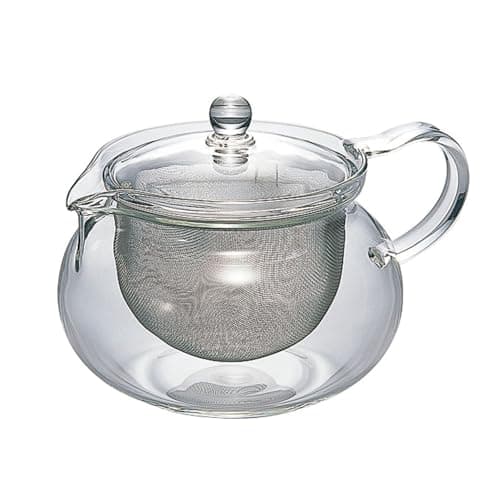 HARIO ChaCha Kyusu Maru Tea PotTop pickBorosilicate glass with a full-width stainless basket, in three sizes. The clearest published spec sheet of any teapot here. | Watching the leaves, which is most of the appeal | 300 ml, 450 ml and 700 ml (practical capacity) | |
| 2 | No image Primula Cast Iron Teapot with Enameled InteriorEnameled inside, so it does not rust and does not season. Holds heat for about an hour, which no glass pot approaches. | Keeping a pot hot through a long afternoon | 34 oz | Check price#ad |
| 3 | 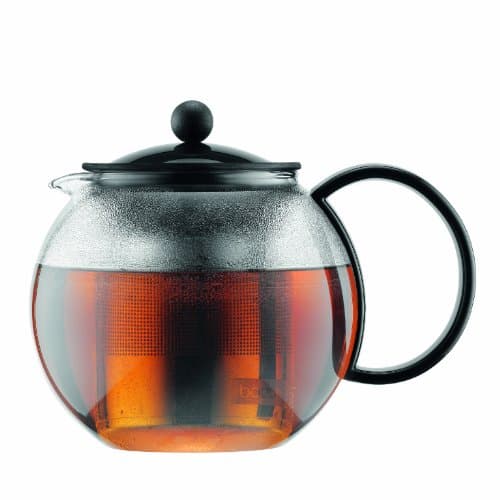 Bodum Assam Glass Tea PressA press, not just a pot. Plunging drops the leaves below the filter and ends the extraction, which is the problem every teapot has. | Stopping the brew at the right moment | 34 oz | |
| 4 | No image Sweese Glass Teapot with InfuserThe cheap end of the glass-and-basket format. Works, and the money you save buys a lot of tea. | A first teapot on a budget | not verified | Check price#ad |
Top pick · Watching the leaves, which is most of the appeal
HARIO ChaCha Kyusu Maru Tea Pot
Borosilicate glass with a full-width stainless basket, in three sizes. The clearest published spec sheet of any teapot here.
Published specifications
- Capacities
- 300 ml, 450 ml and 700 ml (practical capacity)Source: HARIO USA — ChaCha Kyusu Maru Tea Pot
- Materials
- Heatproof borosilicate glass pot and lid; stainless steel strainerSource: HARIO USA — ChaCha Kyusu Maru Tea Pot
- Care
- Safe for hot water, microwave and dishwasher; remove the strainer before microwavingSource: HARIO USA — ChaCha Kyusu Maru Tea Pot
- Not safe for
- Oven, induction hob or open flameSource: HARIO USA — ChaCha Kyusu Maru Tea Pot
- Made in
- Japan (glass and lid); strainer made in ChinaSource: HARIO USA — ChaCha Kyusu Maru Tea Pot
What the numbers mean
The large strainer is the functional argument. A wide basket lets the leaves open across the whole pot rather than packing into a tube, which is the single biggest difference between teapots at this price.
The explicit not-for-stovetop line is the reason we point at this one. Glass teapots get put on hobs and crack, and Hario states plainly that this is not a stovetop object.
Three capacities matter more than they sound. 300 ml is one generous mug; 700 ml is a pot for two or three people. Buying the wrong one is the most common teapot regret.
Good for
- Wide strainer that lets leaves expand
- Microwave and dishwasher safe, both published
- Three sizes, so you can match your actual household
Against it
- Glass loses heat faster than ceramic or cast iron
- Not for the hob, the oven or a flame
- Glass shows tea staining if you leave it wet
Skip it ifSkip it if you want the pot to stay hot for a second and third cup. Glass is the worst insulator here; cast iron is the best.
image
Pick 2 · Keeping a pot hot through a long afternoon
Primula Cast Iron Teapot with Enameled Interior
Enameled inside, so it does not rust and does not season. Holds heat for about an hour, which no glass pot approaches.
#ad · how this is funded · price checked October 16, 2026
Published specifications
- Capacity
- 34 ozSource: Primula — Floral 34 oz. Cast Iron Teapot
- Interior
- Fully enameledEnamel is why it needs no seasoning and will not rust — but also why it never develops the patina a bare tetsubin does.Source: Primula — Floral 34 oz. Cast Iron Teapot
- Infuser
- Removable mesh infuser includedSource: Primula — Floral 34 oz. Cast Iron Teapot
- Heat retention
- Keeps tea hot for up to an hourSource: Primula — Floral 34 oz. Cast Iron Teapot
- Stovetop use
- Not verifiedEnameled cast iron teapots are generally not stovetop vessels; Primula states this explicitly on some models. Boil water separately and check your own model's insert.
What the numbers mean
The enamel lining is the spec that decides everything about ownership. Bare cast iron tetsubin must be dried immediately and seasoned or it rusts. Enameled ones are just pots.
An hour of heat retention is the practical case for cast iron and it is real. If your tea habit is a pot on a table over an afternoon, nothing else here comes close.
It is a brewing vessel, not a kettle. Boil water in something else. Putting an enameled teapot on a hob is the classic way to destroy one.
Good for
- Holds heat for around an hour
- Enameled, so no seasoning and no rust
- Infuser included rather than sold separately
Against it
- Heavy, and heavier still when full
- Not a stovetop vessel
- The enamel chips if it is knocked
Skip it ifSkip it if you want to watch the leaves. Cast iron is opaque, and half the appeal of loose leaf for a beginner is seeing it open.
Pick 3 · Stopping the brew at the right moment
Bodum Assam Glass Tea Press
A press, not just a pot. Plunging drops the leaves below the filter and ends the extraction, which is the problem every teapot has.
Published specifications
- Capacity
- 34 ozSource: Target — Bodum 34oz Assam Tea Press listing
- Body
- Borosilicate glassSource: Target — Bodum 34oz Assam Tea Press listing
- Filter
- Stainless steel basketSource: Target — Bodum 34oz Assam Tea Press listing
- Care
- Dishwasher safeSource: Target — Bodum 34oz Assam Tea Press listing
What the numbers mean
The plunger is the design answer to over-steeping. In an ordinary teapot the leaves keep working while the pot sits on the table, and cup three is bitter. Here you plunge at three minutes and cup three tastes like cup one.
It is a tea press, not a coffee press, and the filter reflects that — but the same object will make coffee badly if you ask it to, which is worth knowing if counter space is tight.
34 oz is a table pot. For one person it is oversized, and a half-full press cools quickly.
Good for
- Extraction stops when you decide it does
- Genuinely dishwasher safe, unusual at this price
- Serves three or four without a refill
Against it
- Glass, so it cools fast and breaks if dropped
- Plunger mechanism is another thing to clean
- Too big for a single drinker
Skip it ifSkip it if you brew one mug at a time. A 34 oz press half-filled is a worse cup than a 300 ml pot filled.
image
Pick 4 · A first teapot on a budget
Sweese Glass Teapot with Infuser
The cheap end of the glass-and-basket format. Works, and the money you save buys a lot of tea.
#ad · how this is funded · price checked October 16, 2026
Published specifications
- Capacity
- Not verifiedSold in several sizes; we have not verified a figure from the maker.
- Stovetop safety
- Not verifiedSome Sweese pots are sold as stovetop safe and some are not. This is the one spec you must read on the listing itself — a glass pot on the wrong hob cracks.
What the numbers mean
The format is proven; this is just an inexpensive execution of it. Glass body, stainless basket, lid.
The stovetop question is the one that actually matters and it varies by model, which is why we flag it rather than answer it. Never assume a glass teapot can go on a hob.
We have not verified published specifications from the maker, so this is a budget category recommendation rather than a model endorsement.
Good for
- The cheapest way into the glass-and-basket format
- Basket infuser rather than a narrow tube
- Widely available
Against it
- No verified published specifications
- Stovetop safety varies by model
- Thin glass cools quickly
Skip it ifSkip it if you want the version with a published spec sheet. The Hario ChaCha tells you exactly what it is and what it is not for.
Wide basket or narrow tube
There are two shapes of built-in infuser and they are not close in quality.
A wide basket sits in the mouth of the pot and is nearly as broad as the pot itself. Leaves spread out and water circulates through the whole mass. This is what you want, and it is what Hario's large strainer provides.
A narrow tube hangs down from the lid like a test tube. It holds very little, it packs whatever it holds, and water flows around it. It is the tea-ball problem transplanted into a teapot, and it is common on inexpensive ceramic pots.
| Signal in the listing | What it suggests |
|---|---|
| Photos showing the basket removed | Usually a wide basket — makers show off good ones |
| A published strainer material | The maker considers it a feature, not a filler |
| Basket described as large or full-width | Wide basket |
| A slim cylinder hanging from the lid in photos | Narrow tube — avoid |
| No photo of the filter at all | Assume the worst and read the reviews |
Built-in versus separate
A built-in basket is one object, so there is less to wash, less to lose and less to buy. It also removes the sizing problem — the basket definitionally fits.
A separate strainer is better for flavor when it is used the traditional way, with the leaves entirely loose in the pot and the strainer catching them on the way out. Nothing constrains the leaf at all. The cost is a second object and a second rinse.
For most people the built-in wins on convenience by enough that the small flavor difference is not worth arguing about. If you already own a plain pot, buy the strainer and keep the pot.
The press variant
The Bodum Assam belongs in this category with an asterisk: its filter moves. Plunging drops the leaves below the mesh and stops the extraction, which is the one problem no static built-in basket solves — leaves keep working while the pot sits.
The listing publishes 34 oz, a borosilicate body and a stainless filter, and lists it as dishwasher safe. If the pot spends time on a table between cups, that mechanism matters more than basket width.
Removability, and why it is not optional
The basket must come out. If it does not, you cannot remove the leaves when the steep is done, and every cup after the first gets more astringent. Primula publishes a removable mesh infuser for its cast iron pot; Hario's strainer lifts out and must be removed before the pot goes in a microwave.
A fixed built-in filter is a design failure, not a simplification. Check that it lifts out before you buy.
How we picked
Basket geometry first, removability second, published materials third, capacity fourth. Where a maker publishes nothing about the filter, the pick ranks below those that do. The method is on how we pick.
What we did not do
We have not brewed in these pots or compared extraction between basket shapes in any measured way. The geometry argument is reasoning from leaf expansion and water flow, and you can check it against the published strainer descriptions cited below.
Questions
Are teapots with built-in infusers good?
Good if the basket is wide — nearly the width of the pot — so leaves can expand. Narrow tube filters hanging from the lid have the same problem as a tea ball and are worse than no filter at all.
Built-in infuser or separate strainer?
Built-in for convenience and guaranteed fit. A separate strainer gives slightly better extraction because the leaves are entirely loose in the pot, at the cost of a second object to wash.
Does the infuser basket need to be removable?
Yes. If you cannot lift the leaves out when the steep finishes, every cup after the first gets more astringent. A fixed filter is a design failure.
What is the difference between a tea press and a teapot with an infuser?
A press moves its filter. Plunging drops the leaves below the mesh and stops extraction, which a static basket cannot do while the pot sits on a table.
Sources
Every figure on this page came from one of these, retrieved during the research pass for this article. Where a maker publishes nothing we could verify, the page says so instead of substituting a number.
Read next
- The best teapots for loose-leaf teaFour teapots covering glass, press and cast iron, chosen on published capacity, materials and safety limits.
- The best glass teapotsThree glass teapots, and the single specification that separates a long-lived one from a cracked one.
- The best tea infusersFour infusers, one of which we tell you not to buy. The format matters more than the brand.
- Teapot materials comparedFive teapot materials on heat retention, flavor neutrality and how much upkeep each one demands.
- How to clean a tea infuserFive-second daily cleaning, the soak that clears a clogged mesh, and what the brown stain actually is.
- HARIO ChaCha Kyusu Maru reviewBorosilicate glass, a full-width stainless strainer and three published practical capacities — plus a published list of what it cannot do.