Infusers, Steepers & Strainers
Tea infuser vs tea strainer
The difference is when the leaves are separated from the water, and that decides how much room they get to open.
We earn a commission if you buy through the links on this page, at no extra cost to you. It does not change which products we name or what we say about them — how this is funded.
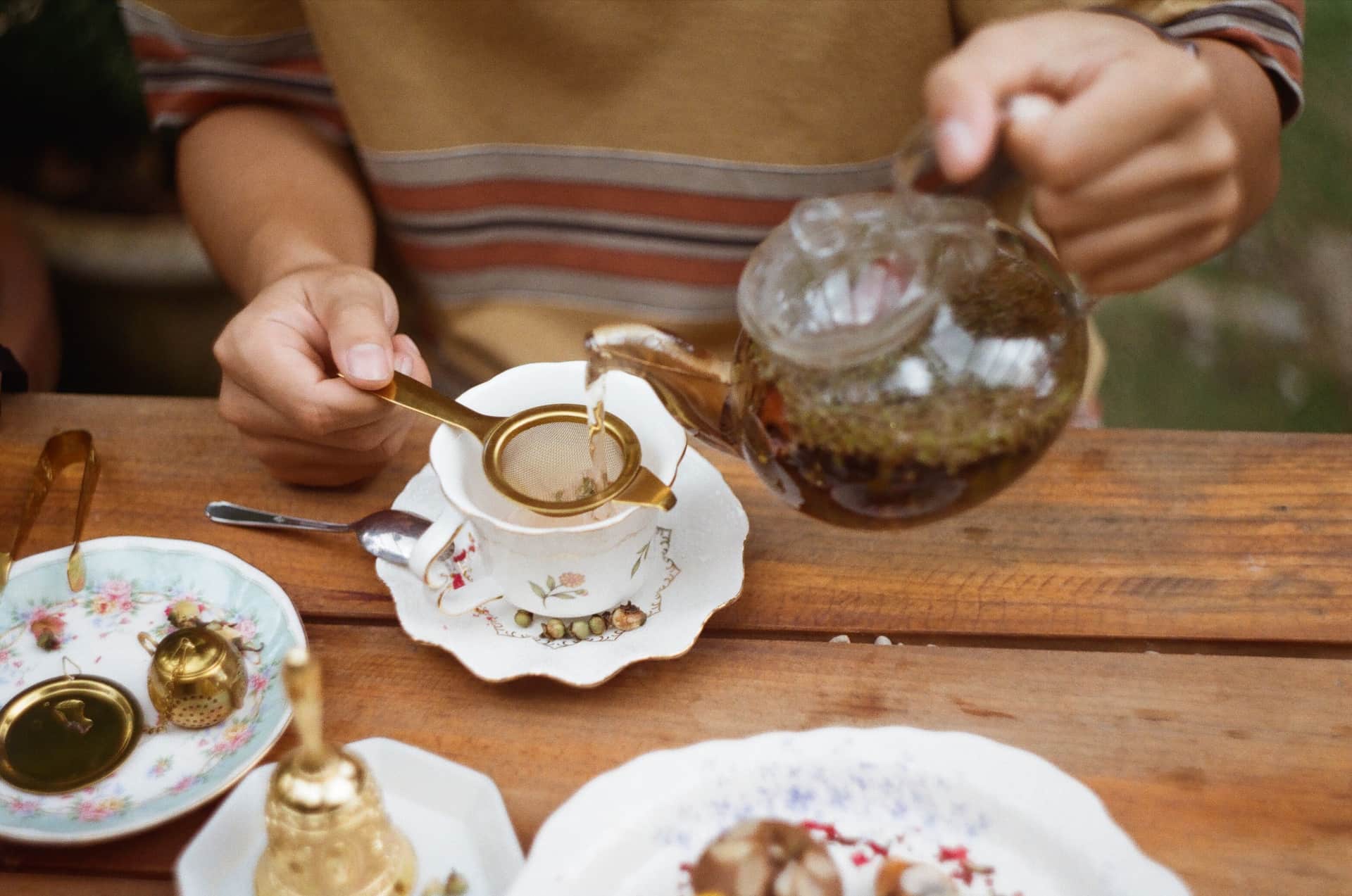
An infuser is a container the leaves sit inside while they brew. A strainer is a mesh you pour through after brewing, so the leaves were loose in the water the whole time. Both end with leaves out of your cup. The difference in the cup is small and real: leaves loose in the full volume of water extract better than leaves packed into a basket, because they have room to unfurl.
| # | Product | Best for | Where the leaves go | Price |
|---|---|---|---|---|
| 1 | 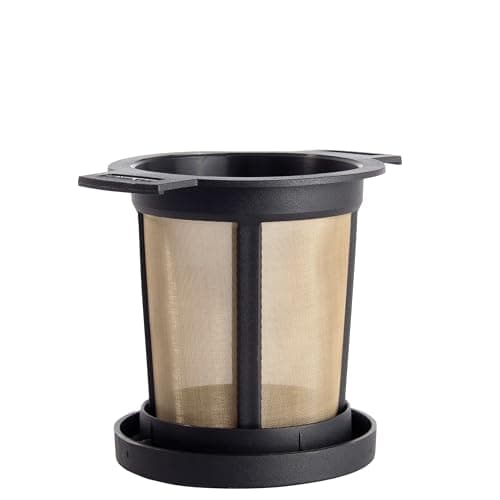 finum Brewing BasketTop pickA tall stainless mesh basket with a lid that flips over into a drip tray. Ten dollars, and it makes better tea than most infusers costing five times more. | The first thing to buy, full stop | Stainless-steel micro-mesh | |
| 2 | 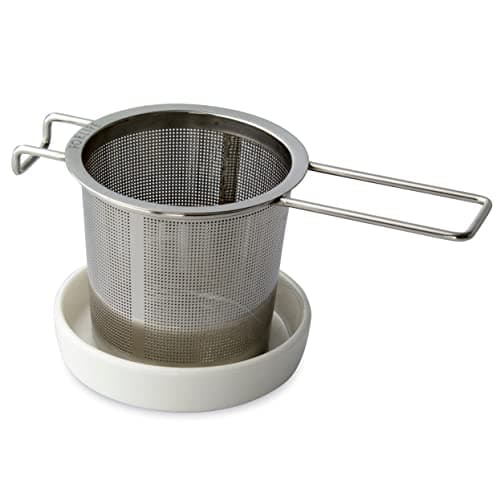 FORLIFE Extra-fine Tea Infuser & Dish SetA 0.3 mm extra-fine stainless basket with a ceramic rest dish in the same box. The published mesh gauge is rare in this category and the dish solves the problem every strainer creates. | The strainer that comes with somewhere to put it | Extra-fine 0.3 mm holes | |
| 3 | No image OXO Good Grips Double Handle Tea StrainerThe tool for the oldest method there is: leaves loose in the water, strainer over the cup. No infuser can beat it on flavor. | Brewing loose in the pot and straining on the way out | not verified | Check price#ad |
Top pick · The first thing to buy, full stop
finum Brewing Basket
A tall stainless mesh basket with a lid that flips over into a drip tray. Ten dollars, and it makes better tea than most infusers costing five times more.
Published specifications
- Filter
- Stainless-steel micro-meshSource: finum — Brewing Basket M
- Frame
- Heat-tolerant, BPA-freeSource: finum — Brewing Basket M
- Cleaning
- Dishwasher safeSource: finum — Brewing Basket M
- Made in
- GermanySource: finum — Brewing Basket M
- In the box
- One basket with a lid that doubles as a drip-off traySource: finum — Brewing Basket M
What the numbers mean
The reason a basket beats a ball is volume. Tea leaves triple in size as they hydrate, and a basket gives them room to do it while a ball crushes them into a pellet that only wets on the outside.
Micro-mesh matters for the fine stuff. Rooibos and broken-leaf teas go straight through a coarse strainer and end up as silt in the bottom of the cup.
The lid-becomes-a-drip-tray detail sounds like marketing until you have carried a dripping infuser across a kitchen once.
Good for
- Enough room for leaves to actually open
- Micro-mesh holds fine-cut and broken leaf
- Dishwasher safe, so cleaning is not a ritual
Against it
- Sized to a mug opening — measure yours before buying
- Mesh eventually stains, which is cosmetic
- Nothing about it is beautiful
Skip it ifSkip it only if your mug is narrower than the basket. Measure the opening; the medium and large sizes fit different mugs and the wrong one perches uselessly on the rim.
Pick 2 · The strainer that comes with somewhere to put it
FORLIFE Extra-fine Tea Infuser & Dish Set
A 0.3 mm extra-fine stainless basket with a ceramic rest dish in the same box. The published mesh gauge is rare in this category and the dish solves the problem every strainer creates.
#ad · how this is funded · price checked September 14, 2026
Published specifications
- Mesh
- Extra-fine 0.3 mm holesSource: FORLIFE Design — Extra-fine Tea Infuser & Dish Set
- Infuser material
- Stainless steel, dishwasher safeSource: FORLIFE Design — Extra-fine Tea Infuser & Dish Set
- Dish material
- Lead-free high-fired ceramic, dishwasher safe and microwavableSource: FORLIFE Design — Extra-fine Tea Infuser & Dish Set
- Fit
- Designed to fit a variety of teacups and teapotsFORLIFE does not publish a diameter range, so measure your mug before buying.Source: FORLIFE Design — Extra-fine Tea Infuser & Dish Set
- Care
- Baking soda dissolved in warm water for tea stainsSource: FORLIFE Design — Extra-fine Tea Infuser & Dish Set
What the numbers mean
0.3 mm is the number to look for and almost nobody publishes it. At that gauge rooibos, broken-leaf blends and fine-cut botanicals stay in the basket instead of settling as silt in the bottom of the cup.
The ceramic dish looks like packaging filler and is the most useful part of the set. Every strainer creates the same problem the moment the steep ends: you are holding a dripping metal object in a kitchen with nowhere to put it.
FORLIFE describes the fit as a variety of teacups and teapots without publishing a diameter range, which is the one gap here. Measure the inside rim of the mug you actually use.
Good for
- Published 0.3 mm mesh gauge, which is unusual in this category
- Comes with its own rest dish rather than needing a saucer
- Both pieces published as dishwasher safe
- Works in a mug or over a cup, so it suits either method
Against it
- No published diameter range, so fit is on you to check
- Ceramic dish is one more thing to break
- Extra-fine mesh clogs sooner than a coarse one and needs rinsing while wet
Skip it ifSkip it if your teapot already has a wide built-in basket. You would be buying a second solution to a problem the pot already solves.
image
Pick 3 · Brewing loose in the pot and straining on the way out
OXO Good Grips Double Handle Tea Strainer
The tool for the oldest method there is: leaves loose in the water, strainer over the cup. No infuser can beat it on flavor.
#ad · how this is funded · price checked September 14, 2026
Published specifications
- Mesh
- Not verifiedNot verified from OXO's own documentation.
- Fit
- Not verifiedThe two handles rest on a cup rim; we have not verified a published diameter range.
What the numbers mean
Brewing loose and straining gives leaves the entire vessel to move in, which is why every tea shop that cares does it this way and no infuser quite matches it.
The two handles are the whole point of this format: they sit on the rim so you have a free hand for the pot.
It is the strainer, not the infuser, that a beginner should own if they already have a teapot without a filter.
Good for
- Full-immersion brewing with nothing constraining the leaves
- Rests on the cup, leaving a hand free
- Works with any pot
Against it
- Adds a step and a thing to wash
- No verified mesh specification
- Fine-cut tea can still pass a coarse strainer
Skip it ifSkip it if your teapot already has a built-in filter basket. You would be buying a second solution to a solved problem.
The mechanism, which is the whole story
Dry leaf is compressed. Rolled oolong opens into something several times its packed size, and even a flat black tea leaf needs water moving around it to give up what it has. Anything that restricts that movement restricts extraction.
A basket infuser restricts it a little. A tea ball restricts it enormously, which is why we tell people not to buy one. Brewing loose and straining restricts it not at all - the leaves have the entire vessel.
That is the honest size of the effect. Loose brewing is better than a wide basket by a noticeable but modest margin, and better than a ball by a large one. If you already own a good basket, this page is not telling you to replace it.
| Infuser | Strainer | |
|---|---|---|
| When leaves separate | Never mix freely - contained throughout | After the steep, as you pour |
| Room for leaves to open | Limited by the basket | The entire vessel |
| Objects to wash | One | Two - the strainer and the brewing vessel |
| Works with | A mug or a pot | Any pot, poured into any cup |
| Ending the steep | Lift it out | Pour it off |
| Where it fails | Narrow baskets and balls crush the leaf | Fine-cut tea and rooibos can pass a coarse mesh |
Which one your situation calls for
Buy an infuser if you brew in a mug. That is the whole rule. Brewing loose in a mug and then straining into a second mug means owning and washing two mugs for one cup of tea, and nobody keeps that up.
Buy a strainer if you brew in a teapot that has no built-in filter. This is the classic setup and it is still the best-tasting one: leaves loose in the pot, strainer resting on the cup, pour. It is how tea shops that care do it.
Buy neither if your teapot already has a wide basket. You would be buying a second solution to a solved problem, and a pot with a full-width basket is already close to loose brewing.
The infuser we would buy
The finum Brewing Basket. finum publishes stainless-steel micro-mesh, a heat-tolerant BPA-free frame, dishwasher safety and made in Germany, and it ships with a lid that flips over into a drip tray. It is tall and wide rather than narrow, which is the geometry that matters, and it costs about ten dollars.
The drip tray is the detail that separates it from cheaper baskets. Every infuser creates the same problem when the steep ends - you are holding a dripping hot object over a kitchen - and this one arrives with the answer in the box.
The strainer we would buy
FORLIFE's Extra-fine Tea Infuser and Dish Set, for the same reason: it is the only product in this category on our list whose maker publishes a mesh gauge. 0.3 mm holes, stainless steel, a lead-free high-fired ceramic rest dish that is dishwasher safe and microwavable, and a fit described as suiting a variety of teacups and teapots.
FORLIFE does not publish a diameter range, which is the gap on this product. Measure the inside rim of the mug you actually use before ordering.
The simplest format - a two-handled mesh strainer that rests on a cup rim - is the one we would point a teapot owner at first. We list one, and we say plainly on its card that we could not verify a mesh gauge or a fit range from the maker's own documentation.
What about the infuser built into your teapot
Most teapots sold for loose leaf now arrive with a basket, and that basket is a third option this comparison usually ignores. It sits between the two: the leaves are contained, but in a basket sized for a pot rather than a mug, so they have far more room than they would in a mug infuser.
Whether it is good enough depends on one visible property. A full-width basket that drops most of the way down the pot is close to loose brewing and you need nothing else. A narrow tube hanging under the lid is closer to a tea ball, and a strainer on the cup will make better tea than it does.
Look at the photograph before you buy a pot, not the description. Basket is a word that covers both shapes.
The washing-up difference, stated honestly
This is the criterion that decides which one you actually keep using, and product pages never mention it. An infuser is one wet object to deal with. Brewing loose and straining is two - the strainer and the vessel with a bed of spent leaves stuck to the bottom of it.
Spent leaves are also harder to get out of a teapot than out of a basket. A basket tips into the bin in one motion. A pot needs rinsing, and wet leaves cling to glass and block sink strainers.
We rank the strainer approach as marginally better tea and the infuser as meaningfully less work. For most people, most days, less work is what determines whether good tea gets made at all - which is why the basket infuser, not the strainer, is our default recommendation for anyone brewing in a mug.
What about a tea steeper
Steeper is a loose retail word rather than a defined object. It usually means an infuser, sometimes means a whole brewing vessel with a stop mechanism, and occasionally means a strainer. When you see it on a listing, look at the photograph rather than the noun and decide which of the two things above it actually is.
Can you use both
Yes, and it is not silly. A basket infuser in a teapot, with a strainer on the cup, catches the fines that escape the basket - which is a genuine issue with rooibos and finely broken blends. It is two objects to wash for one cup, so most people do it only for teas that actually need it.
Questions
What is the difference between a tea infuser and a tea strainer?
An infuser holds the leaves inside it while they brew. A strainer catches the leaves as you pour after brewing, so they were loose in the water the whole time. Both keep leaves out of the cup; only the strainer lets the leaves open freely.
Which makes better tea, an infuser or a strainer?
A strainer, by a modest margin, because the leaves get the entire vessel to move in rather than being packed into a basket. The gap between loose brewing and a wide basket is small. The gap between loose brewing and a tea ball is large.
Do I need a tea strainer if I have an infuser?
Usually not. The exception is fine-cut tea and rooibos, which pass through coarse mesh - a strainer on the cup catches what a basket lets through. Otherwise it is a second object to wash for the same result.
Can you use a tea strainer in a mug?
Not really, not on its own. You would have to brew loose in one mug and pour through the strainer into a second, which means two mugs per cup of tea. In a mug, an infuser basket is the right tool.
What mesh size should a tea strainer be?
Finer than most makers admit to. FORLIFE publishes 0.3 mm, which is the only figure we found published in this category, and at that gauge rooibos and broken-leaf blends stay out of the cup. Most competitors publish no gauge at all.
Sources
Every figure on this page came from one of these, retrieved during the research pass for this article. Where a maker publishes nothing we could verify, the page says so instead of substituting a number.
Read next
- The best tea infusersFour infusers, one of which we tell you not to buy. The format matters more than the brand.
- The best tea strainersStrainers ranked on published mesh gauge and format, including the only pick here that tells you how fine its mesh actually is.
- Basket vs ball infuserA ball cannot hold enough leaf and give it room to expand at the same time. That is the whole comparison.
- How to brew loose-leaf tea without an infuserFour no-equipment methods, honestly ranked, and the ten-dollar object that beats all of them.
- How to use a tea infuserThe method in six steps, with the two mistakes that account for most disappointing cups.
- The best teapots with infusersBuilt-in infusers ranked by basket geometry, which is the only thing that separates a good one from a bad one.