Infusers, Steepers & Strainers
Tea infuser vs tea bag
Loose leaf usually wins, and the reason is leaf size and room to expand rather than anything mystical.
We earn a commission if you buy through the links on this page, at no extra cost to you. It does not change which products we name or what we say about them — how this is funded.
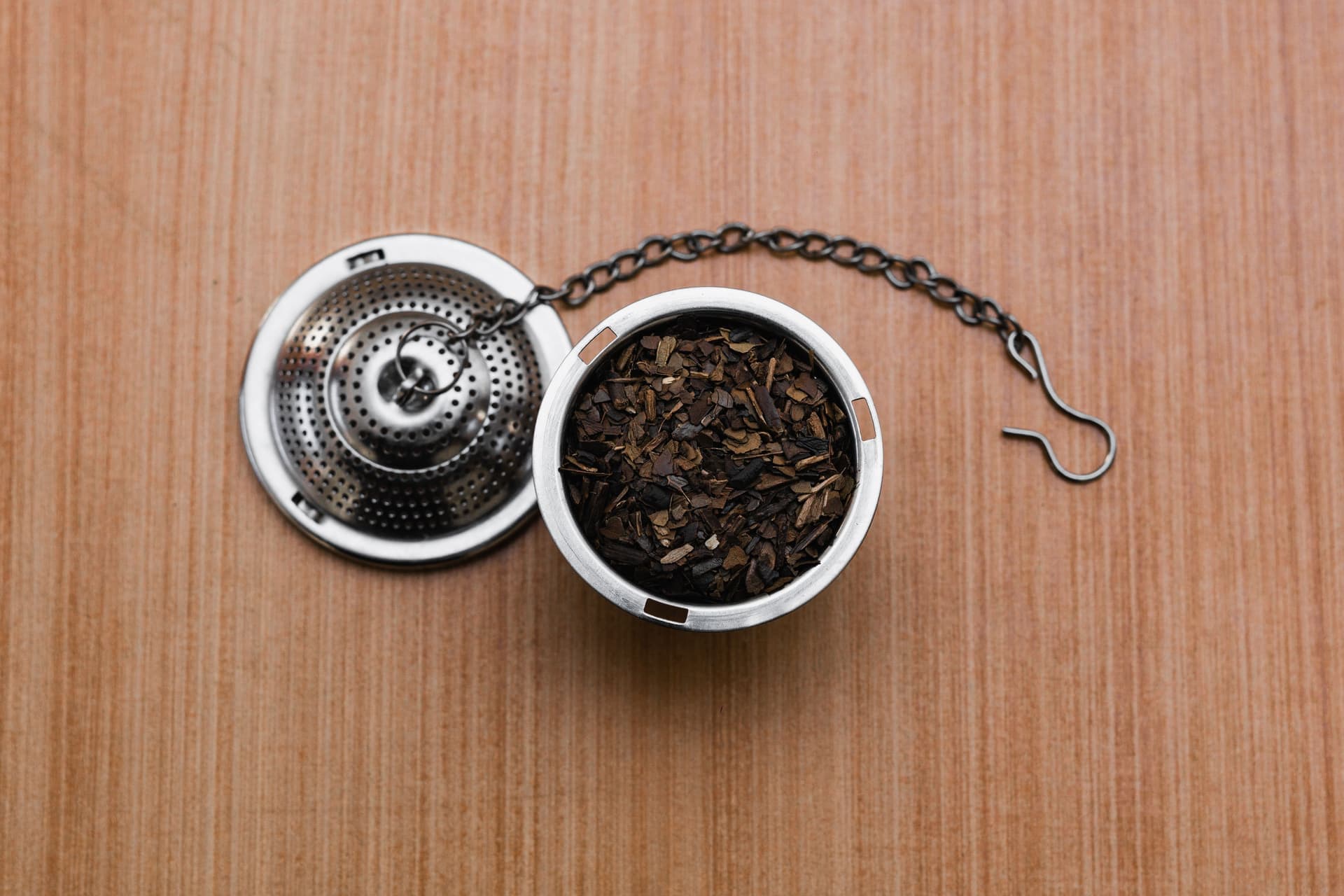
Loose leaf usually tastes better, and the reason has nothing to do with authenticity. It is that most tea bags contain small broken leaf in a space too tight for anything to expand, while a basket infuser holds larger leaf with room to open. A good bagged tea still beats a bad loose one, and anyone telling you otherwise is selling something.
What is actually different
| Standard tea bag | Loose leaf in a basket | |
|---|---|---|
| Leaf grade | Usually broken leaf and fannings | Usually whole or large-piece leaf |
| Room to expand | Minimal — the bag constrains it | Full, if the basket is sized right |
| Water contact | Around the outside of a packed mass | Through the whole mass |
| Dose control | Fixed by the manufacturer | Yours, by the spoon or the gram |
| Re-steeping | Rarely worthwhile | Common with oolong and pu-erh |
| Effort | None | A spoon, a basket, and rinsing it |
| Cost per cup | Usually higher for equivalent quality | Usually lower |
Why smaller leaf changes the flavor
Broken leaf has far more cut surface per gram than whole leaf. More cut surface means faster extraction, which sounds like a benefit and is why bags brew quickly. The cost is that the compounds responsible for briskness and bitterness come out fast too, so the window between under-brewed and harsh is narrow.
Whole leaf extracts more slowly and more evenly, which widens that window. It is why Art of Tea's published steep ranges have real breadth — three to five minutes for black, one to three for green — and why a minute of overshoot on loose leaf is forgiving in a way that a minute on a bag often is not.
The pyramid-bag middle ground
Larger mesh sachets exist specifically to fix the expansion problem, and they genuinely do help — they hold bigger leaf and give it space. They are a real improvement on a paper bag and they sit, honestly, between the two things this page is comparing.
Their downsides are cost per cup and dose control. You get whatever the manufacturer decided, which is fine until you want a stronger cup.
When a bag is the right answer
- At work, in a hotel, on a plane — anywhere rinsing an infuser is a chore you will resent.
- When you want one specific cup and nothing else, with no equipment.
- For someone who will not maintain a setup. A tea bag they drink beats an infuser in a drawer.
- When the bagged tea is genuinely good and the loose alternative available to you is not.
The honest cost comparison
We are not going to publish a cents-per-cup figure, because prices vary enormously and a number here would be stale within a month. What we can say structurally is that loose leaf is generally cheaper per gram than the equivalent quality in bags, because you are not paying for the bag, the tag, the string or the individual wrapper.
Re-steeping widens that gap further. Oolong and pu-erh will give three or four genuinely different infusions from one dose of leaf, and a bag will not.
So what should you do?
Buy a ten-dollar basket, buy one loose tea in a style you already know you like, and brew it beside your usual bag. That comparison costs less than a takeaway coffee and answers the question for your palate rather than ours.
Questions
Is loose-leaf tea actually better than tea bags?
Usually, for a mechanical reason: bags typically hold broken leaf in a space too small for it to expand, while a basket holds larger leaf with room to open. A good bagged tea still beats a poor loose one.
Are pyramid tea bags as good as loose leaf?
They are a real improvement on paper bags because they hold larger leaf with space to expand. You still get a fixed dose chosen by the manufacturer, and cost per cup is usually higher.
Is loose-leaf tea cheaper than tea bags?
Generally, per gram, at the same quality level, because you are not paying for the packaging. Re-steeping oolong and pu-erh widens the gap further since one dose gives several cups.
Can you re-steep a tea bag?
Rarely with worthwhile results, because the small broken leaf gives up most of its flavor in the first steep. Whole-leaf oolong and pu-erh re-steep well and change character each time.
Sources
Every figure on this page came from one of these, retrieved during the research pass for this article. Where a maker publishes nothing we could verify, the page says so instead of substituting a number.
Read next
- The best tea infusersFour infusers, one of which we tell you not to buy. The format matters more than the brand.
- Loose leaf vs tea bagsWhat genuinely changes when you switch, what does not, and the situations where a tea bag still wins.
- How to use a tea infuserThe method in six steps, with the two mistakes that account for most disappointing cups.
- How much loose-leaf tea per cupThe published ratio, why a spoon is unreliable across tea types, and the point at which weighing starts to matter.
- Loose-leaf tea for beginnersWhat the tea types are, which to start with, and the four mistakes that account for most disappointing first cups.