Teapots & Brewing Vessels · Model review
HARIO ChaCha Kyusu Maru review
The only teapot here whose maker tells you in writing what it must not go near.
We earn a commission if you buy through the links on this page, at no extra cost to you. It does not change which products we name or what we say about them — how this is funded.
Buy the 450 ml if you drink alone, the 700 ml if you ever pour for someone else. HARIO publishes practical capacities rather than brim figures, a heatproof borosilicate body, a stainless strainer, and an explicit statement that it is not safe for oven, induction hob or open flame — which makes it the best-documented teapot on this site and the one least likely to be destroyed by a misunderstanding.
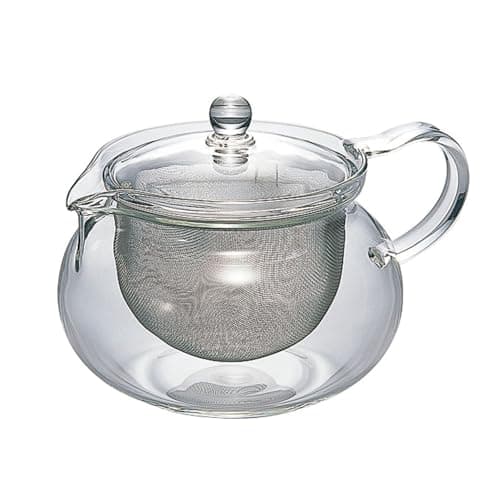
The kettle in question · Watching the leaves, which is most of the appeal
HARIO ChaCha Kyusu Maru Tea Pot
Borosilicate glass with a full-width stainless basket, in three sizes. The clearest published spec sheet of any teapot here.
Published specifications
- Capacities
- 300 ml, 450 ml and 700 ml (practical capacity)Source: HARIO USA — ChaCha Kyusu Maru Tea Pot
- Materials
- Heatproof borosilicate glass pot and lid; stainless steel strainerSource: HARIO USA — ChaCha Kyusu Maru Tea Pot
- Care
- Safe for hot water, microwave and dishwasher; remove the strainer before microwavingSource: HARIO USA — ChaCha Kyusu Maru Tea Pot
- Not safe for
- Oven, induction hob or open flameSource: HARIO USA — ChaCha Kyusu Maru Tea Pot
- Made in
- Japan (glass and lid); strainer made in ChinaSource: HARIO USA — ChaCha Kyusu Maru Tea Pot
What the numbers mean
The large strainer is the functional argument. A wide basket lets the leaves open across the whole pot rather than packing into a tube, which is the single biggest difference between teapots at this price.
The explicit not-for-stovetop line is the reason we point at this one. Glass teapots get put on hobs and crack, and Hario states plainly that this is not a stovetop object.
Three capacities matter more than they sound. 300 ml is one generous mug; 700 ml is a pot for two or three people. Buying the wrong one is the most common teapot regret.
Good for
- Wide strainer that lets leaves expand
- Microwave and dishwasher safe, both published
- Three sizes, so you can match your actual household
Against it
- Glass loses heat faster than ceramic or cast iron
- Not for the hob, the oven or a flame
- Glass shows tea staining if you leave it wet
Skip it ifSkip it if you want the pot to stay hot for a second and third cup. Glass is the worst insulator here; cast iron is the best.
Who this is for
Anyone buying a first proper teapot, and anyone who wants to watch the leaves. Glass plus a full-width basket is the format that teaches you what loose leaf actually does, and this is the version of that format whose maker publishes the most about it.
It is not for someone who wants tea to stay hot for an hour. Glass cools fast, and if a long pot at a table is the habit, enameled cast iron holds heat for roughly an hour where this holds it for minutes.
What HARIO publishes
| Specification | Published value |
|---|---|
| Capacities | 300 ml, 450 ml and 700 ml, stated as practical capacity |
| Materials | Heatproof borosilicate glass pot and lid; stainless steel strainer |
| Care | Safe for hot water, microwave and dishwasher; remove the strainer before microwaving |
| Not safe for | Oven, induction hob or open flame |
| Made in | Japan for the glass and lid; the strainer is made in China |
Two of those rows are unusual enough to be the reason this page exists.
Practical capacity, not brim capacity
HARIO publishes what the pot actually holds in use, with the strainer in and the lid on, rather than the number you would get filling it to the rim. Most makers publish the larger figure because it sounds better.
This matters when you are choosing a size. A pot sold as 700 ml brim might give you 600 ml of tea; HARIO's 700 ml is 700 ml of tea. Compared against a competitor's brim number, HARIO's pot is bigger than it looks on paper.
It also does this consistently across its range — the V60 Buono kettle publishes 800 ml practical against a 1.2 L brim figure on the box. A maker that publishes the less flattering number in two product lines is telling you something about its spec sheets generally.
The 'not safe for' line is the best thing on the page
HARIO publishes, in writing, that this pot must not go in an oven, on an induction hob or over an open flame. Almost no teapot maker states this, and it is the single most expensive thing a teapot buyer can get wrong.
Borosilicate glass that is not rated for direct heat cracks, and it gives no warning — it is intact and then it is not. People put teapots on hobs constantly because a teapot looks like something that belongs on one. A maker that heads that off with a published sentence has saved a number of its customers a broken pot and possibly a burn.
The corollary is worth stating: this is a brewing vessel, so boil water in a kettle and pour it in. It is dishwasher safe and microwave safe with the strainer removed, which covers every legitimate way you would want to heat it.
Which size
| Capacity | Roughly | Suits |
|---|---|---|
| 300 ml | One generous mug | One person, one sitting, or gongfu-style short infusions |
| 450 ml | Two small cups | One person with a refill — the default for solo drinkers |
| 700 ml | Three cups | Two people, or one person over an afternoon |
The common mistake is buying the 700 ml for a household of one because bigger feels safer. A half-filled pot cools faster and brews worse than a filled smaller one, so the 450 ml is the better solo purchase and the 700 ml is the better social one.
Our buy link resolves to the 700 ml, which is the size with the most consistent availability. If you want the 450 or the 300, the listing carries the other sizes and it is worth selecting deliberately rather than accepting the default.
The strainer
Published as stainless steel, and it is full-width rather than a narrow tube hanging under the lid. That distinction decides whether a teapot basket is close to loose brewing or closer to a tea ball, and this is the good version: leaves get most of the pot to expand into.
HARIO publishes no mesh gauge, which is the gap. For rooibos and fine-cut blends, the only published gauge in this category anywhere is FORLIFE's 0.3 mm, and fine material will pass a strainer whose aperture nobody has stated.
HARIO also publishes that the strainer is made in China while the glass and lid are made in Japan. That level of component-level honesty is rare and is the kind of disclosure that makes the rest of the sheet more credible.
What it does not do
- It does not hold heat. Glass cools quickly; a warmer or a cosy is the fix, or a cast iron pot if long sessions are the norm.
- It does not stop extraction. Lift the strainer out or decant, or the last cup will be harsher than the first. A press pot is the alternative that addresses this mechanically.
- It does not publish a mesh gauge, so rooibos and fine-cut tea are a judgment call.
- It does not go on any heat source. HARIO says so; believe it.
Verdict
This is the teapot we would hand someone buying their first one. The format teaches you what leaf does, the materials are inert and published, the capacities are honest figures rather than flattering ones, and the maker tells you what would destroy it. At its price that combination is not matched by anything else we cover.
The deductions are the ones inherent to glass and to drop-in strainers: it cools fast, it breaks, extraction continues until you intervene, and the strainer's fineness is undocumented. Buy the 450 ml unless you pour for other people.
What we did not do
We did not test this pot. There are no cooling curves, no measured mesh apertures and no tastings on this page, because we have run none. Every specification quoted is read from HARIO USA's own product page and links back to it from the product card. Where HARIO publishes nothing — a mesh gauge — the page says so rather than estimating one.
Questions
Can you put a HARIO ChaCha Kyusu on the stove?
No. HARIO publishes explicitly that it is not safe for oven, induction hob or open flame. It is a brewing vessel — boil water in a kettle and pour it in. It is dishwasher safe, and microwave safe with the strainer removed.
What size HARIO ChaCha Kyusu should I buy?
450 ml if you drink alone, 700 ml if you pour for someone else, 300 ml for short gongfu-style infusions. All three are published as practical capacities rather than brim figures, so they are the volume of tea you actually get.
Is the HARIO ChaCha Kyusu good for a beginner?
It is the one we would hand a first-time buyer. Glass lets you watch the leaves open, the full-width stainless strainer gives leaf room to expand, and HARIO publishes the materials, the care instructions and what the pot must not go near.
Does the HARIO ChaCha Kyusu keep tea hot?
Not for long — glass cools quickly. If tea sits on a table for an hour, a teapot warmer helps or enameled cast iron is the better material; Primula publishes about an hour of heat retention for its cast iron pot.
Is the HARIO strainer fine enough for rooibos?
HARIO publishes no mesh gauge, so we cannot tell you. Rooibos is cut to under 4 mm and fine material passes strainers whose aperture is unstated. FORLIFE publishes 0.3 mm, which is the only figure anyone in this category publishes.
Where is the HARIO ChaCha Kyusu made?
HARIO publishes that the glass and lid are made in Japan and the strainer is made in China. That component-level disclosure is unusual in this category and worth noting as a mark in its favor rather than against it.
Sources
Every figure on this page came from one of these, retrieved during the research pass for this article. Where a maker publishes nothing we could verify, the page says so instead of substituting a number.
Read next
- The best glass teapotsThree glass teapots, and the single specification that separates a long-lived one from a cracked one.
- The best teapots for loose-leaf teaFour teapots covering glass, press and cast iron, chosen on published capacity, materials and safety limits.
- What size teapot do you need?Teapot capacity matched to the number of people who will actually drink, and why the biggest pot is rarely the safest choice.
- Stovetop-safe teapots: how to check before you crack oneMost teapots crack on a hob. How to read the safety statement, and why boiling separately is almost always the answer.
- The best teapot warmersBase diameter decides fit and the candle decides duration. Three warmers whose maker actually publishes both, and when a warmer is the wrong fix.
- Tea kettle vs teapotA kettle boils water; a teapot brews it. The confusion is common, it is expensive when it goes wrong, and most people end up owning both.