Tea Kettles
Why does my kettle taste like plastic?
If the kettle is new, it almost certainly fades. If it is not new, the plastic is in the water path and no amount of cleaning changes that.
We earn a commission if you buy through the links on this page, at no extra cost to you. It does not change which products we name or what we say about them — how this is funded.
If the kettle is less than about two weeks old, the taste is manufacturing residue on new plastic parts and it fades on its own — run three or four boils and discard the water, and it usually goes. If the kettle is older than that and the taste persists, plastic is sitting in the water path and the fix is a different kettle. The one we would buy is the COSORI Original Gooseneck, because COSORI publishes 304 food-grade stainless for the kettle, lid and spout, and a kettle with no plastic in the water path cannot produce this taste at all.
| # | Product | Best for | Capacity | Price |
|---|---|---|---|---|
| 1 | 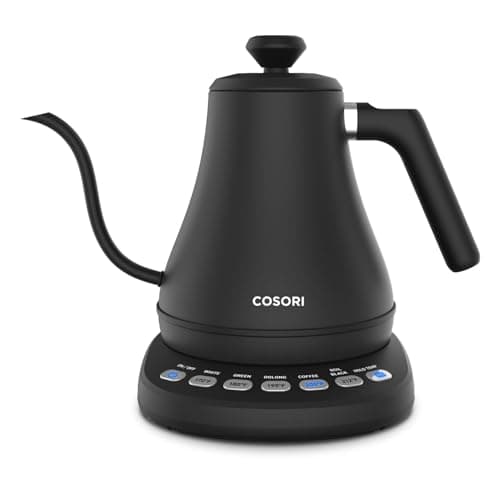 COSORI Original Electric Gooseneck Kettle (CO108-NK)Top pickFive presets that map to actual tea types, a 60-minute hold, and no plastic in the water path. This is the value pick and it is not close. | The sensible first variable-temperature kettle | 0.85 qt / 0.8 L | |
| 2 | 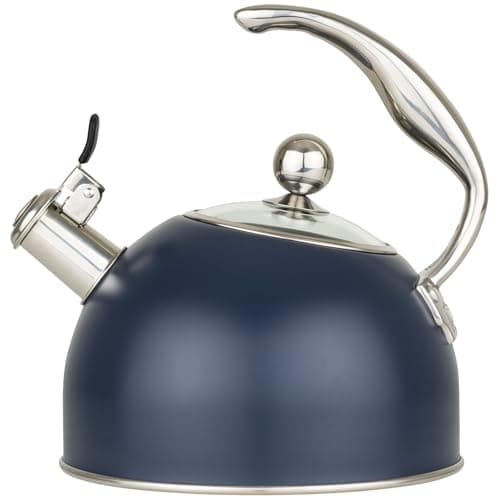 Viking 2.6-Quart Stainless Steel Whistling Kettle with 3-Ply BaseA clad-base stainless kettle that publishes more about itself than anything else in the category, including a Limited Lifetime Warranty nobody else on this site will commit to. | The only kettle here with a lifetime warranty | 2.6 quarts (2.5 liters) | |
| 3 | 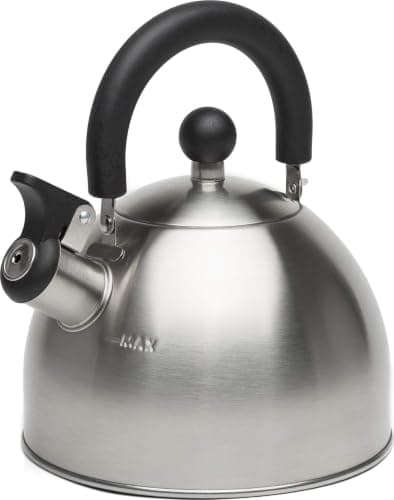 Primula Stewart Whistling Kettle with Folding Handle, 1.5 Qt.A 1.5-quart food-grade stainless whistler with a flip-up spout and a handle that folds flat. It boils water and stores in a drawer, which is the entire brief. | The cheapest kettle on this site that we would actually own | 1.5 qt |
Top pick · The sensible first variable-temperature kettle
COSORI Original Electric Gooseneck Kettle (CO108-NK)
Five presets that map to actual tea types, a 60-minute hold, and no plastic in the water path. This is the value pick and it is not close.
Published specifications
- Capacity
- 0.85 qt / 0.8 LSource: COSORI — Original Electric Gooseneck Kettle (CO108-NK)
- Presets
- 170F white, 180F green, 195F oolong, 205F coffee, 212F blackSource: COSORI — Original Electric Gooseneck Kettle (CO108-NK)
- Hold
- Keeps water warm for up to 60 minutesSource: COSORI — Original Electric Gooseneck Kettle (CO108-NK)
- Power
- 1200 W (AC 120 V, 60 Hz)Source: COSORI — Original Electric Gooseneck Kettle (CO108-NK)
- Water contact
- 304 food-grade stainless steel kettle, lid and spoutSource: COSORI — Original Electric Gooseneck Kettle (CO108-NK)
- Warranty
- 2-year limitedSource: COSORI — Original Electric Gooseneck Kettle (CO108-NK)
What the numbers mean
The presets are the reason to recommend this to someone new. You do not have to know that sencha wants roughly 180F; you press the button that says green. That is one fewer thing to learn on week one.
Presets are also its limit. If you later want 165F for a delicate gyokuro, the button for it does not exist. Most people never get there, and the ones who do have already stopped being beginners.
It publishes 304 stainless for everything the water touches. That is the single spec worth checking on any cheap kettle, and plenty of them will not tell you.
Good for
- Presets named after teas, not temperatures
- 60-minute hold, longer than several kettles that cost more
- Stainless kettle, lid and spout published, not implied
Against it
- Preset steps only — no arbitrary target temperature
- 0.8 L is the smallest capacity here
- The gooseneck is slower to fill under a tap than a wide-mouth kettle
Skip it ifSkip it if you want to dial an exact number. Buy the OXO or the Stagg for that; this one gives you five good answers instead of infinite ones.
Pick 2 · The only kettle here with a lifetime warranty
Viking 2.6-Quart Stainless Steel Whistling Kettle with 3-Ply Base
A clad-base stainless kettle that publishes more about itself than anything else in the category, including a Limited Lifetime Warranty nobody else on this site will commit to.
#ad · how this is funded · price checked October 23, 2026
Published specifications
- Capacity
- 2.6 quarts (2.5 liters)Source: Viking Culinary — 2.6-Quart Stainless Steel Whistling Kettle with 3-Ply Base
- Body and spout
- 304 stainless steel, with a surgical grade stainless interiorSource: Viking Culinary — 2.6-Quart Stainless Steel Whistling Kettle with 3-Ply Base
- Base
- 3-ply, with an aluminum core between two layers of stainlessAluminum conducts heat far better than steel, so a clad base spreads heat across the whole base instead of concentrating it over the burner.Source: Viking Culinary — 2.6-Quart Stainless Steel Whistling Kettle with 3-Ply Base
- Handle
- High-polished stainless steel, riveted to the pot, with a heat breakA heat break is a deliberate interruption in the metal path so less heat travels from body to handle.Source: Viking Culinary — 2.6-Quart Stainless Steel Whistling Kettle with 3-Ply Base
- Also included
- Removable quilted fabric heat sleeveSource: Viking Culinary — 2.6-Quart Stainless Steel Whistling Kettle with 3-Ply Base
- Lid
- Tempered glassSource: Viking Culinary — 2.6-Quart Stainless Steel Whistling Kettle with 3-Ply Base
- Whistle
- Melodic whistleSource: Viking Culinary — 2.6-Quart Stainless Steel Whistling Kettle with 3-Ply Base
- Cooktop compatibility
- Works on all stovetops, including inductionViking also lists gas, electric, halogen and ceramic.Source: Viking Culinary — 2.6-Quart Stainless Steel Whistling Kettle with 3-Ply Base
- Care
- Hand wash onlySource: Viking Culinary — 2.6-Quart Stainless Steel Whistling Kettle with 3-Ply Base
- Warranty
- Limited Lifetime WarrantySource: Viking Culinary — 2.6-Quart Stainless Steel Whistling Kettle with 3-Ply Base
- Dimensions and weight
- Not verifiedNot published on Viking's product page. At 2.6 quarts this is the largest kettle on the site, so check it against your hob and your cupboard.
What the numbers mean
The warranty is the specification that separates this from everything else we have written up. Caraway publishes no warranty at all and Chantal states a limited warranty without a duration. Viking publishes Limited Lifetime, which is a commitment rather than an adjective.
The 3-ply base is the real construction difference. Every other stovetop kettle on this site is a single layer of steel or enameled carbon steel, where heat enters wherever the burner touches. An aluminum core spreads it across the base first, which is the same reason clad pans exist.
At 2.6 quarts it is the largest kettle here by a clear margin, against 1.7 to 1.8 for the enameled ones. That is around ten cups from one boil and a genuinely slow way to make a single mug.
Good for
- Limited Lifetime Warranty, published - the only one on this site
- 3-ply clad base with an aluminum core, which no other kettle here has
- Handle heat break and a removable heat sleeve, both published
- Every cooktop named, induction included
- Tempered glass lid, so you can see the water
Against it
- Boiling only, like every stovetop kettle
- 2.6 quarts is a lot of water to heat for one mug
- Hand wash only, published
- A glass lid is a breakable part the all-metal kettles do not have
- No published dimensions or weight
Skip it ifSkip it if you brew a single mug at a time. Ten cups of capacity is the wrong shape for one person, and the enameled 1.7-quart kettles heat faster because there is less water in them.
Pick 3 · The cheapest kettle on this site that we would actually own
Primula Stewart Whistling Kettle with Folding Handle, 1.5 Qt.
A 1.5-quart food-grade stainless whistler with a flip-up spout and a handle that folds flat. It boils water and stores in a drawer, which is the entire brief.
Published specifications
- Material
- Food-grade stainless steelSource: Primula — Stewart Whistling Kettle with Folding Handle, 1.5 Qt.
- Spout
- Flip-up whistling spoutThe flip is one-handed, which matters when the other hand is holding a mug.Source: Primula — Stewart Whistling Kettle with Folding Handle, 1.5 Qt.
- Handle
- Stay-cool coating; folds down for storageThe folding handle is the reason this fits in a drawer rather than living on the hob.Source: Primula — Stewart Whistling Kettle with Folding Handle, 1.5 Qt.
- Lid
- Wide-mouth lid for cleaning and dryingSource: Primula — Stewart Whistling Kettle with Folding Handle, 1.5 Qt.
- Finishes
- Brushed stainless (PTK-6215-B) and chromeSource: Primula — Stewart Whistling Kettle with Folding Handle, 1.5 Qt.
- Cooktop compatibility
- Not verifiedPrimula does not name hob types on this page. Stainless is induction-compatible only when the base is magnetic, so hold a magnet to it or check the listing before buying for an induction hob.
- Warranty
- Not verifiedNo warranty length is published on the product page.
What the numbers mean
The honest case for a kettle at this price is that boiling water is a solved problem. A stovetop whistler has no electronics to fail, no temperature board to drift and nothing that stops working in year three. What you give up is the ability to set a temperature, and for black and herbal tea there is nothing to set.
1.5 quarts is about six mugs. That is a genuinely useful size: enough for a pot on the table, not so much that you are heating a liter of water you will pour down the sink.
The folding handle sounds like packaging copy and is the most practical thing here. A kettle that folds flat goes in a cupboard between uses, which is the difference between owning one and living with one permanently occupying a burner.
Good for
- Costs less than most infusers
- Nothing electronic to fail
- Folds flat, so it does not have to live on the hob
- Food-grade stainless is published, which is more than most kettles at this price say
Against it
- Boiling only — no temperature setting of any kind
- Thin stainless heats fast and cools fast
- No published hob compatibility, so induction buyers have to check
- No published warranty
Skip it ifSkip it if green tea is the reason you are here. Boiling water scorches it, and no whistling kettle will tell you when the water has dropped to 175F.
Work through it in this order
- How old is the kettle? Under two weeks, go to the new-kettle section. Over two weeks, skip it.
- Does the smell come from the kettle itself when it is cold and empty? If yes, it is the kettle. If no, it may be your water.
- Does bottled water boiled in the same kettle taste the same? If it does, the kettle is the cause.
- Does the same bottled water taste fine from a pan on the hob? Then it is definitively the kettle, not the water and not your mug.
- Look at what the water actually touches: lid, sight window, filter, spout collar, the ring where the body meets the base.
That sequence takes about ten minutes and it separates the three causes that account for almost all of these cases. It is worth doing before buying anything, because one of the three is free to fix.
Cause one: the kettle is new
New plastic parts carry residue from molding and from however long they sat in a box. Heated, that residue comes off into the water. It is the most common cause by a distance and it is the only one that resolves itself.
Fill the kettle, boil it, pour the water away, and repeat three or four times. Many people add a tablespoon of baking soda or a cup of white vinegar to one of those boils, rinse thoroughly, then do two plain boils afterward. Either approach works; neither is doing anything clever. You are simply flushing a surface.
If the taste is noticeably weaker after the first few boils, you have your answer and you can stop reading. If after a week of ordinary use it is exactly as strong as on day one, the residue was never the cause and you are in the next section.
Cause two: plastic is in the water path
This is the case nobody wants, because there is no procedure that fixes it. Heated plastic can carry a faint flavor into water continuously, not once. It is not a safety emergency — the plastics used in kettles are food-contact compliant — but it is a taste problem, and tea is a drink where faint flavors are the entire point. You bought loose leaf specifically to taste it.
The frustrating part is that a kettle described as stainless steel can have a plastic lid, a plastic sight window, a plastic filter and a plastic collar where the spout meets the body. The word stainless on a listing refers to the shell. The water touches a different set of parts.
| Part | How often it is plastic | Does water touch it? |
|---|---|---|
| Outer body | Rarely on a steel kettle | Yes |
| Lid and lid underside | Very often | Yes — steam condenses and runs back in |
| Sight window / water gauge | Almost always | Yes |
| Spout filter | Usually | Yes, on the way out |
| Spout collar or seam | Often | Yes |
| Handle and lid pull | Usually, and correctly so | No |
The lid is the part people miss. Steam rises, condenses on the underside of the lid and runs back into the water, so a plastic lid is in the water path even though nothing ever pools against it.
Cause three: it is not the kettle
Two other things produce a taste people describe as plastic or chemical. Chlorinated tap water is the first, and it is especially noticeable in water that has been reboiled. The second is a mug — a travel lid, a silicone seal or a glaze fault will do it, and it survives the dishwasher.
The pan test in step four separates these cleanly. Same water, same mug, no kettle. If the taste follows, the kettle is innocent and you have saved yourself a purchase.
What to buy if the plastic is in the water path
The criterion is narrow and it is not a material preference. You want a maker that publishes what each water-contact part is made of. Stainless steel, borosilicate glass and porcelain enamel are all inert and all fine; what you are buying is the sentence that tells you which one is actually in there.
COSORI publishes 304 food-grade stainless for the kettle, lid and spout on the Original Gooseneck — three parts named separately, which is rarer than it should be and is exactly the statement this problem requires. Viking publishes 304 stainless with a surgical-grade stainless interior, and it is a stovetop kettle, so there is no electronics housing for water to find. Primula publishes food-grade stainless on the Stewart, which is the cheapest way out of this problem on this site.
Each of those three is the wrong answer for someone. The COSORI holds 0.85 quarts, which is two mugs. The Viking holds 2.6 quarts, which is too much water to boil for one cup. The Primula has no temperature control, so green tea needs a thermometer. The cards below name the buyer each one is wrong for.
Two variants worth separating
Two patterns come up often enough to be worth naming, because each points somewhere different.
It smells of plastic but the water tastes fine
Usually the handle or the lid pull, warmed by steam and sitting right under your nose as you pour. Those parts are supposed to be plastic and they are not in the water path. Pour into a mug, walk to another room, and taste it there — if the tea is fine away from the kettle, you have a smell rather than a taste and there is nothing to fix.
Only the first cup of the day tastes of it
This one points at plastic in the water path rather than away from it. Water that sat in the kettle overnight has had eight hours of contact with every surface inside, so whatever those surfaces give up is concentrated in that first boil and diluted in the rest.
The free test is to empty the kettle every night and fill it fresh in the morning. If the first cup is suddenly fine, the kettle is leaching slowly into standing water and the nightly habit is a genuine workaround. It is also a reasonable habit for its own sake, since reboiling water that has sat concentrates whatever the water itself carries.
What about BPA-free?
BPA-free means one specific compound is absent from the plastic. It says nothing about the other plastics used and nothing about whether they touch the water, and it is routinely printed on kettles where no plastic touches water at all. It is not a bad sign. It is simply much less informative than its prominence on the box suggests, and it will not tell you whether this kettle is going to taste of plastic.
The phrase to look for instead is a water-contact statement: which part, and what it is made of. A kettle that has one is a kettle whose maker decided that question was worth answering.
What to do with the kettle you are replacing
It still boils water correctly, which is most of what a kettle does. Keep it for the jobs where the water is not the drink: pasta, a hot water bottle, filling a washing-up bowl, rinsing a teapot before brewing. None of those care about a trace of plastic flavor.
The one thing not to do is keep it for coffee on the theory that coffee is strong enough to cover it. It is, mostly — and the reason you noticed this problem at all is that you started paying attention to what your water tastes like, which is not a thing you un-notice.
Does the taste mean the water is unsafe?
We are not in a position to tell you that it is, and we will not tell you that it is not. What we can say is what the honest reason for avoiding plastic in a kettle is: taste. The plastics in kettles sold in the US are food-contact compliant, and the concern this page is built around is that you can taste them and tea is a drink you bought in order to taste.
If your concern is a health one rather than a flavor one, the action is the same — buy a kettle whose maker publishes an inert water path — so nothing on this page changes. We simply are not going to pretend to an expertise we do not have about what is in the water.
What we did not do
We have not boiled water in these kettles, tested anything for leaching, or run a taste panel. There is no laboratory here. Everything above is published manufacturer specification, cited below, plus ordinary reasoning about where water goes inside a kettle.
Questions
Why does my new kettle taste like plastic?
Manufacturing residue on the new plastic parts. Boil and discard the water three or four times, optionally with a cup of white vinegar or a tablespoon of baking soda in one of those boils, then rinse and run two plain boils. It usually clears within a week of normal use.
How do I get the plastic taste out of a kettle?
Several boil-and-discard cycles, with vinegar or baking soda in one of them. If the taste is unchanged after a week, it is not residue — plastic is in the water path, and no cleaning method removes a part.
Will the plastic taste eventually go away on its own?
If the kettle is new, almost always, and you should notice it weakening within a few days. If the kettle is months old and the taste has never faded, it will not start now.
Is it safe to drink water that tastes of plastic?
The plastics used in kettles sold in the US are food-contact compliant, and we are not qualified to assess leaching. The honest reason we tell people to avoid plastic in the water path is taste: you can detect it, and it sits on top of a drink you bought in order to taste.
Which kettles have no plastic touching the water?
Look for a maker that names the material of each water-contact part rather than one that says stainless steel and leaves it there. COSORI publishes 304 food-grade stainless for the kettle, lid and spout on its gooseneck; Viking publishes 304 with a surgical-grade interior. A kettle that publishes nothing about this is not necessarily bad, but it cannot answer the question.
Sources
Every figure on this page came from one of these, retrieved during the research pass for this article. Where a maker publishes nothing we could verify, the page says so instead of substituting a number.
Read next
- The safest tea kettle materialsStainless, glass and enamel are all inert. What separates kettles is whether the maker publishes what the water touches.
- Glass vs stainless steel kettleBoth materials are inert. What separates them is that the steel kettles publish what the water touches and the cheap glass ones do not.
- The best tea kettles for hard waterLimescale is decided by your water, not your kettle. What a kettle can change is visibility and access - and a gooseneck makes both worse.
- The best electric tea kettlesElectric kettles ranked on the specification that actually matters: how long they hold the temperature they reached.
- How to choose a tea kettleThe five questions that eliminate kettles fastest, in order, each ending in a named pick rather than a category.
- Why is my tea bitter?Four causes of bitter tea, ordered by how likely they are, with the free fix and the paid fix named separately for each one.