Tea Kettles
HARIO V60 Buono Drip Kettle review
The gooseneck you can heat on a hob, from the maker whose spout most pour-over technique was written around.
We earn a commission if you buy through the links on this page, at no extra cost to you. It does not change which products we name or what we say about them — how this is funded.
Buy the HARIO V60 Buono if you want a gooseneck spout without an electric base taking up counter space, and you already own a thermometer or only drink teas that want boiling water. It is the stovetop gooseneck on this site, it is made in Japan, HARIO publishes its practical capacity rather than its brim capacity, and it has no temperature control of any kind. We have not poured water from one.
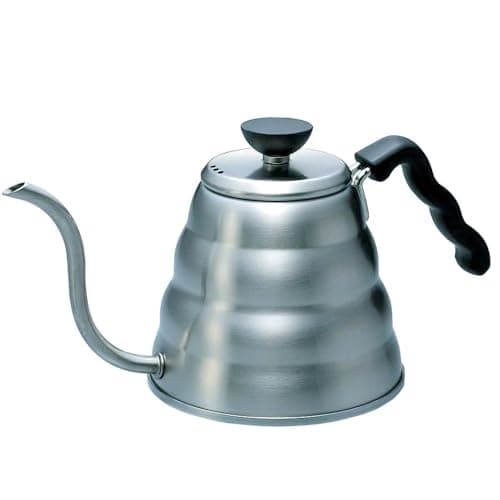
The kettle in question · A gooseneck you can use on the hob
HARIO V60 Buono Drip Kettle
The stovetop gooseneck. Made in Japan, 800 ml of working capacity, and the spout that most pour-over technique was written around.
#ad · how this is funded · price checked October 23, 2026
Published specifications
- Practical capacity
- 800 mlHario publishes practical capacity, not brim capacity — the 1.2 L on the box is the latter.Source: HARIO USA — V60 Buono Drip Kettle
- Materials
- Stainless steel body and lid; phenol resin handle and knobSource: HARIO USA — V60 Buono Drip Kettle
- Dimensions
- W274 x D144 x H147 mmSource: HARIO USA — V60 Buono Drip Kettle
- Made in
- JapanSource: HARIO USA — V60 Buono Drip Kettle
- Induction compatibility
- Not verifiedHario's US page does not state a hob type. Check the base against your own hob before buying if you cook on induction.
What the numbers mean
The practical-versus-brim capacity distinction is worth internalizing. A kettle sold as 1.2 L that holds 800 ml in use is not overstating anything, but it will surprise you if you plan around the bigger number.
This is the crossover object for anyone arriving from coffee. If you already pour over, this kettle is already in your kitchen, and the only tea gear you still need costs about ten dollars.
No temperature control, and the published spec is silent on induction. Both are the price of a stovetop kettle at this price.
Good for
- A genuine gooseneck without an electric base on the counter
- Published practical capacity, which is the honest number
- Pours slowly and precisely into a gaiwan or a small pot
Against it
- No temperature control
- Induction compatibility is not published
- The resin handle gets warm on a gas hob with a wide flame
Skip it ifSkip it if you cook on induction and want certainty. The maker does not publish a hob compatibility line, and a gooseneck you cannot heat is an expensive jug.
First: there are two Buonos, and this is the stovetop one
This matters before anything else, because the search results for this kettle are a mix of two different products. HARIO sells a stovetop V60 Buono and an electric V60 Buono with temperature control. They look similar, they share a name, and they are not the same purchase.
This review is the stovetop one, item number VKB-120HSV, the 1.2 L silver model. It has no electronics, no base, no temperature readout and no way to tell you how hot the water is. If what you want is a Buono that holds 175F for you, you want the electric model and this page is not about it.
What HARIO publishes
More than most, and in a more useful form than most. Four figures, each one of them a number you can act on.
| Specification | Published value | What it means in practice |
|---|---|---|
| Practical capacity | 800 ml | The working figure, not the 1.2 L on the box. Two large mugs or a small pot |
| Dimensions | W274 x D144 x H147 mm | Wide rather than tall; the spout is most of the width |
| Body and lid | Stainless steel | An inert water path, with no plastic window or filter to taste |
| Handle and lid knob | Phenol resin | Thermoset plastic, away from the water, which is where plastic belongs |
| Made in | Japan | Published, which is rarer in this category than you would expect |
| Hob compatibility | Not published | No gas, electric or induction line anywhere on HARIO's US page |
The practical capacity figure is the best thing on the page
Almost every kettle in the world is sold on brim capacity — the volume it physically holds if you fill it to the lip, which nobody ever does and which would be dangerous on a hob. HARIO publishes 800 ml as the practical capacity alongside the 1.2 L name.
That is an honest number and it is also a small one. Eight hundred milliliters is two large mugs. If you are brewing for three people you will be refilling, and a 1.5-quart stovetop kettle would serve you better. This is the same trade every gooseneck makes: a narrow spout and a large body do not go together, so the spout costs you capacity.
Worth internalizing as a reading habit, too. When a kettle is sold as 1.2 L and holds 800 ml in use, nothing is being overstated — but you will plan around the wrong number if nobody tells you.
The spout, and who it is actually for
This is the spout a great deal of pour-over technique was written around, and the tea case for it is narrower than the coffee case. A gooseneck gives you a slow, narrow, aimable stream. Pouring into a 100 ml gaiwan from a wide-mouthed kettle is a mess; from this one it is easy and you can stop exactly when you mean to.
If your tea lives in a mug or a 500 ml teapot, the spout is buying you precision you will not use. It becomes genuinely useful the day you buy a gaiwan or start brewing gongfu style, and it is useful immediately if you also make pour-over coffee — which is the overlap this kettle exists in.
The induction question, which HARIO does not answer
This is the most important thing missing from the specification, and we want to be precise about what we checked. HARIO's US product page lists materials, dimensions, practical capacity and country of manufacture, and states no heat source at all — no gas line, no electric line, no induction line. The page links a product manual as a PDF; it is a scanned document we could not extract text from, so we cannot tell you what it says.
So the honest position is that induction compatibility is unverified, and that is how our entry for this kettle is marked. Stainless steel is not automatically magnetic — the 300-series alloys commonly used for kettle bodies are generally not — so this is not a gap you can reason your way across.
If you cook on induction, treat the missing line as a no, or buy from a maker that prints one. Chantal publishes a compatibility line covering gas, electric, halogen and induction. Viking publishes induction ready. A gooseneck you cannot heat is an expensive jug.
No temperature control, and what that costs you
A stovetop kettle cannot tell you the water temperature. That is not a flaw in this kettle; it is the category. It matters in exactly one circumstance, and it is the circumstance half of tea drinkers are in.
Art of Tea publishes 160-180F for green tea and 160-185F for white, against 200-212F for black and herbal. If you drink the second group, this kettle does the whole job and temperature control would be a feature you pay for and never use. If you drink the first group, you need a fifteen-dollar instant-read thermometer alongside it, or you need an electric kettle instead.
The thermometer route is genuinely fine and we recommend it often. It adds one step per brew: boil, wait, check, pour. The electric route removes that step, which is the entire thing you are buying when you buy temperature control.
The handle, honestly
Phenol resin, published. It is a thermoset plastic, which means it does not soften with heat the way the molded plastics on cheap kettles do, and it sits away from the water so it has no bearing on taste.
The caveat is a gas hob with a wide flame. The handle arcs over the body, and on a burner set too large for the base the flame can reach around the sides toward it. The fix is free — use a burner matched to the base and keep the flame under the kettle rather than around it — but it is the thing to know before the first boil.
How it compares to the alternatives on this site
| Kettle | Power | Published capacity | Temperature control | Best for |
|---|---|---|---|---|
| HARIO V60 Buono | Stovetop | 800 ml practical | None | A gooseneck without an electric base on the counter |
| COSORI Original Gooseneck | Electric | 0.85 qt / 0.8 L | 5 presets, 60-minute hold | Green and white tea without a thermometer |
| OXO Brew Adjustable Temperature | Electric | 1 liter | 104-212F, 30-minute hold | Setting your own exact number |
| Fellow Stagg EKG | Electric | 30 oz / 0.9 L | 104-212F, timed hold | Buyers who want the object as much as the function |
The Buono is the only one of the four that works in a power cut, takes up no counter space when it lives on the hob, and has nothing in it that can fail electronically. It is also the only one that cannot tell you a temperature.
What it does not do
- No temperature control, display or hold. Boiling is the only setting.
- No published hob compatibility, which is a problem specifically on induction.
- 800 ml of practical capacity, so brewing for three means refilling.
- No keep-warm, so water off the boil is cooling from the moment you stop.
- Nothing published about dishwasher safety, so hand wash it.
Verdict
The right kettle for a specific person: someone who pours into small vessels, cooks on gas or electric, and either drinks teas that want boiling water or is happy to own a thermometer. For that buyer it is hard to improve on — a published practical capacity, an inert stainless water path, resin kept away from the water, made in Japan, and the spout the whole category is measured against.
The wrong kettle for an induction cook, for anyone brewing for a table, and for anyone whose main tea is green and who does not want an extra step in every brew. For those three, the answer is elsewhere on this site and we would rather send you there.
What we did not do
We have not owned, heated, poured from or timed this kettle. We have not placed it on an induction hob to find out, because a single informal result would not be a specification and publishing it as one would be exactly the thing this site refuses to do. Everything above is HARIO's published specification, cited below, plus reasoning about what those figures mean for brewing tea.
Questions
Is the HARIO Buono worth it?
For a gooseneck you can keep on the hob, yes. It publishes a practical capacity, a stainless water path and Japanese manufacture, and the spout is the one most pour-over technique was written around. It is not worth it if you drink green tea and do not want to use a separate thermometer.
Is the HARIO Buono electric or stovetop?
Both exist. This review covers the stovetop model, item VKB-120HSV, which has no electronics and no base. HARIO also sells an electric Buono with temperature control, which is a different product at a different price.
Can you use the HARIO Buono on an induction hob?
HARIO's US product page does not state any heat source, so we cannot tell you. Stainless is not automatically magnetic, so treat a missing induction line as a no unless you can verify it yourself.
How much water does the HARIO Buono actually hold?
HARIO publishes 800 ml as the practical capacity. The 1.2 L in the product name is brim capacity, which is the volume it holds filled to the lip. Plan around 800 ml, which is about two large mugs.
Do you need a gooseneck kettle for tea?
Only if you pour into something small. For a mug or a standard teapot the spout buys precision you will not use, and it costs you capacity. It earns its place the day you start brewing in a gaiwan.
Sources
Every figure on this page came from one of these, retrieved during the research pass for this article. Where a maker publishes nothing we could verify, the page says so instead of substituting a number.
Read next
- The best gooseneck kettles for teaFour goosenecks ranked on hold time and water contact, and a straight answer on whether tea needs the spout at all.
- Gooseneck vs regular kettleA gooseneck buys you an aimable, slow stream. Whether that is worth anything depends entirely on the size of what you are pouring into.
- The best stovetop tea kettlesThree stovetop kettles with published hob compatibility, and the one spec that decides whether any of them will work in your kitchen.
- The best kettle for pour over and teaThe two jobs share a spout requirement and disagree on temperature. Four kettles that cover both, ranked on the tea half rather than the coffee half.
- How to choose a tea kettleThe five questions that eliminate kettles fastest, in order, each ending in a named pick rather than a category.
- How to use a gaiwanThe grip, the ratio and the rhythm of short infusions, written for someone holding a gaiwan for the first time.